Bringing Medication into Norway: Customs Rules and Schengen Certificates
Landing at Gardermoen airport with a suitcase full of prescription bottles and a heart full of anxiety is a rite of passage for many new arrivals. I remember clutching my medical folder like a shield during my first move, terrified that my basic asthma inhalers would somehow lead to an interrogation in a back room. This guide solves the confusion around Norwegian customs, clarifying exactly what paperwork you need to ensure your transition into the country is as smooth as possible.
Understanding the General Framework for Personal Medication
Norway has some of the strictest pharmaceutical regulations in the world, managed by the Norwegian Medical Products Agency (Direktoratet for medisinske produkter). While the country is not a member of the EU, it is part of the EEA and the Schengen Area, which heavily dictates how your medicine is treated at the border. The fundamental rule is that you are allowed to bring in medication for "personal use," but the definition of personal use—and how much of it you can carry—varies wildly depending on where you are traveling from.
Determining Your Maximum Supply Limits
The most common mistake I see expats make is assuming a three-month supply is the universal standard. In reality, if you are coming from an EEA country (which includes the EU plus Iceland and Liechtenstein), you can generally bring up to a one-year supply of non-narcotic medication. This is incredibly helpful for those who have a preferred brand or a complex regimen that they want to maintain while they navigate Healthcare in Norway for Expats: How the System Works (2027). It gives you a massive buffer to settle in without rushing to find a local doctor on day one.
However, if you are arriving from a country outside the EEA—such as the United States, the UK, Australia, or Canada—the rules tighten significantly. In these cases, you are strictly limited to a maximum of a three-month supply. This often catches people off guard, especially those with chronic conditions who are used to ordering 90-day refills just before a trip. If you show up with four or five months' worth of medication from a non-EEA country, customs has the legal right to seize the excess, and they often do.
When I first moved from a non-EU country, I had to meticulously count my pills to ensure I stayed under that 90-day threshold. It felt like a math exam where the stakes were my own health. To avoid this stress, always check your flight origin and any transit points, as the rules apply to the country where you actually purchased the medication and where your journey began.
The Critical Need for Documentation
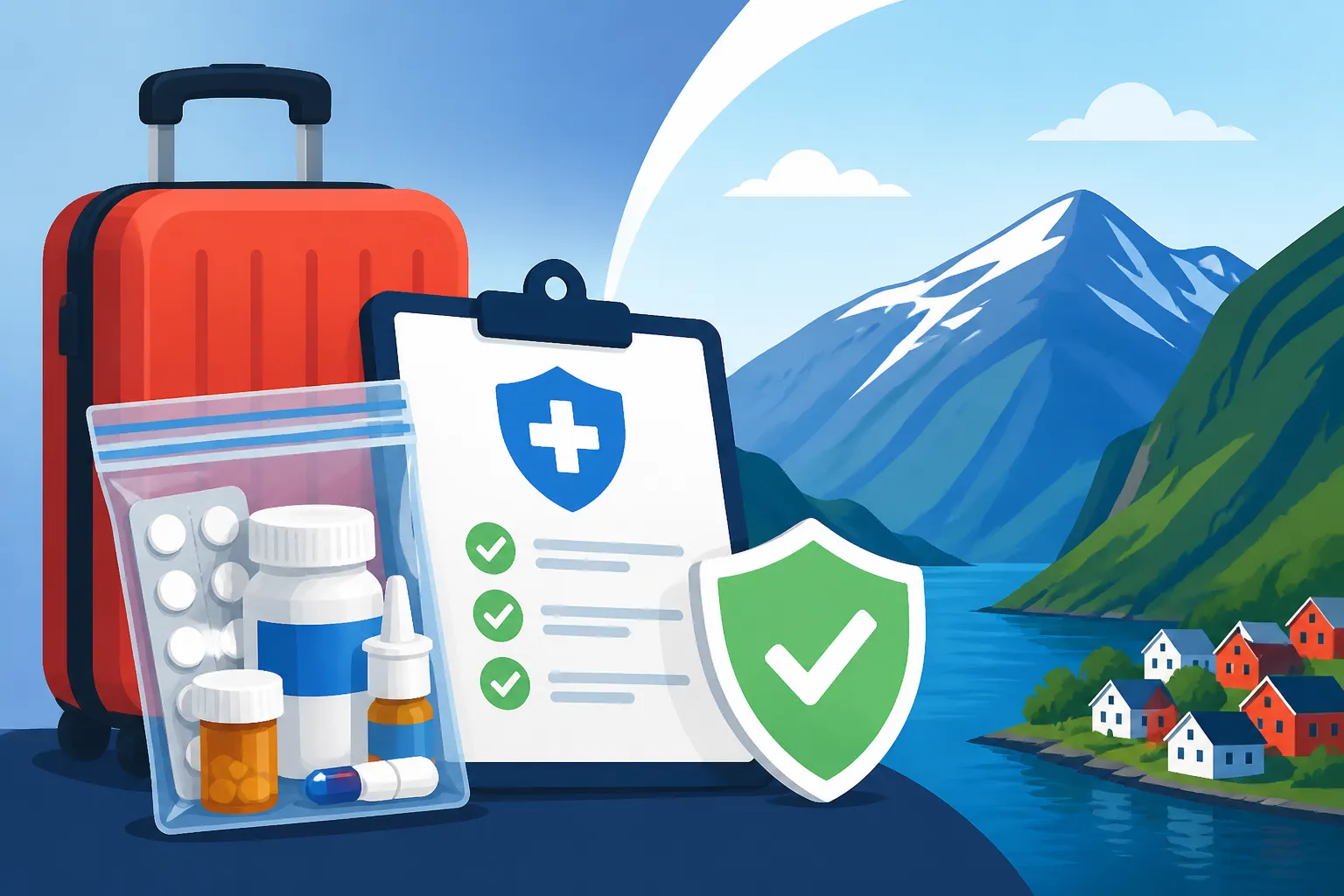
Regardless of whether you are bringing a week's worth of hay fever tablets or a year's supply of blood pressure medication, documentation is your best friend. Norwegian customs officials (Tolletaten) are professional and usually quite friendly, but they operate strictly by the book. You must be able to prove that the medication was prescribed specifically for you. The easiest way to do this is to keep everything in its original packaging from the pharmacy, with the label clearly showing your name, the doctor’s name, and the dosage.
It is wise to carry a "Medical Passport" or a signed letter from your GP, written in English or a Scandinavian language. This letter should list your diagnoses and the specific medications you are taking. While it might feel like overkill for a standard prescription, having that letter can prevent a 20-minute delay at the border from turning into a multi-hour ordeal. If you are using a provider like SafetyWing for your initial travel insurance, keep their contact details handy as well, as they can sometimes assist with emergency medical documentation if your bags are lost or inspected.
Furthermore, if you have a complex medical history, this documentation serves a secondary purpose once you are in the country. It will be the primary evidence you present when you are going through the First 30 Days Health Checklist: GP, Frikort, and Pharmacies to transition your care to a local provider. Without clear, original documentation from your home country, a Norwegian doctor may insist on re-diagnosing you from scratch before issuing a local prescription.
Over-the-Counter vs. Prescription Thresholds
One of the biggest culture shocks for expats in Norway is discovering that medications that are over-the-counter (OTC) in their home country are prescription-only here. This includes high-dose ibuprofen, certain allergy medications, and even some types of melatonin. If you arrive with a bulk bottle of 800mg ibuprofen from a US warehouse club, customs may treat it as a prescription medication. If you don't have a prescription for it, you could technically be in violation of import laws.
Because the dosage per pill exceeded the Norwegian OTC limit, it was flagged. Luckily, he had a note from his pharmacist, but it was a close call. Always check the strength of your OTC meds. If they are "extra strength" or "industrial size," try to get a quick note from your doctor or stick to smaller, standard-dose packages.
For those who rely on specific brands for comfort, it is worth checking Over-the-Counter (OTC) Drugs in Norway: What You Can Buy in Supermarkets to see what is readily available. You might find that you don't need to waste suitcase space on paracetamol or low-dose allergy pills, as these are sold in every Kiwi and Rema 1000 across the country.
The Schengen Certificate and Controlled Substances
If your medication falls into the category of narcotics or psychotropic substances—which includes many strong painkillers, sleep aids, and ADHD medications—the rules change entirely. This is the area where "I've-been-there" experience really matters because the consequences of a mistake here are not just a confiscated bottle; they can involve legal trouble. Norway takes the movement of controlled substances across its borders very seriously.
What is a Schengen Certificate?
The Schengen Certificate is a specific document used for people traveling within the Schengen Area who need to carry prescribed narcotic or psychotropic drugs. If you live in a Schengen country (like Germany, France, or Spain) and are moving to Norway, you must obtain this certificate from your local health authority or a designated pharmacy in your home country before you leave. It is usually valid for 30 days and covers the specific duration of your travel.
For those coming from outside the Schengen Area—like the UK or the US—you cannot get a "Schengen Certificate," but you must provide equivalent documentation. This usually means a very detailed medical certificate from your doctor. It must state why you need the medication, the exact dosage, and the duration of your stay. Note that even with this paperwork, the limit for narcotic medications for non-residents is usually only a 30-day supply.
Many people struggle with the transition for ADHD meds specifically. If you are in this boat, you should read our deep dive on Getting ADHD Medication in Norway: Diagnostic Proof Required. The Norwegian system is very cautious with stimulants, and having your paperwork in perfect order at the border is the first step in proving your legitimate need for these medications to future Norwegian specialists.
Medications Requiring Special Attention
It’s not always obvious which medications are considered "narcotics" by Norwegian standards. It isn’t just morphine or oxycodone. It can include medications for anxiety like diazepam (Valium) or alprazolam (Xanax), as well as methylphenidate (Ritalin). Even some cough syrups containing codeine are strictly controlled. If you are unsure, the best resource is the Norwegian Customs website or the list provided by the Norwegian Medical Products Agency.
| Medication Category | EEA/Schengen Origin Limit | Non-EEA Origin Limit | Required Document |
|---|---|---|---|
| Standard (Non-Narcotic) | 1 Year Supply | 3 Months Supply | Prescription/Label |
| Narcotics/Psychotropics | 30 Days Supply | 30 Days Supply | Schengen Cert/Doctor Letter |
| Supplements/Vitamins | For Personal Use | For Personal Use | Original Packaging |
| Performance Enhancers | Prohibited/Strict | Prohibited | Medical Certificate |
When I was helping a friend move here who suffered from chronic back pain, we spent weeks ensuring her pain management prescriptions were documented correctly. We found that even for temporary visitors, having a clear plan is essential. Some expats choose to supplement their public coverage with Private Health Insurance in Norway: Is It Worth the Extra Cost? to get faster access to specialists who can take over these controlled prescriptions once the initial 30-day supply runs out.
Validity and Timelines for Narcotics
The 30-day limit for narcotics is a hard wall. Unlike standard meds where you can often "stretch" a three-month supply, the 30-day rule for controlled substances is rarely flexible. If you are moving to Norway permanently, this means you have exactly one month from the day you land to find a Norwegian doctor, get a referral, and have a local specialist approve your prescription.
This is one of the most stressful parts of the move. I highly recommend booking your first doctor's appointment before you even leave your home country if possible. You can learn how to manage this via The Fastlege Scheme: Navigating Norway’s GP System. Do not wait until you have three pills left to start the process; the waiting lists for specialists in Norway can be long, and your GP (Fastlege) may not be authorized to prescribe certain controlled medications without a specialist's "blessing" first.
Bringing Meds from Outside the EEA (US, UK, Canada, etc.)
For my fellow expats coming from across the Atlantic or from the UK, the "Three-Month Rule" is the law of the land. This can be a major logistical hurdle, especially if your insurance company back home refuses to dispense more than 30 days at a time. You may need to request an "override" for travel purposes, explaining that you are relocating and need a full 90-day supply to bridge the gap until you enter the Norwegian system.
The Conflict of Illegal Supplements
This is the "Melatonin Trap" I mentioned earlier. Norway has very specific rules about what constitutes a "supplement" versus a "medicine." Many things sold as supplements in US health stores are considered medicines in Norway. If a product contains ingredients that are on the Norwegian "Medicine List," it is treated as a drug. If you don't have a prescription for that "supplement," it could be confiscated.
A classic example is Melatonin. While the rules have relaxed slightly in recent years for very low dosages, high-dose Melatonin is still frequently flagged. Another one is DHEA or certain herbal "hormone balancers." If you are a fan of high-dose vitamin D or specialized pre-workout blends, be very careful. You can read more about this in Bringing Supplements to Norway: Why Melatonin Can Get Confiscated. Generally, if it looks like a medicine and acts like a medicine, Norwegian customs will treat it as a medicine.
We recommend: if it’s essential for your health, get a prescription for it, even if it’s OTC at home. If it’s just a "nice to have" supplement, consider buying it locally or at least be prepared to lose it at the border. The peace of mind of walking through the Green Zone without a pounding heart is worth more than a bottle of imported multivitamins.
Managing Chronic Illnesses During the Move
Relocating with a chronic condition like diabetes, Crohn’s disease, or heart disease requires a level of planning that goes beyond just packing bags. Because you are limited to 90 days of medication from outside the EEA, you must be proactive. Ensure you have your full medical records digitized and printed. Norwegian doctors love data—blood test results, scan reports, and clear history of medication efficacy will speed up your integration into the local system.
During this transition period, some expats use Cigna Global to maintain a high level of private coverage. This can be helpful because it often allows you to see private specialists (like those at Aleris or Volvat) much faster than the public system, which is crucial when you only have a 90-day window to get your Norwegian prescriptions set up. Having private coverage can be a lifesaver if you find yourself stuck on a waiting list for a public specialist while your home-country supply dwindles.
I remember a neighbor who moved from London with a complex autoimmune disorder. She didn't realize how long the referral process could take. By the time she got her User Fees (Egenandel) for Doctor Visits Before Reaching Frikort Status sorted, she was down to her last week of meds. She ended up having to pay out-of-pocket for a private consultation just to get a bridge prescription. Learn from her: start the process the second you get your D-number or Fødselsnummer.
Prohibited Substances and Performance Enhancers
It should go without saying, but any form of performance-enhancing drugs, steroids, or unapproved "experimental" medicines are strictly prohibited. Norway has a zero-tolerance policy for these substances unless they are part of a very specific, documented medical treatment for a diagnosed condition (like Hormone Replacement Therapy). Even then, the paperwork required is extensive.
If you are a competitive athlete or a bodybuilder moving to Norway, do not assume your "stack" is legal here just because it was legal in your home country. If customs finds these substances without a very clear, legitimate medical prescription, they won't just take them away—you could face significant fines or even a ban on entry. Always err on the side of caution and consult the Pharmacies and Prescriptions in Norway: White vs Blue Slips guide to understand how Norway classifies different tiers of medicine.
Navigating Norwegian Customs (Tolletaten) at the Border
You’ve landed, you’ve gathered your bags, and now you face the final boss: the Customs area. In Norway, as in most of Europe, you have a choice between the Green Zone (Nothing to Declare) and the Red Zone (Goods to Declare). Most expats with standard medications feel a massive urge to just walk through the Green Zone and hope for the best.
Red Zone vs. Green Zone: Making the Choice
My advice? If you are carrying a large amount of medication (more than a month's supply) or anything that could be considered a controlled substance, walk through the Red Zone. It might seem counterintuitive to invite inspection, but being proactive is a sign of honesty. If you go through the Green Zone and are stopped for a random check—and they find a 90-day supply of antidepressants or a box of Ritalin—they may view it as an attempt to smuggle.
When you walk into the Red Zone, simply say to the officer, "I am moving to Norway and have a three-month supply of my personal prescription medications. Here is my doctor's letter and my prescriptions." Nine times out of ten, they will glance at the letter, check the labels, and wave you through with a "Velkommen til Norge." It takes five minutes and removes all the legal risk.
I have walked through the Red Zone with everything from specialized skin creams to boxes of inhalers. The officers are used to expats moving with their lives. They are looking for people bringing in 500 liters of beer or commercial quantities of narcotics, not a new resident trying to manage their asthma. If you have SafetyWing or similar travel insurance, remember that they expect you to follow local laws, so being honest at customs also keeps your insurance valid.
What Happens During a Customs Audit?
If you are selected for a random check in the Green Zone, stay calm. The officers will ask you to open your bags and will likely zoom in on any pill bottles. This is where your original packaging and labels become vital. If the medication is in an unlabelled plastic bag or a generic "days of the week" pill organizer, you are going to have a very long afternoon.
During an audit, they will check the substance against the Norwegian Medicine List. If they find something that isn't allowed or is over the quantity limit, they will explain the rules to you. If it's a minor infraction (like having four months of a non-narcotic instead of three), they might just confiscate the extra month. If it's more serious, they may issue a fine. However, if you have your paperwork and can prove it’s for you, they are generally very reasonable.
One thing to note: never lie to a customs officer. If they ask if you have medicine and you say no, but they find it, the situation escalates from a "paperwork issue" to a "deception issue." Just be upfront. They are there to protect the public, not to make your life miserable.
Handling Confiscations and Appeals
If the worst happens and your medication is confiscated, you will be given a receipt and a document explaining why. You do have the right to appeal if you believe the decision was made in error—for example, if they miscalculated your supply or misidentified the drug. However, the appeal process is slow and usually won't help you get your meds back in time to take them.
If your essential medication is seized, your priority shifts to replacing it. This is where you would head to the nearest Legevakten (emergency clinic) or book an urgent appointment with a private provider like Dr. Dropin. Show them the confiscation notice; it actually serves as proof that you were taking the medication, which might help them feel more comfortable writing a temporary local prescription.
Transitioning to the Norwegian Pharmacy System
Once you are past the border, your clock starts ticking. You have until your imported supply runs out to become a "patient" in the Norwegian system. This transition is often where the reality of living in Norway sets in—the system is excellent, but it moves at its own pace.
Getting Your First Norwegian Prescription
To get a prescription in Norway, you generally need to see your Fastlege. If you haven't been assigned one yet because you are still waiting for your residence permit or ID number, you may need to use private clinics. When you see a Norwegian doctor, bring your empty bottles from home and your medical records.
Norwegian doctors are often more conservative with prescribing than doctors in the US or UK. They might suggest a different brand (a "generic" version) or a slightly different dosage to align with Norwegian medical guidelines. This is where having Cigna Global can be helpful, as some private specialists are more accustomed to working with international patients and may be more flexible in maintaining your original treatment plan if it's medically sound.
Once the doctor enters the prescription into the system, it becomes an "e-resept" (electronic prescription). You don't get a piece of paper; instead, you just walk into any pharmacy in Norway (Apotek 1, Vitusapotek, etc.), show your ID, and they pull it up on their screen. It’s incredibly efficient once you're in the loop. You can even see your active prescriptions and learn How to Renew a Prescription on Helsenorge through the national health portal.
Understanding Blue vs. White Prescriptions
When you get your first local prescription, you'll hear the terms "blå resept" (blue prescription) and "hvit resept" (white prescription). This is a crucial distinction for your wallet. A blue prescription is for chronic conditions and is heavily subsidized by the government. You only pay a small fraction of the cost, which counts toward your User Fees (Egenandel) for Doctor Visits Before Reaching Frikort Status.
A white prescription is for short-term use or medications not covered by the national subsidy. For these, you pay the full price. If you were used to low copays back home, some white prescription prices in Norway might give you sticker shock. However, once you reach your annual "Frikort" limit (usually around 3,000 NOK), almost all blue prescription costs and doctor fees are covered for the rest of the year.
I remember my first year thinking I was spending a fortune on meds, but then I hit my Frikort limit in August, and for the rest of the year, my prescriptions were essentially free. It’s a "front-loaded" system that rewards those with long-term needs.
Online Pharmacies and Delivery
In recent years, Norway has embraced online pharmacies like Farmasiet and Apotekera. These are fantastic for expats living in more remote areas or those who just prefer the convenience of home delivery. Once your "e-resept" is in the system, you can log into these sites using BankID, select your meds, and have them delivered to your door or a nearby "Post i Butikk" (postal point in a grocery store).
This is a lifesaver during the winter months when trekking to a physical pharmacy in a blizzard feels like a chore. Just remember that you need BankID to use these services, which is something you’ll secure as part of your banking setup. Until then, you’ll be visiting physical pharmacies, which are plentiful in every Norwegian city and town.
Disclaimer
This guide is intended for informational purposes only and is based on personal experience and general regulations as of 2026. Customs laws and medical regulations in Norway can change without notice. Always verify the latest requirements with the Norwegian Medical Products Agency (Direktoratet for medisinske produkter) or the Norwegian Customs (Tolletaten) before traveling. The author is not a legal or medical professional, and this content should not be taken as professional advice.