Do I Have to Take a Driving Test Again to Exchange My US License?
Moving to Norway often feels like a never-ending sequence of deadlines and digital portals, but few things catch Americans off guard quite like the driver’s license exchange rules. If you plan on getting behind the wheel, the 12-month clock is already ticking the moment you register your residency. This guide explains why you likely need a practical test and how to avoid the incredibly expensive mistake of waiting too long.
The Crucial 12-Month Window and the Exchange Trap
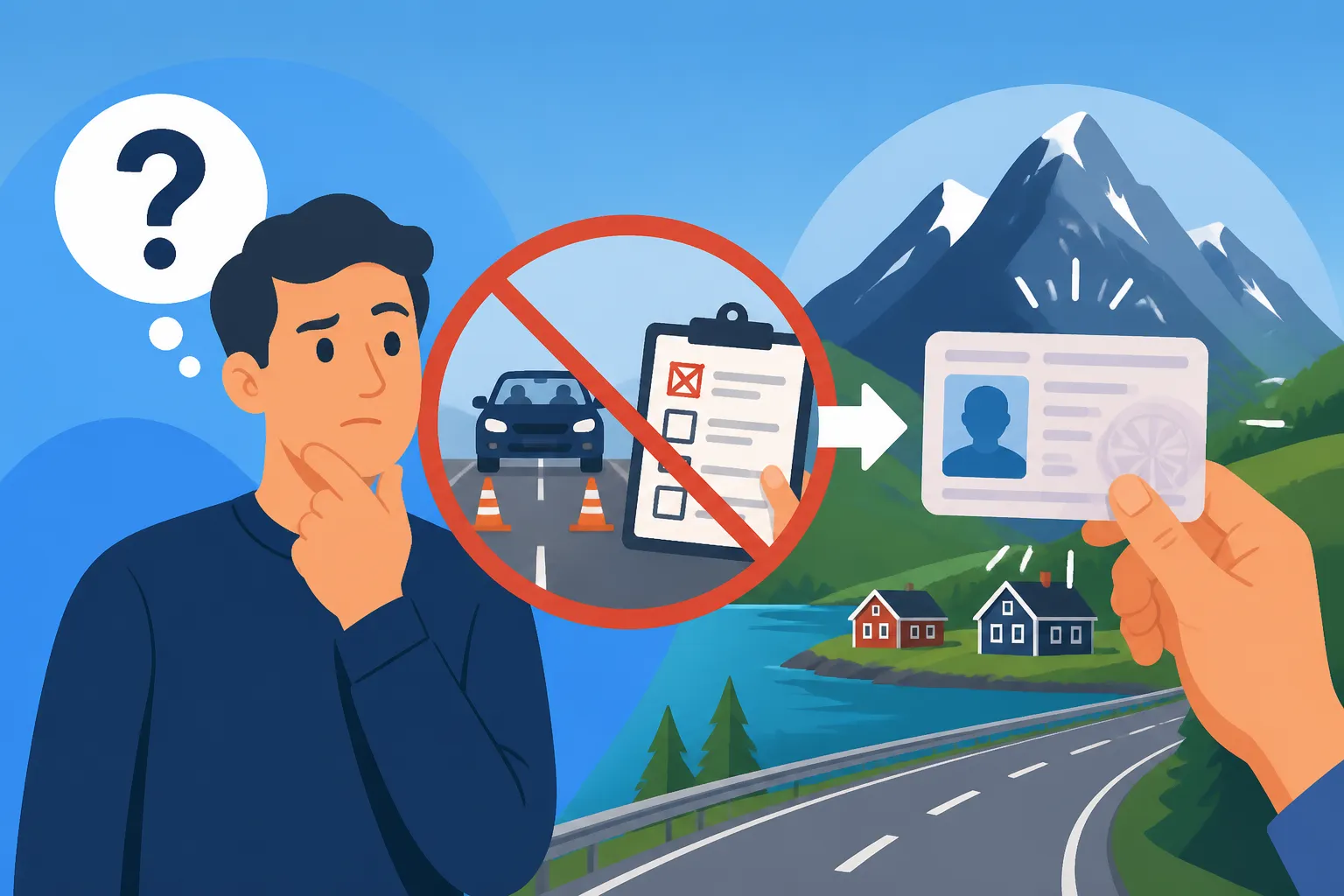
The first thing you need to realize as a US license holder is that Norway does not view your driving experience as equivalent to their own rigorous training program. Unlike citizens from the EU or EEA, who can often just swap their plastic card for a Norwegian one, Americans fall into a category that requires a "skill check." This isn't just a bureaucratic hurdle; it is a time-sensitive requirement that can cost you thousands of dollars if you miscalculate the dates.
The One-Year Deadline Explained
From the day you move to Norway and register with the National Registry, you have exactly one year to complete the exchange process. This doesn't just mean "submitting the application"—it means passing the practical driving test. Many expats make the mistake of thinking they have plenty of time, only to realize that the waiting lists for driving tests at the local Statens Vegvesen (Public Roads Administration) can be months long, especially in major cities like Oslo or Bergen.
If you are currently searching for a long-term home through platforms like Spotahome, you might find yourself looking at neighborhoods further from the city center where a car is essential for grocery runs or school drop-offs. In these cases, your license isn't just a convenience; it's your lifeline to the community. You can legally drive on your US license for the first three months of your residency, but after that, you are technically in a gray area until your exchange is finalized.
What Happens if You Wait Longer Than 12 Months?
This is the nightmare scenario every veteran expat warns newcomers about. If you let that first year slip by without passing your practical test, your right to an "exchange" evaporates. You are no longer seen as an experienced driver looking to convert a foreign permit; you are seen as a brand-new student. You will be required to go through the entire Norwegian driver’s education curriculum from scratch.
To put this in perspective, the full Norwegian driving course includes mandatory first aid classes, night driving demonstrations (mørkekjøring), skid car courses (glattkjøring), and a specific number of hours of supervised "long-distance" driving. The total cost for this full process often exceeds 30,000 to 40,000 NOK. By missing the one-year exchange window, you essentially hand over a massive sum of money and dozens of hours of your life to a driving school for a skill you likely already possess.
The Two-Year Absolute Limit
While the first 12 months are for the "limited" exchange (just the practical test), there is a second deadline at the two-year mark. If you haven't exchanged the license within two years of moving to Norway, you lose the ability to exchange it at all, even if you were willing to do the full course earlier. At that point, your US license is effectively a piece of souvenir plastic. It is vital to check your Converting Your Foreign Driver's License to a Norwegian License status early to ensure you aren't caught in this administrative pincer movement.
The Practical Driving Test: What to Expect
Let's address the big question: Yes, you almost certainly have to take a practical driving test. While you don't have to take the written theory exam (if you apply within the one-year window), the "oppkjøring" or practical test is mandatory for almost all US states. It is a 45-to-60-minute session where a Norwegian examiner evaluates not just your ability to operate the vehicle, but your adherence to very specific Norwegian road philosophies.
Why Experienced US Drivers Frequently Fail
It is a common "humble-pie" moment for Americans who have been driving for 20 years to fail their first Norwegian driving test. The standards here are incredibly high. The most common reason for failure is the "Priority from the Right" (høyreregel). In many Norwegian residential areas and unmarked intersections, you must yield to any vehicle coming from the right. To an American used to stop signs and clear right-of-way markings, this feels counter-intuitive and dangerous, but failing to yield is an automatic "fail" on the test.
Another sticking point is "eco-driving." Norwegian examiners want to see that you are using the engine efficiently, shifting gears early (if driving manual), and coasting to stops rather than braking aggressively. They are also obsessed with your "eye movement." You need to exaggerate your checks of mirrors and blind spots so the examiner sees you are actively scanning for cyclists and pedestrians, who have significant rights on Norwegian roads. While you are navigating these new rules, having a reliable data connection via Airalo can be helpful for looking up local traffic signs or using GPS to find the testing center without added stress.
The Cost of the Exchange Process
Even though you are "just" taking a test, the costs add up quickly. You will need to pay the application fee, the fee for the practical test itself, and the fee for the physical production of your new Norwegian license. Furthermore, you cannot take the test in your own car. You must rent a car from a certified driving school, and usually, that car must be dual-controlled (with pedals on the passenger side for the examiner).
| Expense Item | Estimated Cost (NOK) | Notes |
|---|---|---|
| Application Fee | ~600 | Paid to Statens Vegvesen |
| Practical Test Fee | ~1,200 | Paid per attempt |
| Car Rental (from Driving School) | ~2,500 – 3,500 | Includes 45-min warm-up usually |
| New License Production | ~200 – 300 | Paid after passing |
| Optional Prep Lessons | ~800 – 1,100 | Per hour (Highly recommended) |
Booking Your Appointment via Statens Vegvesen
The process begins by submitting an application form, either online or by mail, to the Statens Vegvesen. You will need to provide your original US license. Be prepared: they will often take your physical US license away while your application is being processed. They might give you a temporary paper permit, but this is only valid in Norway. If you had plans to fly back to the States and rent a car, you might find yourself without a valid physical ID to show the rental agency. Dealing with this requires the same level of patience as navigating BankID Explained: Norway's Digital Identity System and Expat Challenges, so plan your international travel accordingly.
Step-by-Step Guide to the Exchange Process
Navigating the bureaucracy is easier if you treat it like a checklist. Don't wait until you've settled in perfectly; start this within your first month of arrival. The peace of mind knowing you have a test date on the calendar is worth the early effort.
Step 1: Documentation and the Health Certificate
You will need your passport, your residence card, and your valid US driver's license. One nuance that often trips people up is the "self-declaration of health." When you apply, you'll fill out a form regarding your vision and general health. If you have any medical conditions or wear glasses, you might be required to get a separate certificate from a Norwegian doctor. This is just one of many small tasks that make the First 30 Days Health Checklist: GP, Frikort, and Pharmacies so important for new arrivals.
Step 2: The "Trial" Lesson
I cannot stress this enough: do not go into your practical test "cold." Even if you think you're an amazing driver, book one or two "evaluation lessons" with a local driving school. Tell the instructor, "I am an American exchanging my license; tell me why I am going to fail." They will point out your bad habits—like one-handed steering or failing to check your blind spot when entering a bike lane—that would lead to an immediate failure. This small investment prevents you from having to pay for the test and car rental a second time.
Step 3: Mastering the Norwegian Road Environment
Driving in Norway is vastly different from the wide, straight interstates of the US. You will deal with narrow mountain roads, complex tunnels, and the ubiquitous roundabouts. You must also be prepared for the environmental factors. If you take your test in the winter, you are expected to know how to handle icy patches and demonstrate "defensive driving" in low visibility. Understanding Winter Tires (Piggdekk vs Piggfrie): Legal Dates and Rules is essential, as the examiner might ask you basic questions about the vehicle's equipment before you even pull out of the parking lot.
Step 4: After the Test
Once the examiner tells you that you've passed (a moment of pure euphoria, believe me), you don't get your license immediately. You will be given a temporary digital permit which you can access via the Statens Vegvesen app. Your physical "Class B" license will arrive in the mail about a week later. Make sure your name is clearly marked on your mailbox, or Posten will return it to the sender. This is a common hiccup that also affects those waiting for their tax documents or Filing Your Tax Return (Skattemelding): Deadlines and Common Deductions notices.
Essential Tips for Success on the Road
To ensure you don't end up as one of the many expats telling a "failure story" at the local pub, keep these hyper-local tips in mind. Norwegian driving culture is built on cooperation and extreme caution, which can be a culture shock if you're coming from a high-aggression driving environment like Los Angeles or New York.
- Pedestrians are Kings: In Norway, if a pedestrian even looks like they might want to cross at a crosswalk, you stop. Not stopping is considered a major safety breach.
- The "Zipper" Merge: Norwegians are generally very good at the zipper merge. Trying to "block" someone from merging is seen as aggressive and un-Norwegian.
- Public Transport Priority: Buses have the right of way when pulling out from a stop in speed zones of 60 km/h or less. Watch for those blinkers! If you're used to the Public Transport in Oslo (Ruter): Zones, Tickets, and Monthly Passes, you'll know how frequently these buses move.
- Roundabouts: These are the heart of Norwegian intersections. Use your blinker into the roundabout if you are turning left (blinking left), and you must blink right to exit.
- Wildlife Awareness: Especially if you are testing in a more rural municipality, be aware of the risk of animals. The examiner will appreciate you scanning the tree line, as they know the dangers discussed in What to Do If You Hit a Moose or Deer While Driving.
Dealing with Test Anxiety and Language Barriers
It is perfectly normal to feel stressed. The Norwegian driving test is expensive, and the stakes feel high because of the one-year deadline. Most examiners speak excellent English and will be happy to conduct the test in English. They aren't there to trick you; they want to see that you are a "predictable" driver. In the Norwegian road book, predictability is the highest virtue.
If you are worried about the technical terms, don't be. "Left," "Right," and "Follow signs for Drammen" are about as complex as the instructions get. Focus on your Driving in Norway: Licenses, Winter Driving, and Electric Vehicles (EVs) knowledge, keep your eyes moving, and remember to yield to the right.
Before you set out for your test, ensure your car is properly equipped for the season. If it's between November and April, ensure you've brushed up on Preparing Your Car for the Norwegian Winter: Antifreeze and Scrapers so you don't look like a novice before the engine even starts. Once you have that Norwegian license in your wallet, the country truly opens up to you, from the coastal fjords to the high mountain cabins.
Disclaimer
This guide is for informational purposes only and reflects the rules as of early 2026. Immigration and transport regulations in Norway are subject to change by the UDI and Statens Vegvesen. Always verify deadlines and requirements directly with the Norwegian Public Roads Administration before beginning your application. Standard user fees and medical requirements may vary based on individual circumstances and age.