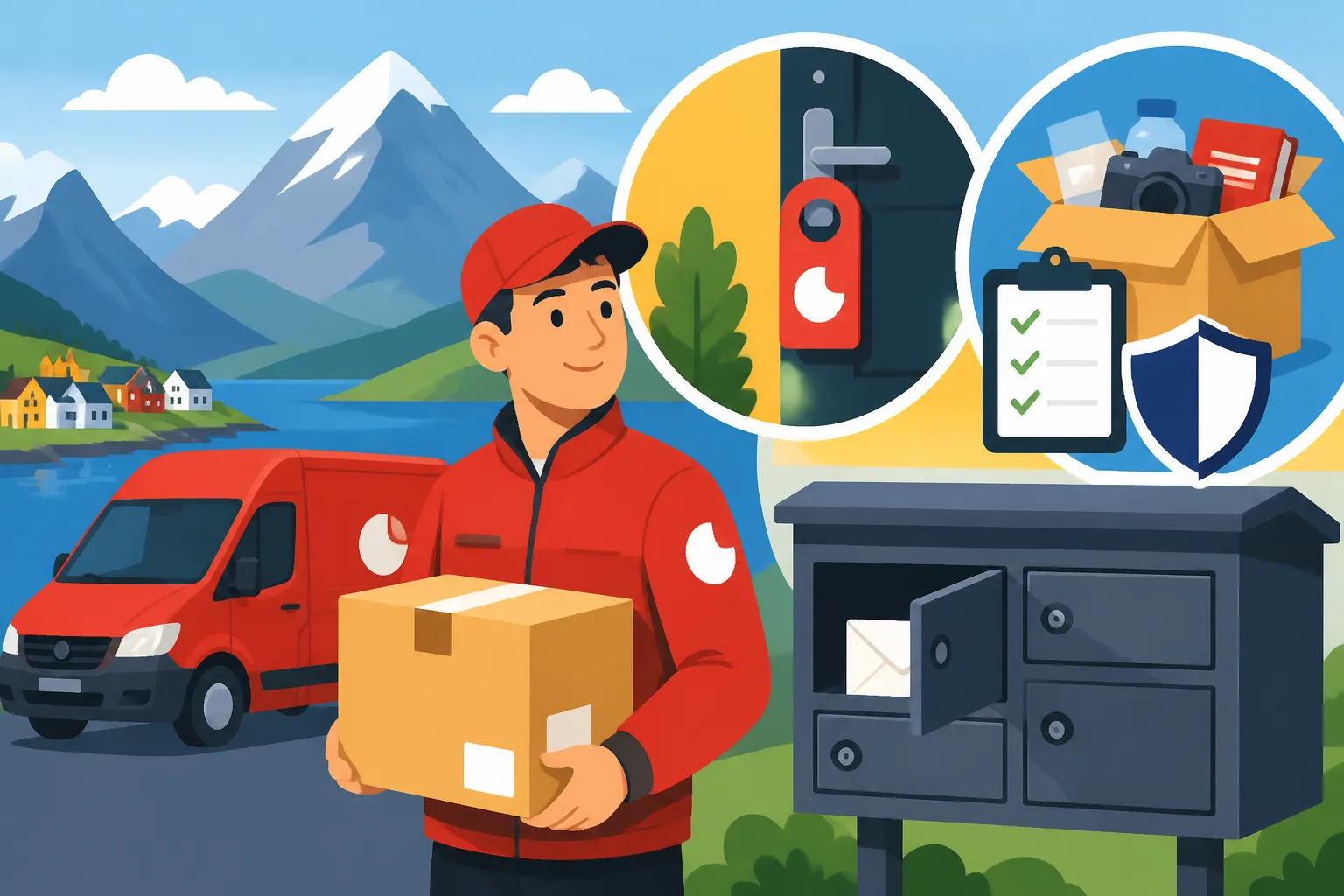
Postal Services (Posten): Redelivery, Customs, and Mailbox Names
Moving to a new country involves a massive learning curve, but few things are as unexpectedly frustrating as the Norwegian postal system. You might think a mailbox is just a box, but in Norway, if your name isn't precisely where the mailman expects it, your vital documents will vanish. This guide solves the mystery of Posten, customs fees, and the absolute necessity of proper mailbox labeling.
The Absolute Necessity of Mailbox Labeling and Address Registration
In many countries, mail is delivered to an address regardless of who lives there. In Norway, Posten (the national postal service) operates on a name-based system. If the name on the envelope does not match a name physically printed on the mailbox, the mail carrier is legally allowed—and often required—to mark it as "Receiver Unknown" and send it back to the sender. This can be disastrous if you are waiting for your residence card or tax documents.
Registering Your Address on Your Mailbox Properly
The first thing you must do when moving into a new apartment, perhaps one you found through a service like Spotahome to secure a long-term spot before arrival, is to get your name on that box. It isn't enough to just have your name inside the lid; it must be visible on the outside. Most apartment buildings have a standardized slot for a nameplate. You should not just use a piece of masking tape and a Sharpie, as these often fall off in the brutal Norwegian rain and wind.
When you are Registering Your Address on Your Mailbox Properly, ensure that every person living in the household is listed. If you are a couple with different surnames, both names must be there. If you are a sub-letter or staying in a "kollektiv" (shared house), this is even more critical. I’ve seen expats miss their first D-Number vs Fødselsnummer: How It Affects Your Banking Options notification simply because the mailman didn't see their name next to the landlord's. You can often order a professional, engraved nameplate through the building's "styre" (board) or from specialized websites like Skiltmax.
The Role of the Folkeregisteret in Mail Delivery
Posten’s database is linked to the National Registry (Folkeregisteret). When you move, you are legally obligated to report your change of address within eight days. This isn't just for the government to track you; it’s how the postal system updates its internal routing. If you haven't performed Reporting Address Changes to the National Registry (Folkeregisteret), your mail might still be directed to your old "hybel" or temporary hotel.
Even if you have updated the government, you must also manually update Posten. They are technically separate entities. You can do this on the Posten website under "Address Change" (Adresseendring). For the first few months, it is highly recommended to pay for "Ettersending," which is a mail forwarding service. This ensures that if a bank or a doctor sends something to your old address, it will be redirected to your new home. This is a vital step in your First 30 Days Health Checklist: GP, Frikort, and Pharmacies.
Navigating C/O Addresses for Temporary Residents
If you are staying in a short-term rental or a friend's place while you look for a permanent home on Spotahome, you will likely need to use a "C/O" (Care Of) address. This is a frequent point of confusion for new arrivals. A C/O address tells the mail carrier: "Deliver this to the person whose name is on the mailbox, but the letter is actually for the person listed in the C/O line."
Format your address as follows:
Your Name
c/o The Name on the Mailbox
Street Name and Number
Postal Code and City
Without that "c/o" line, if the mailman sees a letter for "John Smith" but the box says "Olaf Nordmann," it goes straight back to the sorting center. This is particularly important when you are Opening a Norwegian Bank Account Without a Permanent Address and need to receive your physical debit card.
Managing Deliveries and the Posten App
Norway is an incredibly digital society, and the postal service is no exception. The days of waiting by the door for a package are largely over. Now, everything happens through your smartphone. To keep your life stress-free, downloading the Posten app should be one of the first things you do after landing and setting up your mobile data—potentially using an eSim from Airalo to avoid roaming charges while you wait for a local ID number.
Navigating the Posten App and Tracking
The Posten app is your lifeline for any logistics. It allows you to track packages in real-time, see which "Post i Butikk" (Post in Shop) your parcel has been sent to, and even open digital locks on parcel lockers. If you have a phone number registered in Norway, the app will often automatically pick up any packages sent to that number and add them to your tracking list.
One of the most useful features of the app is the ability to see the "Hentefrist" (pickup deadline). Most packages are only held for 7 to 14 days before being returned to the sender. The app will send you push notifications as the deadline approaches. If you are out of town or busy, you can often use the app to request an extension of the pickup deadline for a small fee. Having a reliable data connection via Airalo ensures you don't miss these time-sensitive notifications when you're away from home Wi-Fi.
Understanding Pakkeboks and Digital Pickup
Norway has pioneered the use of "Pakkeboks"—green or grey lockers located on street corners, at gas stations, or near apartment complexes. These are revolutionary for expats who work late or don't want to wait in line at a grocery store. When your package arrives in a Pakkeboks, you receive a notification in the app. You walk up to the locker, turn on your Bluetooth, and tap a button in the app to "Open Locker."
The door pops open, you grab your package, and you’re done. There is no interaction with staff and no need to show ID, as your identity is verified through your phone. It’s a seamless experience, but it requires you to be tech-savvy. If you are still Navigating the Helsenorge App in English: A Step-by-Step Translation, you will find the Posten app follows a similar logical structure, though it is thankfully available in English as well.
Redelivery and Missing a Home Delivery
In Norway, "Home Delivery" (På døren) is often a premium service. However, if the courier arrives and you aren't home—or if they can't access your apartment building's main door—they won't usually leave the package on the street. Instead, they will take it to the nearest "Post i Butikk." You will receive a text or a note in the app saying your delivery was "unsuccessful."
If you specifically want a redelivery to your door, you can sometimes order this through the app for an extra charge. However, most Norwegians simply accept that they will have to walk to the local Kiwi or Meny supermarket to pick it up. Be aware that the courier might not even ring your doorbell if your name isn't on the intercom system. Just like the mailbox, your name must be on the doorbell or the digital directory of the building.
Navigating Norwegian Customs and Import Fees
This is the area where most expats lose money and sanity. Norway is not part of the EU Customs Union. This means that almost everything you order from abroad—whether it's a gift from your parents in the UK or a gadget from Amazon US—is subject to Value Added Tax (VAT) and potential customs duties.
| Service Type | Typical Cost | Delivery Speed | Best For |
|---|---|---|---|
| Pakkepost (Standard) | Included in shipping | 2-5 days (Domestic) | Everyday online shopping |
| Pakkeboks (Locker) | Included in shipping | 24/7 Access | Working professionals |
| På Døren (Home) | 150-300 NOK extra | Evening (17:00-21:00) | Large furniture or heavy items |
| Ekspress Over Natt | 400+ NOK | Next day by 09:00 | Urgent documents/passports |
The VOEC Scheme and Online Shopping
To make things easier, Norway introduced the VOEC (VAT On E-Commerce) scheme. Large international retailers like Amazon, eBay, and Etsy are registered under this scheme. When you buy from a VOEC-registered shop, you pay the 25% Norwegian VAT at the checkout. The package is then marked with a specific VOEC code, allowing it to sail through Posten Customs Clearance Fees: Receiving Packages from Outside Europe without any additional "handling fees."
If the store is not VOEC-registered, or if the item costs more than 3,000 NOK, you will be hit with a "Customs Clearance Fee" (Fortollingsgebyr) by Posten, which is usually around 150-300 NOK, on top of the 25% VAT. I’ve seen expats order a $10 t-shirt from a niche brand only to be charged $25 in fees once it hits the Norwegian border. Always check if a site is VOEC-compliant before hitting "buy."
Dealing with Gifts from Home
Many expats think that if a package is marked as a "Gift," it is free from taxes. This is only partially true. In Norway, gifts from private individuals are only tax-free if the value is below 1,000 NOK. If your grandmother sends you a Christmas hamper worth 1,100 NOK, you will be charged VAT on the entire amount, including the shipping cost, plus the Posten handling fee.
When family sends things, they must be extremely specific on the customs declaration. "Used personal belongings" or "Birthday gift" with a realistic value is necessary. If they leave the value blank or write "N/A," Posten will hold the package and send you a letter (or an app notification) asking you to provide documentation of the value. This can delay your package by weeks.
Prohibited Items and Restricted Goods
Norway has very strict rules about what can enter the country. Alcohol and tobacco are the obvious ones, but many expats are surprised by the restrictions on medicines and supplements. Even common over-the-counter vitamins can be seized if they exceed certain dosages or contain ingredients considered "prescription only" in Norway.
If you are Bringing Medication into Norway: Customs Rules and Schengen Certificates, make sure you have the paperwork. For postal deliveries, it’s even riskier. Ordering Melatonin or high-dose Vitamin D from the US can result in the package being destroyed by Toll (Customs) without a refund. Always check the Legemiddelverket (Norwegian Medical Agency) list if you are unsure about a supplement.
Practical Logistics: Sending Mail and Post i Butikk
One of the quirks of Norway is that dedicated "Post Offices" with red counters and specialized staff have almost completely disappeared. Instead, postal services are integrated into grocery stores. Look for the red "Post i Butikk" sign inside your local Rema 1000, Coop, or Kiwi.
How Post i Butikk Works
When you enter a grocery store with a post counter, you will usually see a touchscreen near the entrance. You must take a ticket for "Post" and wait for your number to be called. These counters can handle everything: sending registered mail, buying stamps, or shipping heavy boxes. The staff are grocery store employees who have been trained in postal basics, so they are generally very efficient but might not know the deep nuances of international maritime shipping.
If you are sending a package within Norway, you don't even need to wait in line if you use the Posten app. You can buy a "Norgespakke" (standardized shipping label) in the app, write the code on the box with a marker, and drop it off at the counter. It’s significantly cheaper than paying for a label at the store. This is a great way to save money when moving small items between apartments if you initially used Spotahome for a short-term stay and are now moving your life to a permanent home.
Digital Stamps and Mailing Letters
Traditional stamps still exist, but they are becoming rare. Posten now offers "Digital Stamps." You go into the app or website, pay for the postage, and they give you a code (e.g., a mix of letters and numbers in a 3×3 grid). You write this code directly on the envelope where the stamp would usually go.
This is incredibly convenient because you can mail a letter at 11:00 PM without needing to find a store that sells stamps. Just drop the letter in one of the bright red post boxes you see on the street. Be aware that mail pickup times are usually once a day, and there is no mail delivery on Saturdays or Sundays in most of Norway.
Sending Valuables and Registered Mail
If you need to send something important—like a signed contract or a passport—never use standard mail. Ask for "Rekommandert post" (Registered mail). This gives you a tracking number and requires the recipient to show ID at their local post office to pick it up. It is the only way to ensure that important documents don't get lost in the transition of a move.
When sending valuables abroad, ensure you fill out the digital customs declaration form on the Posten website before you get to the store. This generates a QR code that the clerk can scan. It saves time and ensures that your description of the items matches what the destination country’s customs office expects to see.
Digital Mail and Government Communication
While physical mail is still used for things like bank cards, the Norwegian government is rapidly moving toward "Digipost." This is a secure digital mailbox that is legally equivalent to physical mail.
Setting Up Digipost
Once you have your BankID (which you get after your D-Number vs Fødselsnummer: How It Affects Your Banking Options process is complete), you should set up a Digipost account. This is where you will receive your tax return, letters from the municipality, and results from your doctor. It’s far more secure than email and ensures that important letters aren't lost if you forget to update your name on your physical mailbox.
Many government agencies will check if you have a digital mailbox before they send a paper letter. If you have Digipost, they will send it there automatically. This is especially helpful for expats who travel frequently, as you can access your official Norwegian mail from anywhere in the world. Just make sure your mobile data is active via a service like Airalo so you can receive the two-factor authentication codes required to log in if you're traveling outside the EU.
Connecting Digipost to Helsenorge
There is a deep integration between your digital mail and the healthcare system. If you receive a referral for a specialist, the letter will often arrive in your Digipost. This prevents sensitive medical information from sitting in a physical mailbox where a neighbor or landlord might see it. It’s a key part of maintaining your privacy while Managing Chronic Illness in Norway: Diabetes, Asthma, and Heart Disease.
If you prefer physical mail for specific things, you can go into the settings of your digital mailbox and opt-out of certain categories, but in general, embracing the digital shift will make your life in Norway much smoother. It eliminates the "Receiver Unknown" risk entirely for your most important documents.
Disclaimer
The information provided in this guide is for informational purposes only and reflects the postal regulations and systems in Norway as of 2026. While every effort has been made to ensure accuracy, postal rates, customs thresholds, and digital service requirements can change without notice. Always verify current rules on the official Posten.no or Toll.no websites. This guide does not constitute legal or administrative advice regarding immigration or tax obligations.