Friluftsliv: Embracing the Norwegian Outdoors and “Right to Roam”
Moving to Norway often feels like a masterclass in psychological resilience, especially when you realize the locals treat a sideways sleet storm like a sunny day at the beach. If you have ever felt isolated in your apartment while the sun sets at 3:00 PM, wondering how everyone else seems so energetic, this guide is your roadmap to the cultural heart of the country: Friluftsliv. We will break down the legalities of the "Right to Roam," the gear you actually need, and how to navigate the social unwritten rules of the Norwegian wilderness.
The Philosophical Core of Friluftsliv
Friluftsliv is a term that most foreigners initially translate as "outdoor life," but that does it a massive disservice. After living here for a few years, you start to realize it is less about "conquering" a mountain and more about a spiritual reconnection with the natural world. It is the antithesis of the high-stress, urban grind. For a Norwegian, a Sunday without a walk in the woods is a Sunday wasted, and as an expat, embracing this mindset is often the "silver bullet" for surviving the long, dark winters.
More Than Just Exercise
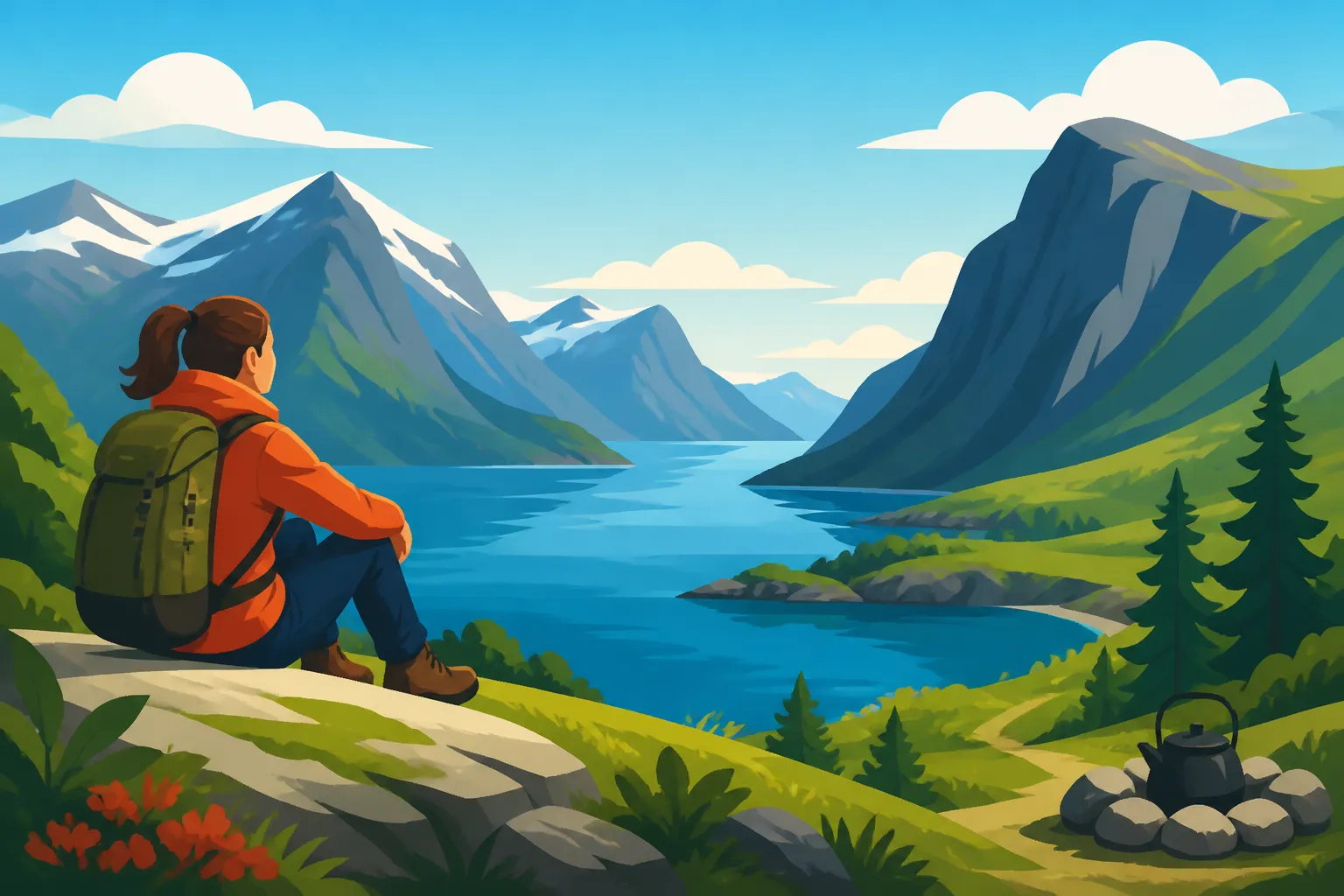
In many cultures, being outdoors is synonymous with "working out." You put on your expensive leggings, hit the trail at a sprint, and check your heart rate monitor. In Norway, Friluftsliv can be that, but it is just as likely to be a slow stroll with a thermos of coffee and a seat pad. It is about the "being" rather than the "doing." You will see families with toddlers slowly picking blueberries or elderly couples sitting on a log for an hour just watching the fog roll over a fjord.
The struggle for many of us coming from high-performance cultures is learning to slow down. If you are constantly looking for a gym in nature, you are missing the point. The goal is to reach a state where the outdoors feels like an extension of your living room. When you are looking for your first apartment through services like Spotahome, seasoned expats will tell you to prioritize proximity to the "marka" (the forest) over proximity to the trendiest bars. Being able to walk out your front door and be in the woods within ten minutes will do more for your mental health here than any happy hour ever could.
The Mental Health Connection
There is a reason Norway consistently ranks high on happiness scales despite the abysmal weather. Friluftsliv acts as a national antidepressant. When the "Mørketid" (the dark season) hits, the temptation to hunker down and never leave the house is overwhelming. However, the Norwegian philosophy dictates that you must go out anyway. The phrase "there is no such thing as bad weather, only bad clothing" isn't just a cliché; it is a survival strategy.
By forcing yourself into the elements, you break the cycle of seasonal affective disorder. You start to appreciate the subtle beauty of the blue hour or the way the snow muffles the sound of the city. As you're Coping with Seasonal Affective Disorder (SAD) in the Norwegian Winter, you will find that the more you lean into the outdoor lifestyle, the less the darkness feels like a prison and the more it feels like a cozy, quiet backdrop for your adventures.
Allemannsretten: The Legal Right to Roam
One of the most mind-blowing aspects of Norwegian society is Allemannsretten. This is the "Right to Roam," a traditional right that was codified into the Outdoor Recreation Act in 1957. It essentially gives everyone the right to access and enjoy the great outdoors, regardless of who owns the land. For those of us from countries where "Private Property" signs and barbed wire fences are the norm, this feels like a radical level of freedom.
Understanding Innmark vs Utmark
To use this right correctly, you have to understand the distinction between innmark (cultivated land) and utmark (uncultivated land). This is where most foreigners get into trouble. Innmark includes private gardens, farmyards, plowed fields, and hay meadows. You generally do not have a right to roam here, especially during the growing season. You must respect the privacy of homeowners and the livelihoods of farmers.
Utmark, on the other hand, is basically everything else: mountains, forests, moors, beaches, and lakes. This is your playground. In the utmark, you can walk, ski, and cycle to your heart's content. You can even pick wild berries, mushrooms, and flowers. However, there are nuances. For instance, in Northern Norway, there are specific rules about picking cloudberries, which are considered "Arctic Gold" and are often the private property of local landowners. Before you head out, it’s worth checking Allemannsretten: Where Can You Legally Pitch a Tent in Norway? to ensure you aren't inadvertently breaking a local bylaw.
The Rules of Engagement for Camping
The Right to Roam comes with significant responsibilities. You can pitch a tent or sleep under the stars in the utmark without asking for permission, provided you stay at least 150 meters away from the nearest inhabited house or cabin. This 150-meter rule is sacred. It ensures that while you enjoy nature, you aren't staring into someone’s kitchen window.
If you plan to stay in the same spot for more than two nights, you generally need the landowner's permission, except in the high mountains or very remote areas. Also, be mindful of the campfire ban. From April 15th to September 15th, lighting fires in or near forests is strictly prohibited due to wildfire risks. You can still use designated fire pits in some areas, but always check the local conditions. If you are venturing deep into the wilderness, having a reliable data connection via Airalo is essential so you can check the latest fire danger warnings and weather updates on your phone.
| Feature | Innmark (Cultivated) | Utmark (Uncultivated) |
|---|---|---|
| Access Rights | Restricted to roads/paths | Full access for walking/skiing |
| Camping | Not allowed without permission | Allowed (150m from buildings) |
| Berries/Flowers | Not allowed | Allowed (with some exceptions) |
| Cycling | Only on paths and roads | Allowed (except on certain trails) |
| Duration | N/A | Max 2 nights in one spot |
Seasonal Gear and the Art of Layering
If you try to do Friluftsliv in a cotton hoodie and denim jeans, you are going to have a miserable time. You might even put yourself in danger. The Norwegian weather is famously fickle; it can go from sunshine to a blizzard in twenty minutes. To embrace the outdoors like a local, you need to master the three-layer system.
The Three-Layer System
The base layer is the most important. In Norway, this means wool. Specifically, Merino wool. Cotton is your enemy because when it gets wet (from sweat or rain), it stays wet and pulls heat away from your body. You will see Norwegians of all ages wearing wool "long johns" from October through May. It’s so fundamental that you should check Where to Buy Affordable Winter Clothing in Norway before your first big hike.
The middle layer is for insulation—think fleece or a light down jacket. This traps air and keeps you warm. The outer layer is your "shell," which should be windproof and waterproof. This is your barrier against the elements. The beauty of this system is that you can add or remove layers as your activity level or the weather changes. When you are climbing a steep hill, you might strip down to your base layer. Once you reach the windy summit, you throw the shell back on.
Sourcing Gear Without Breaking the Bank
New outdoor gear in Norway is incredibly expensive. If you walk into a high-end store in downtown Oslo, you could easily spend 10,000 NOK on a single outfit. Most expats learn quickly that the best way to gear up is through the second-hand market.
Websites like Finn.no or apps like Tise are goldmines for "as-new" hiking boots, skis, and jackets. Since Norwegians are constantly upgrading their gear, the second-hand market is robust. Another tip is to shop at "Sport Outlet" stores or wait for the end-of-season sales. When you are settling in and Buying Second-Hand on Tise or Finn to Save Money, prioritize high-quality brands like Norrøna, Bergans, or Helly Hansen—they are designed specifically for the brutal Scandinavian climate and will last for a decade if cared for properly.
Navigation and the DNT Cabin Network
One of the coolest things about Norway is the infrastructure that supports Friluftsliv. You aren't just thrown into the woods and told to survive. There is a massive network of trails and cabins maintained by the Den Norske Turistforening (DNT), or the Norwegian Trekking Association. Joining the DNT is arguably the first thing any expat should do after getting their residence permit.
The Magic of DNT Cabins
The DNT maintains over 550 cabins across the country. They range from fully staffed lodges that serve three-course meals to "self-service" cabins where you use a standard DNT key to get in, chop your own wood, and cook food from a pantry. It is a system built entirely on trust. You fill out a form saying what you ate and how many nights you stayed, and they send you a bill later.
For a newcomer, staying in a DNT cabin is the ultimate way to experience Cabin Culture (Hyttekultur): Etiquette When Invited to a Norwegian Cabin. It teaches you the "rules of the mountain": always carry out your trash, always leave enough dry wood for the next guest, and always sign the guestbook. These cabins allow you to go on multi-day treks without having to carry a heavy tent and sleeping bag, making the wilderness accessible even if you aren't an elite athlete.
Digital Tools for the Wilderness
While paper maps are still recommended for safety, Norway has incredible digital resources. The app "UT.no" is the bible for hikers. It shows every trail, every DNT cabin, and provides real-time updates on trail conditions. You can plan your route, see the elevation gain, and even find suggestions for "family-friendly" walks nearby.
When you are out on these trails, having a local data plan is vital. While many trails are well-marked with red 'T's painted on rocks, it is easy to get turned around in the fog. Using an eSIM from Airalo ensures you have data to check your GPS coordinates or call for help if needed. Just remember that in deep valleys or high mountains, signal can be spotty, so always download your maps for offline use before you leave your house.
Cultural Nuances and Unwritten Rules
There is a specific social etiquette to Friluftsliv that can be baffling to outsiders. In the city, Norwegians are famously private and might avoid eye contact on the bus. But the moment they hit a hiking trail, they become the friendliest people on earth.
The Trail Greeting and the Matpakke
When you pass someone on a trail, it is customary to say "Hei" or "God tur!" (Have a good trip!). It is a small acknowledgment of your shared membership in the outdoor community. If you don't say hi, you will be seen as grumpy or rude. It is one of the few places in Norwegian society where small talk with strangers is not only accepted but expected.
Then there is the matpakke. This is the ubiquitous packed lunch, usually consisting of open-faced sandwiches separated by small sheets of wax paper (mellomleggspapir). A proper Friluftsliv matpakke often includes a "Kvikk Lunsj" (a chocolate bar similar to a Kit-Kat) and an orange. This is so culturally ingrained that the Kvikk Lunsj wrapper even has the "Mountain Code" printed on the inside. If you want to fit in, leave the fancy Tupperware at home and embrace the simple, brown-bread-and-cheese lifestyle.
Respecting the Quiet
While Norwegians are friendly on the trail, they value the silence of nature above all else. Playing loud music on a portable speaker while hiking is considered a major social sin. People go to the mountains to escape noise. Similarly, if you are staying in a DNT cabin, there is usually a "quiet hours" rule starting around 10:00 PM.
This respect for the environment extends to the "Leave No Trace" principle. You will rarely see litter on a Norwegian trail. If you see a piece of plastic, it is common practice to pick it up and carry it out. The goal is to leave the wilderness looking as if you were never there. If you are Hiking Trolltunga and Preikestolen Safely as a New Resident, you will see that the most respected hikers aren't the ones with the fastest times, but the ones who move through the landscape with the most care and least impact.
Challenges: Safety and the Reality of the Elements
I would be remiss if I didn't mention that Friluftsliv can be dangerous. Every year, tourists and even experienced locals have to be rescued from the mountains because they underestimated the conditions. The Norwegian wilderness is beautiful, but it is also unforgiving.
The Mountain Code (Fjellvettreglene)
To keep people safe, the Norwegian Red Cross and DNT developed the "Mountain Code." These are nine rules that everyone should memorize. They include things like "Plan your trip and inform others where you are going," "Adjust your planned route according to conditions," and "Don't be ashamed to turn back."
Turning back is the hardest part for many. You have spent money on a train ticket, you have hiked for four hours, and you are only 30 minutes from the summit—but the fog is rolling in and the temperature is dropping. The Norwegian way is to turn around. The mountain will still be there tomorrow. If you find yourself in a situation where you need help, knowing how Emergency Medical Care in Norway: 113, Legevakten, and Hospitals works is crucial, but prevention through the Mountain Code is your best defense.
Wildlife and Natural Risks
In most of Norway, the wildlife isn't a major threat. We have moose, which can be dangerous if you get between a mother and her calf, and the occasional lynx or wolf, though they are incredibly shy. The real "predator" in Norway is the terrain. Shifting rocks, hidden bogs, and icy patches are what cause the most injuries.
If you are moving to the far north, however, the rules change. Moving to Svalbard: Housing Crisis, Polar Bears, and Logistics involves a completely different set of safety protocols, including the requirement to carry a firearm for polar bear protection. For the mainland, though, your biggest concern will be ticks in the summer (which can carry Lyme disease or TBE) and the rapid onset of hypothermia if you get wet and windy. Always pack an emergency "space blanket" and an extra wool layer, even if the sun is shining when you start.
Healthcare Budgeting Disclaimer
This article provides general information about the Norwegian outdoor lifestyle and legal rights. While Friluftsliv is a healthy activity, it carries inherent risks. Always consult official resources like the Norwegian Trekking Association (DNT) or the Norwegian Red Cross for safety guidelines. The information regarding land rights is based on the Outdoor Recreation Act, but local variations may apply. For medical emergencies in the wilderness, always dial 113. For details on how medical costs are handled should an accident occur, refer to Healthcare Budgeting: The Frikort Exemption Card and User Fees.