Norwegian Public Schools vs International Schools: Making the Choice
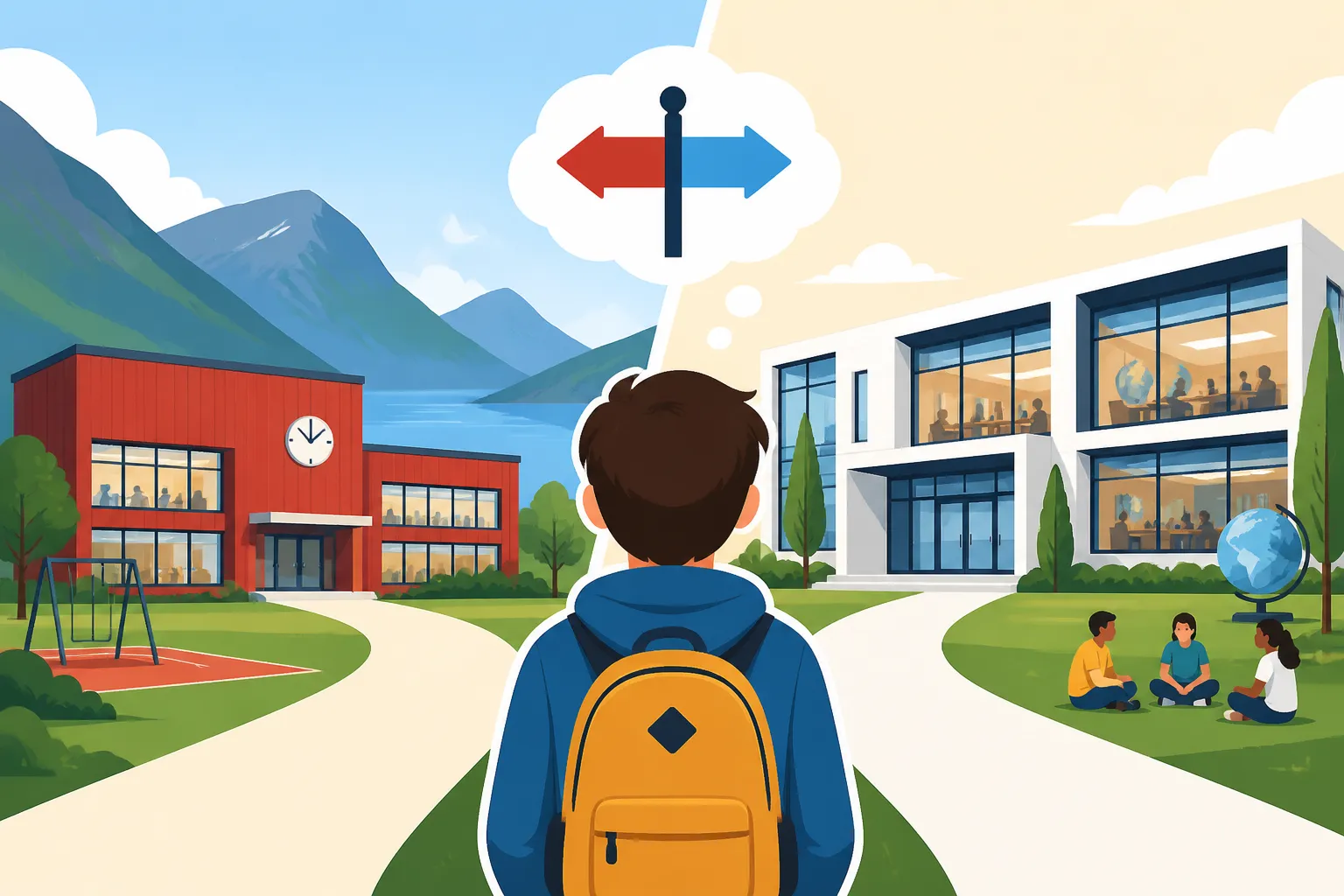
Moving to Norway with children adds a layer of administrative and emotional complexity that can feel overwhelming, especially when you are staring at a map of Oslo or Stavanger trying to decode the difference between a local "grunnskole" and an elite international academy. This guide dives deep into the realities of both systems to help you decide which educational path will truly help your family thrive in the Nordics.
The Norwegian Public School System Explained
The Norwegian public school system, often referred to as "Fellesskolen," is the bedrock of the country's egalitarian society. Most Norwegian children attend their local neighborhood school, and for many expats, this is the quickest route to true integration. The system is designed to provide equal opportunities regardless of a family's background, which means your child will rub shoulders with everyone from the children of diplomats to local tradespeople.
The Philosophy of Equality and Inclusion
In a Norwegian public school, you will immediately notice a lack of formal hierarchy. Children call teachers by their first names, and school uniforms are non-existent. The focus is heavily weighted toward social development, cooperation, and well-being rather than high-stakes testing in the early years. This can be a culture shock for parents coming from more competitive academic environments in the UK, US, or Asia. You might find yourself wondering when the "real" homework starts, only to realize that the school prioritizes "friluftsliv" (outdoor life) and emotional intelligence over rote memorization.
This philosophy extends to the "Dugnad" culture, where parents are expected to chip in for school events or neighborhood clean-ups. Engaging in these activities is often more important for your social standing in the community than your professional title. It is through these shared tasks that you will likely make your first local friends. Understanding Norwegian Work Culture: Flat Hierarchies and Communication Styles can actually help you navigate these parent-teacher interactions, as the same principles of consensus and equality apply in the classroom as they do in the office.
Language Immersion and the Innføringsklasse
If your children do not speak Norwegian, the public system offers a structured path called "Innføringsklasse" (introductory class). These are specialized groups within regular schools where children spend a significant portion of their day learning Norwegian in an intensive, supportive environment. Depending on the municipality, children might spend six months to a year in an introductory class before transitioning full-time into a standard classroom.
The success of this immersion often depends on the age of the child. Younger children in primary school (Barneskole) tend to pick up the language with startling speed, often becoming the family's primary translator within months. For teenagers, the transition can be more socially taxing, as they are navigating complex social hierarchies while simultaneously trying to master a new language. This is where parents often struggle, watching their once-confident teen become quiet. However, the long-term benefits of bilingualism and the ability to access higher education in Norway for free are significant motivators.
Practicalities: Registration, Zones, and the School Day
Public schools are governed by the "proximity principle," meaning your child is entitled to a spot at the school closest to your registered address in the National Registry. This makes your choice of housing incredibly important. Before you even sign a lease, you should verify which school district the property falls into. Many expats use services like Spotahome to find verified apartments in specific family-friendly neighborhoods, which allows them to secure a home near a highly-rated local school before they even land in the country.
The school day in Norway is relatively short, usually starting around 08:30 and ending by 13:30 or 14:00 for the younger grades. This is where the SFO comes in. You will need to budget for SFO (Skolefritidsordning): After-School Care Costs and Sign-Up, as it provides supervised play and activities until parents finish work. Registration for public school is handled through your local municipality (kommune), and you will generally need a national identity number to complete the process. If you are still waiting on paperwork, check D-Number vs Fødselsnummer: How It Affects Your Banking Options to understand how your residency status impacts these administrative hurdles.
The Reality of International Schools in Norway
International schools are the "safety net" for many expat families, providing a familiar curriculum and an English-speaking environment. In cities like Oslo, Stavanger, Bergen, and Trondheim, these schools serve a mix of short-term corporate transfers and long-term residents who want their children to maintain a global educational standard, such as the International Baccalaureate (IB).
The IB Curriculum and Global Academic Standards
Most international schools in Norway follow the IB Primary Years, Middle Years, or Diploma Programmes. This is a massive advantage if your career requires you to move every few years. A child can move from an international school in Singapore to one in Stavanger and find a nearly identical curriculum. This continuity reduces academic "gaps" and ensures that the child is prepared for universities worldwide.
However, the academic rigor can be a double-edged sword. While the students are often high-achieving, they may miss out on the local cultural nuances that their peers in public school experience daily. The pressure to perform can also be higher, as these schools often attract families with high academic expectations. If you are balancing a demanding job and settling in, having your child in a stable, predictable environment can be a relief. Using a digital SIM from a provider like Airalo can help you stay connected with your child's school apps and parent groups the moment you land, ensuring you don't miss those critical first-week updates while your local fiber internet is still being installed.
The Expat Bubble: Social Integration Challenges
The biggest critique of international schools in Norway is the "bubble" effect. Because the primary language of instruction is English, children (and parents) may find it difficult to break out of the expat circle. You might live in Norway for five years and never truly learn the language or make a close Norwegian friend if your entire social life revolves around the international school gates. This can lead to a sense of isolation once the initial "honeymoon phase" of moving abroad wears off.
For parents, the international school community is a lifeline. You will find people who understand exactly what it feels like to navigate BankID Explained: Norway's Digital Identity System and Expat Challenges or the frustrations of the UDI. These schools often have active parent-teacher associations that organize coffee mornings and excursions. While this is wonderful for support, it can sometimes delay your integration into the wider Norwegian society. It is a trade-off: immediate social comfort versus long-term local integration.
Tuition Fees and Admission Hurdles
Unlike public schools, international schools in Norway carry a price tag. While some are partially subsidized by the state and keep fees relatively low (around 30,000 to 40,000 NOK per year), others are fully private and can cost significantly more. For many skilled workers, these fees are covered as part of a relocation package. If you are paying out of pocket, you must factor this into your Cost of Living in Norway 2026: Budgeting for Singles and Families projections.
Admission is not guaranteed. Schools like the Oslo International School or the British International School of Stavanger often have waiting lists, especially for certain grade levels. It is common for schools to prioritize siblings of current students or children of employees at partner corporations. When planning your move, contact the admissions office as early as possible—even before your visa is finalized. Having a reliable data connection via Airalo while you are visiting schools for tours is essential, as you will likely be using maps and translation tools constantly to navigate the different campuses spread across the suburbs.
Key Differences: A Comparative Deep Dive
Choosing between these two paths requires a cold-eyed look at your family's long-term goals. Is this a three-year "adventure," or is Norway your forever home? The answer to that question should dictate your choice more than any brochure or ranking.
Language Acquisition vs. Comfort Zone
In a public school, your child will likely experience "the wall"—a period of 3 to 6 months where they feel frustrated and tired because their brain is working overtime to process a new language. It is heartbreaking to watch, but once they break through, they are essentially "local." They will speak Norwegian with a perfect local accent and understand the slang used on the playground.
In an international school, Norwegian is usually taught as a second language, often just a few hours a week. While they will learn basic phrases, they will rarely become fluent enough to navigate a purely Norwegian social setting. If you plan to apply for Norwegian Citizenship: Naturalization Laws, Dual Nationality, and Passports in the future, your children will have a much easier time if they have come through the public system, as their language skills will already meet or exceed the requirements.
After-School Care (SFO) and Extracurriculars
Norwegian culture places a massive emphasis on "Idrett" (sports) and outdoor activities. In the public system, the school day ends early, and children transition to SFO or local sports clubs. These clubs are usually run by volunteers and are highly localized. If your child plays football for the local "klubb," they will be playing with the same kids they sit next to in math class.
International schools often offer their own extracurricular programs on-site. This is convenient for working parents but further reinforces the bubble. It is common to see international school students being driven across the city for specialized activities, whereas public school kids tend to walk or bike to their local community center. This independence is a hallmark of Family Life in Norway: Daycare (Barnehage), Schools, and Kids' Activities, where "friluftsliv" starts with the simple act of walking home from school alone from the age of seven or eight.
Academic Rigor vs. Holistic Well-being
The Norwegian public system is famously relaxed about grades until the age of 13 (Ungdomsskole). There are no official grades in "Barneskole." The focus is on finding one's place in the group and developing a love for learning. For some expat parents, this feels like "lost time." They worry their child will fall behind their peers in their home country.
International schools maintain a more traditional academic focus. There are assessments, reports, and a clear trajectory toward university entrance. If your child is older (15+), putting them into a Norwegian public school can be risky if they intend to apply to competitive universities in the US or UK, as the Norwegian "Videregående" (high school) system is quite different and specialized. For younger children, the "holistic" approach of the public school is often seen by expats as a gift of a stress-free childhood.
| Feature | Norwegian Public School | International School |
|---|---|---|
| Cost | Free (except SFO fees) | 30,000 NOK to 200,000+ NOK/year |
| Language | Norwegian (Immersion) | English (Primary) |
| Curriculum | Norwegian National Curriculum | IB or National (UK/US/French) |
| Social Focus | Integration into local community | Integration into expat community |
| Commute | Usually walking distance | Often requires driving/long bus ride |
| Outdoor Life | High (Weekly "Tur" days) | Varies (Usually less than public) |
| Homework | Minimal in early years | Moderate to High |
Logistics and Living Near Schools
Where you choose to live will be the single biggest factor in your school experience. In Norway, your "poststed" (postal area) defines your school district, and there is very little room for "school shopping" within the public system.
Choosing a Neighborhood Based on Schooling
If you are leaning toward the public system, you should look for neighborhoods with a high density of families. In Oslo, areas like Nordstrand, Ullern, and Sagene are popular because of their excellent local schools. If you are looking at international schools, you will likely find yourself searching in the western suburbs of Oslo (like Bærum) or near the city centers of Stavanger and Bergen.
Using a platform like Spotahome allows you to filter for properties in these specific areas. Because you can view video tours and high-quality photos of the neighborhood, you can get a feel for the "walkability" to the local school before you arrive. This is crucial because many Norwegian families do not own two cars; being able to walk your child to school or SFO is a major quality-of-life factor.
Connectivity and Commuting
The commute to an international school can be a major drain on your time. While the public school is usually within a 10-minute walk, the international school might require a 30-minute train ride or a complex drive through morning traffic. If you are working in a role that requires you to be at your desk by 08:00, the logistics of school drop-off can become a nightmare.
Always check the Ruter (Oslo) or Skyss (Bergen) apps to see the public transport links between your potential home and the school. Having an active data plan from Airalo during your first month is a lifesaver here, as you will be constantly checking bus times and walking routes. Norwegian public transport is excellent, but it requires precision timing, especially in the winter when the snow might slow things down.
Financial and Administrative Considerations
Beyond the headline tuition figures, there are hidden costs and administrative tasks that can catch the unwary expat off guard.
Costs Beyond Tuition
In public schools, the hidden costs are mostly related to gear. You will need to buy high-quality wool layers, rain suits, and winter boots. There is a saying in Norway: "There is no such thing as bad weather, only bad clothing." You will also likely need to apply for Child Benefit (Barnetrygd): Applying via NAV as a Foreign Worker to help offset the costs of SFO and winter gear.
International schools often have additional fees for uniforms (if applicable), school trips, and extracurricular activities. Some also require a "capital levy" or a one-time enrollment fee that can be several thousand dollars. Make sure you read the fine print of the enrollment contract. If you are moving for a job, ensure your contract specifies whether these "extra" fees are covered.
Long-term Impact on Residency and Citizenship
If you plan to stay in Norway long-term, the public school system is objectively the better choice for your children's future residency rights. By the time they finish primary school, they will be fluent in the language and fully integrated into the social fabric. This makes the transition to Norwegian "Videregående" (Upper Secondary) seamless.
For those on a temporary assignment, the international school preserves the option to move back home or to another country without the child losing a year of schooling. It’s also worth noting that if you are here on a specific visa, such as a Skilled Worker Visa in Norway: Eligibility, Salary Thresholds, and Process, the stability of an international school can provide a sense of "normalcy" while you navigate the stresses of a new job and a new country.
Health and Medical Requirements for School
Before starting at any school, your child will need to be registered with a "Fastlege" (General Practitioner). The school will often require a record of vaccinations. If you haven't done this yet, read up on The Fastlege Scheme: Navigating Norway’s GP System to understand how to get your family into the medical registry.
Public schools have a "Helsesykepleier" (school nurse) who monitors the children's health, including hearing and vision tests. International schools often have similar facilities, but they may not be as integrated into the local municipal health service. Ensuring your child is covered by the National Insurance Scheme (Folketrygden): What Your 7.7% Contribution Covers is vital, as this ensures that any medical issues found during school screenings are treated for free (or for a small user fee).
Disclaimer
This guide is intended for informational purposes only and does not constitute legal or professional educational advice. School policies, admission requirements, and municipal regulations in Norway can change frequently. Readers are encouraged to contact the Norwegian Directorate for Education and Training (Utdanningsdirektoratet) or their local municipality (kommune) for the most current and specific information regarding school enrollment and regulations.