Garbage Sorting and Recycling Rules in Norwegian Municipalities
Standing in a Norwegian kitchen with a handful of yogurt tubs and a stack of colorful plastic bags is a rite of passage every expat undergoes. It feels like a high-stakes logic puzzle where one wrong move might earn you a stern look from a neighbor or a notification from the municipality. This guide simplifies the complex world of Norwegian recycling, ensuring you avoid confusion, stay environmentally compliant, and master the local systems effortlessly.
The Norwegian Philosophy of Waste Management
Coming from countries where "trash is just trash," the level of granular detail in Norway can be overwhelming. The Norwegian approach is built on the concept of kildesortering (sorting at the source). The idea is that waste is not a burden but a resource, provided it is separated correctly. If you have just arrived and are staying in temporary housing found through platforms like Spotahome, you might find that the infrastructure for sorting is already neatly integrated into the kitchen cabinets, reflecting how deeply this is ingrained in the culture.
The Variance Between Municipalities
One of the most frustrating aspects for newcomers is that recycling rules are not national; they are local. What applies in Oslo might be completely different in Bergen or a rural village in Lofoten. In Oslo, the system is famous for its "circular" logic using colored plastic bags that are sorted optically at a central plant. In other cities, like Stavanger or Trondheim, you might have four or five different outdoor bins, each with a specific colored lid.
Before you start throwing things away, you must identify which kommune (municipality) you live in. Each municipality has a dedicated agency, often called Renovasjonsetaten or a similar variation. They are responsible for the collection and processing of your waste. If you are moving frequently or just settling in, having a reliable data connection through a service like Airalo can be a lifesaver, allowing you to quickly look up your local municipality’s specific PDF guides or download their waste calendar apps while standing at the bins.
Understanding the Collection Calendar
Waste is not collected every day. In fact, different types of waste are often collected on different weeks. For example, your general waste might be picked up every week, while paper and plastic packaging are picked up every second or fourth week. Most municipalities offer a physical calendar, but the vast majority of residents now use apps like Min Renovasjon.
These apps allow you to enter your address and receive push notifications the night before a collection. This is vital because if you miss the "paper day," you might be stuck with a mountain of Amazon boxes for another month. For those who are still in the process of Setting Up Utilities: Electricity, Heating, Internet, and Mobile Plans, getting your waste schedule sorted should be high on your priority list to avoid a cluttered balcony or basement.
Decoding the Colors: How to Sort at Home
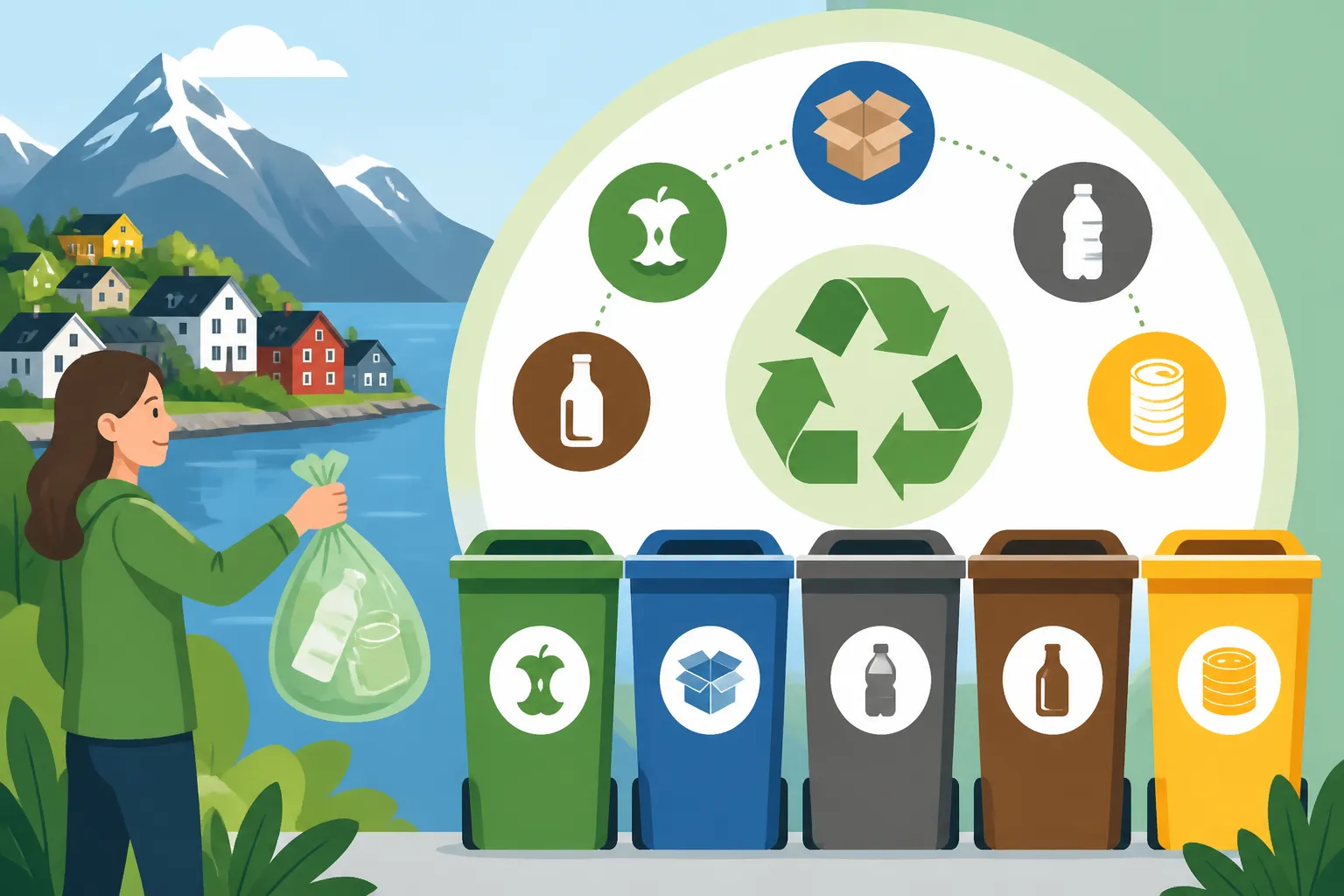
If you live in a municipality that uses the "bag system" (like Oslo), you will need to get used to the green, blue, and white bags. These are typically available for free at most supermarkets. You simply grab a roll from the dispensers near the exit or the fruit section.
Food Waste and the Green Bag
The green bag is strictly for food waste (matavfall). This includes fruit peels, coffee grounds, eggshells, and leftover dinner scraps. The logic here is that this waste is converted into biogas and bio-fertilizer. One of the biggest mistakes expats make is putting "biodegradable" plastic or nappies in the green bag. In Norway, if it didn't grow in the ground or come from an animal, it likely doesn't belong in the green bag.
The smell can be an issue, especially during the summer. Experienced expats suggest using a dedicated small bin with a lid under the sink and changing the green bag frequently. It is also helpful to let wet food waste drain a bit before tossing it in to prevent the bag from leaking. If you are currently Where to Live in Norway: Top Expat Neighborhoods in Oslo, Bergen, and Beyond, you will notice that modern apartment buildings often have specialized chutes for these bags, making the process much cleaner.
Plastic Packaging and the Blue Bag
The blue bag is for plastic packaging (plastemballasje). This is perhaps the most misunderstood category. It is only for plastic that has held food or products—think shampoo bottles, yogurt tubs, and the film over meat trays. It is not for hard plastics like toys, toothbrushes, or kitchen utensils. Those are considered "hard plastic" and must be taken to a recycling station.
A critical rule is that the plastic must be clean. You don't need to run it through the dishwasher, but a quick rinse with cold water and a swipe with a brush is expected. If the plastic is too greasy (like a bacon package), it’s often better to put it in the residual waste to avoid contaminating the recycling stream.
Residual Waste: The White Bag
Residual waste (restavfall) is for everything that cannot be recycled elsewhere. This includes diapers, vacuum cleaner bags, cigarette butts, and heavily soiled packaging. In the bag-based system, you use a regular plastic bag for this—often a white one or just a standard grocery bag.
While it might be tempting to use the residual waste bag as a "catch-all" when you are tired, the municipalities do perform spot checks. In some areas, bins with too much recyclable material in the residual section will simply not be emptied, and a "shame sticker" will be attached to your bin. If you are renting and want to stay on good terms with your landlord, mastering this is just as important as Understanding Hybel, Leilighet, and Kollektiv: Apartment Types Explained.
| Waste Type | Container/Bag Color | Common Items | Destination/Process |
|---|---|---|---|
| Food Waste | Green Bag | Coffee grounds, peels, leftovers | Biogas and Fertilizer |
| Plastic Packaging | Blue Bag | Yogurt cups, foil, bottles | New Plastic Products |
| Paper/Cardboard | Blue/Green Bin | Mail, boxes, cartons | Paper Pulp/New Paper |
| Glass/Metal | Shared Station | Jam jars, soda cans, foil | Smelting/Refining |
| Residual Waste | Plain/White Bag | Diapers, dust, hygiene items | Incineration/District Heating |
Specialized Recycling: Paper, Glass, and Metal
Not everything fits into a bag. Larger items and specific materials require a different approach. Paper and cardboard are usually collected in a separate, larger bin outside your home or in a communal area.
Paper, Cardboard, and Cartons
This category covers newspapers, magazines, cereal boxes, and the ubiquitous "drink cartons" (like milk or juice boxes). Norway has a unique "carton lottery" (Returkartonglotteriet). If you write your name and phone number on a rinsed and squashed milk carton and toss it in the paper recycling, you could win up to 100,000 NOK. It sounds like an expat myth, but it is real and serves as a great incentive to recycle.
Make sure to flatten all boxes. Space in the communal bins is often limited, and nothing irritates a Norwegian neighbor more than a bin filled with one large, unflattened IKEA box. This falls under the general social contract of What is "Dugnad"? Surviving Mandatory Community Volunteering, where everyone does their small part for the collective good.
Glass and Metal Packaging
Glass and metal packaging are rarely collected from your doorstep. Instead, you must take them to a gjenvinningsstasjon or a neighborhood collection point. These are often located near supermarkets or transport hubs. These containers are specifically for packaging. This means you can recycle your pasta sauce jar and your tuna tin, but you cannot recycle a broken drinking glass or a frying pan here.
Drinking glasses and porcelain are made of different materials that melt at different temperatures than packaging glass. If you toss a broken porcelain plate into the glass bin, it can ruin an entire batch of recycled glass. These specific rules are part of the "unwritten" Norwegian life that newcomers must learn, similar to the nuances of Norwegian Etiquette: Social Rules, Dugnad, and Making Local Friends.
Hazardous Waste and Electronics (EE-avfall)
Norway is very strict about hazardous waste. You should never throw batteries, lightbulbs, or old electronics into the regular trash. These items contain heavy metals and chemicals that can leak into the environment if not handled properly.
Managing Old Electronics and Batteries
The easiest way to recycle electronics (EE-avfall) is to take them back to a store that sells similar products. By law, any store selling electronics (like Elkjøp or Power) must accept your old ones for free, regardless of where you bought them. Small batteries can often be dropped off in dedicated tubes found at the entrance of most grocery stores.
If you are moving into a new place and find the previous tenant left behind old cables or a broken toaster, don't panic. You can easily find a nearby drop-off point. Using an eSIM from Airalo makes it easy to map out these locations on the go without worrying about roaming charges or finding Wi-Fi.
Large Recycling Centers (Gjenbruksstasjon)
For larger items—like a broken sofa, old paint cans, or wood scraps—you will need to visit a major recycling center (gjenbruksstasjon). Most residents have a "recycling map" or a quota of free deliveries per year. In Oslo, for example, you scan your "Oslonøkkelen" app or a physical card to enter.
These stations are incredibly organized. You drive through various zones, dropping off wood in one container, metal in another, and hazardous chemicals in a specialized "red box" area. If you are currently Buying Property in Norway: Bidding Wars, Mortgages, and Rules, you will likely visit these stations frequently as you renovate or clear out old sheds.
The Panting System: A Norwegian Success Story
One of the most satisfying parts of Norwegian recycling is the pantesystem. When you buy a bottle of soda or a can of beer, you pay a small deposit (usually 2 or 3 NOK). This is called pant. To get your money back, you take the empty containers to a panteautomat, a machine located at the entrance of almost every grocery store.
How to Use the Panteautomat
You simply feed the bottles and cans into the machine one by one. It scans the barcode and the shape to verify the deposit. Once finished, you press a button and receive a voucher that can be used as cash at the register or exchanged for actual money. There is also a "lottery" button on many machines where you can donate your deposit to the Red Cross for a chance to win a prize.
This system is so effective that Norway has some of the highest return rates for plastic bottles in the world. It is also a common sight to see people leave empty bottles on top of trash cans in the city so that those in need can collect the pant. For a more detailed breakdown, you might want to check out The Panting System: How to Return Bottles for Cash in Norway.
Deposit Values and Financial Benefits
While 2 NOK doesn't seem like much, it adds up. A typical family can easily gather 50–100 NOK worth of bottles over a few weeks. It is an excellent way to teach children about recycling and the value of money. If you are struggling with the Cost of Living in Norway 2026: Budgeting for Singles and Families, being diligent about your pant and using supermarket loyalty apps is a small but helpful way to manage your finances.
Practical Tips for New Residents
The learning curve for Norwegian recycling can be steep, but it becomes second nature within a few months. The key is to set up a system in your home that mimics the municipality’s requirements.
Sorting in Small Apartments
If you are living in a compact apartment, space for five different bags can be tight. Many expats use stackable bins from IKEA or specialized cabinets designed for waste. If you haven't found your permanent home yet, searching on Spotahome can help you find modern rentals that already have built-in sorting systems, which saves you the hassle of buying extra bins.
Another tip is to "process" your recycling as it comes in. Flatten cardboard immediately and rinse plastic jars as soon as they are empty. This prevents the "recycling corner" from becoming a mountain of chaos. If you are unsure about a specific item, most municipality websites have a search function where you can type in the item (e.g., "pizza box") and it will tell you exactly where it goes.
Avoiding Fines and Neighborly Disputes
In Norway, waste management is a community responsibility. If you live in a building with shared bins, your neighbors will notice if you consistently put the wrong things in the wrong places. While official fines are rare for individuals, they can be levied against a housing association (borettslag), which then results in higher monthly fees for everyone.
To avoid the "passive-aggressive note" on your door, take the time to read the labels on the bins. Most have English translations or clear icons. If you are moving out, be sure to follow the Moving Out Checklist: Cleaning Standards (Utvask) and Deposit Return to ensure that your landlord doesn't deduct cleaning or disposal fees from your deposit because of incorrectly sorted trash.
Summary of Best Practices
Recycling in Norway is less about "being perfect" and more about "being conscious." The system is designed to handle some errors, but the goal is to keep the streams as clean as possible.
- Always download your local waste app (Min Renovasjon).
- Get your green and blue bags for free at the supermarket.
- Rinse your plastic and metal packaging.
- Never put batteries or electronics in the regular trash.
- Use the pant system for all bottles and cans.
By following these rules, you contribute to one of the most efficient waste management systems in the world and settle more comfortably into your new life in the North.
Disclaimer
This guide is for informational purposes only. Waste management regulations and recycling rules in Norway are subject to change by local municipal authorities. While we strive to provide the most up-to-date information, you should always consult your local municipality's official website (Renovasjonsetaten) or waste management app for the most current rules and collection schedules specific to your address. The authors and publishers are not responsible for any fines or disputes resulting from the misinterpretation of local recycling laws.