Norwegian Hospitals: Inpatient Care, Outpatient Care, and Patient Choice
The moment you receive a referral for a hospital consultation in Norway, a wave of "administrative vertigo" usually sets in. I remember sitting in my living room in Bergen, clutching a letter from my doctor and wondering if I was about to be hit with a massive bill or lost in a labyrinth of Norwegian medical jargon. This guide demystifies exactly how Norwegian hospitals operate, from your rights as a patient to the nuances of staying overnight.
Understanding the Norwegian Hospital Landscape: Public vs. Private
The Norwegian healthcare system is built on the principle of universal access, but the way hospitals are structured can be confusing for newcomers. Most hospital care falls under the "Specialist Health Service" (Spesialisthelsetjenesten). These are not run by your local municipality but by four massive Regional Health Authorities: Helse Sør-Øst, Helse Vest, Helse Midt-Norge, and Helse Nord. When you enter a public hospital, you are entering a highly regulated, state-funded machine designed to provide high-quality care based on medical necessity rather than the size of your wallet.
While the public system is the backbone of the country, private hospitals like Aleris or Volvat exist alongside it. These private facilities often focus on elective surgeries, such as hip replacements or cosmetic procedures, and diagnostic imaging like MRIs. Many expats find that while the quality of care in public hospitals is world-class, the waiting times for non-urgent specialist care can be frustrating. This is where having supplemental coverage from a provider like Cigna Global can be a game-changer, as it allows you to bypass the public waiting lists and head straight to a private specialist.
It is important to realize that for life-threatening emergencies, the public system is your only destination. Private hospitals in Norway generally do not have emergency rooms (ERs) equipped for major trauma or acute cardiac events. For a deeper look at the foundational principles, you should read Healthcare in Norway for Expats: How the System Works (2027) to understand how your residency status impacts your access to these different tiers of care.
The Role of Regional Health Authorities
The Regional Health Authorities (RHFs) act as the "owners" of the hospitals in their respective geographic areas. Helse Sør-Øst is the largest, covering Oslo and the surrounding regions, and manages behemoths like Oslo University Hospital (Ullevål and Rikshospitalet). Each RHF is responsible for ensuring that the population in its region receives the necessary specialist health services. This regional structure is why you might find that waiting times for a specific surgery are shorter in Stavanger than in Oslo.
For expats, this means your "default" hospital is determined by where you live. However, the system is more flexible than it looks. If you are referred to a specialist, you aren't strictly tethered to the hospital closest to your house. Understanding this regional hierarchy helps you navigate the system when you want to exercise your right to choose a treatment location, a topic we will dive into later in this guide.
Public Hospitals and the "Specialist" Label
In Norway, "hospital" almost always refers to a public institution. These are centers of research and education where the most complex cases are handled. When your GP refers you to a specialist, they are referring you to the "Specialist Health Service." This could mean an appointment at a large hospital or a smaller specialized clinic that has a contract with the RHF.
The distinction is crucial because the billing remains the same whether the specialist is in a massive hospital ward or a smaller contracted clinic. You will pay a standardized user fee until you reach your annual limit. If you are a visitor or a digital nomad not yet registered in the national system, providers like SafetyWing offer specialized plans that cover these specialist visits, which can otherwise be quite expensive if paid entirely out-of-pocket without local insurance.
Private Hospitals: When to Step Outside the Public System
Private hospitals in Norway serve as a "relief valve" for the public system. They are popular for those who have insurance through their employer or those who choose to pay for speed. For example, if the public waiting list for a knee surgery is six months, a private clinic might see you in six days.
Expats often use private hospitals for quick diagnostic tests. If your GP thinks you need an ultrasound but the local hospital has a long queue, you can pay to have it done privately. This is a common strategy for those who want peace of mind quickly. For long-term residents, weighing the cost of private care versus the wait of public care is a constant calculation. You can find more details on this choice in our guide on Private Health Insurance in Norway: Is It Worth the Extra Cost? to see if it aligns with your lifestyle.
Inpatient Care: What to Expect When You’re Admitted
Being admitted as an inpatient (innlagt) in Norway can be a bit of a culture shock if you are used to the more "service-oriented" healthcare systems in the US or some parts of Asia. The Norwegian approach is clinical, efficient, and egalitarian. You won't find luxury suites here; instead, you’ll find high-tech equipment and staff who focus heavily on patient autonomy and early mobilization. I was surprised to find that even after a significant procedure, the nurses were encouraging me to walk to the "day room" for my own coffee almost immediately.
Inpatient care is divided into "acute" (akutt) and "elective" (planlagt). Acute admissions happen through the emergency department, known as the Akuttmottak. Elective admissions are scheduled weeks or months in advance following a referral. Regardless of how you get there, the "no-frills" nature of Norwegian wards is consistent. You are there to get well, and the system is designed to move you through the recovery process and back into your home environment as quickly as safely possible.
Admission and Triage Procedures
When you arrive for a scheduled admission, you will usually check in at a central reception before being directed to a specific ward (avdeling). The nurses will take your vitals and go through a series of standard questions. It is vital to have your BankID ready or your physical ID if you haven't set up digital services yet. If you are admitted via an emergency, you will go through "triage," where a nurse determines the urgency of your condition.
During an emergency admission, things move fast. You might find the staff to be very direct—this isn't a lack of politeness, but a focus on clinical efficiency. For those who are in Norway on a temporary basis, having a plan like SafetyWing is essential here, as the hospital will need to know who is covering the costs of your stay. For more on the initial steps of an emergency, refer to Emergency Medical Care in Norway: 113, Legevakten, and Hospitals.
The Hospital Ward Experience
Norwegian hospital rooms are usually shared, typically with two to four patients, although single rooms are becoming more common in newer facilities like the new hospital in Stavanger. The beds are high-tech, but the "hospital pajamas" (the white, slightly oversized cotton gowns) are a universal staple. One thing that surprises many is the "Hospital Hotel" (Sykehushotell). If you are well enough to not need constant nursing but still need to be close for tests or treatments, the hospital might put you up in a nearby hotel rather than a ward bed.
The food is typically traditional Norwegian "husmannskost"—think open-faced sandwiches (skiver) with brown cheese for breakfast and a hot meal like fish balls or stew for dinner. While it’s healthy, it can be a bit bland for international palates. Most wards have a "day room" (dagligstue) where patients are encouraged to sit, eat, and socialize, which is part of the philosophy that staying in bed too long slows down recovery.
Discharge and the "Hjem" Transition
Discharge (utskrivelse) in Norway is often a quick process. Once the doctor clears you, you are expected to head home. The hospital will send an "eprikrise" (discharge summary) to your GP so they are kept in the loop. If you need medications, you’ll receive a prescription—either a "white" or "blue" slip—which you can pick up at any pharmacy.
For many expats, the suddenness of discharge can feel overwhelming if you live alone. It is important to discuss your home situation with the social worker or nurse on the ward before you leave. They can help coordinate "Hjemmesykepleie" (home nursing) if you need help with wound care or medications. This transition is a core part of the system, and you can learn more about managing these costs in the guide on Healthcare Budgeting: The Frikort Exemption Card and User Fees.
| Feature | Public Inpatient Care | Private Inpatient Care |
|---|---|---|
| Cost | Free (Covered by Folketrygden) | High (Paid by insurance/Out-of-pocket) |
| Room Type | Usually shared or Hospital Hotel | Primarily private rooms |
| Waiting Time | Can be long for elective surgery | Usually very short |
| Emergency Care | Full 24/7 emergency facilities | Generally no emergency facilities |
| Referral Needed | Yes (from GP/Fastlege) | Yes, or direct consultation |
Outpatient Care and Specialist Consultations
Most hospital interactions in Norway actually happen in the "Poliklinikk" (outpatient clinic). This is where you go for specialist consultations, follow-up appointments, or minor procedures that don't require an overnight stay. If your GP suspects a thyroid issue or a heart murmur, they will send a referral to the outpatient department of your regional hospital.
The outpatient system is the gateway to specialist knowledge. You don't just "show up" at a hospital to see a specialist; the gatekeeper is always your GP. This is a source of frustration for many who are used to being able to book a cardiologist directly. However, once you are in the system, the outpatient care is thorough. You will be seen by a "Overlege" (Senior Consultant) or a "LIS-lege" (Doctor in specialization), and they will coordinate all necessary tests, from blood work to X-rays, usually within the same facility.
The Referral and Waiting Period
Once your GP sends a referral, the hospital has a legal obligation to "evaluate" it within a certain timeframe (usually 10 working days). They will decide if you have a right to "Necessary Health Care" and assign you a maximum waiting time. You will receive a letter—often digitally via Helsenorge—stating the date of your appointment or confirming that you are on the waiting list.
The wait can be anywhere from two weeks to six months, depending on the urgency. If you find the wait too long, this is a prime moment to look into private options or use your Cigna Global insurance to find a specialist who can see you sooner. For a detailed breakdown of how these queues are managed, check out Specialist Referrals in Norway: How the Waiting Times Work.
The Poliklinikk Visit
A visit to the poliklinikk is usually straightforward. You check in at a digital kiosk using your national ID number, pay the "egenandel" (user fee), and wait in a designated area. The appointments are often strictly timed, so it’s best to have a list of your questions and medications ready in Norwegian or English. Most Norwegian doctors speak excellent English, but if you are dealing with complex medical terminology, you can request a free interpreter in advance.
These visits are where the bulk of your medical "detective work" happens. If you require day surgery—procedures where you are anesthetized but go home the same day—this will also be managed through the outpatient department. For expats, navigating the digital side of this is essential, and you should read Using the Helsenorge App in English: A Step-by-Step Translation to make sure you don't miss any digital appointment notifications.
User Fees and Financial Limits
Unlike inpatient care, which is free at the point of service for residents, outpatient visits require a co-payment. This is typically around 350 to 400 NOK per consultation. These fees add up, but they are tracked automatically by the state. Once you hit the annual "Frikort" limit, all subsequent outpatient visits and hospital-prescribed medications are free for the rest of the calendar year.
This financial safety net is one of the best parts of the Norwegian system. It ensures that even if you have a chronic illness requiring dozens of specialist visits, your out-of-pocket costs are capped. You can find more about these specific limits in User Fees (Egenandel) for Doctor Visits Before Reaching Frikort Status.
Patient Choice (Fritt behandlingsvalg): Taking Control of Your Treatment
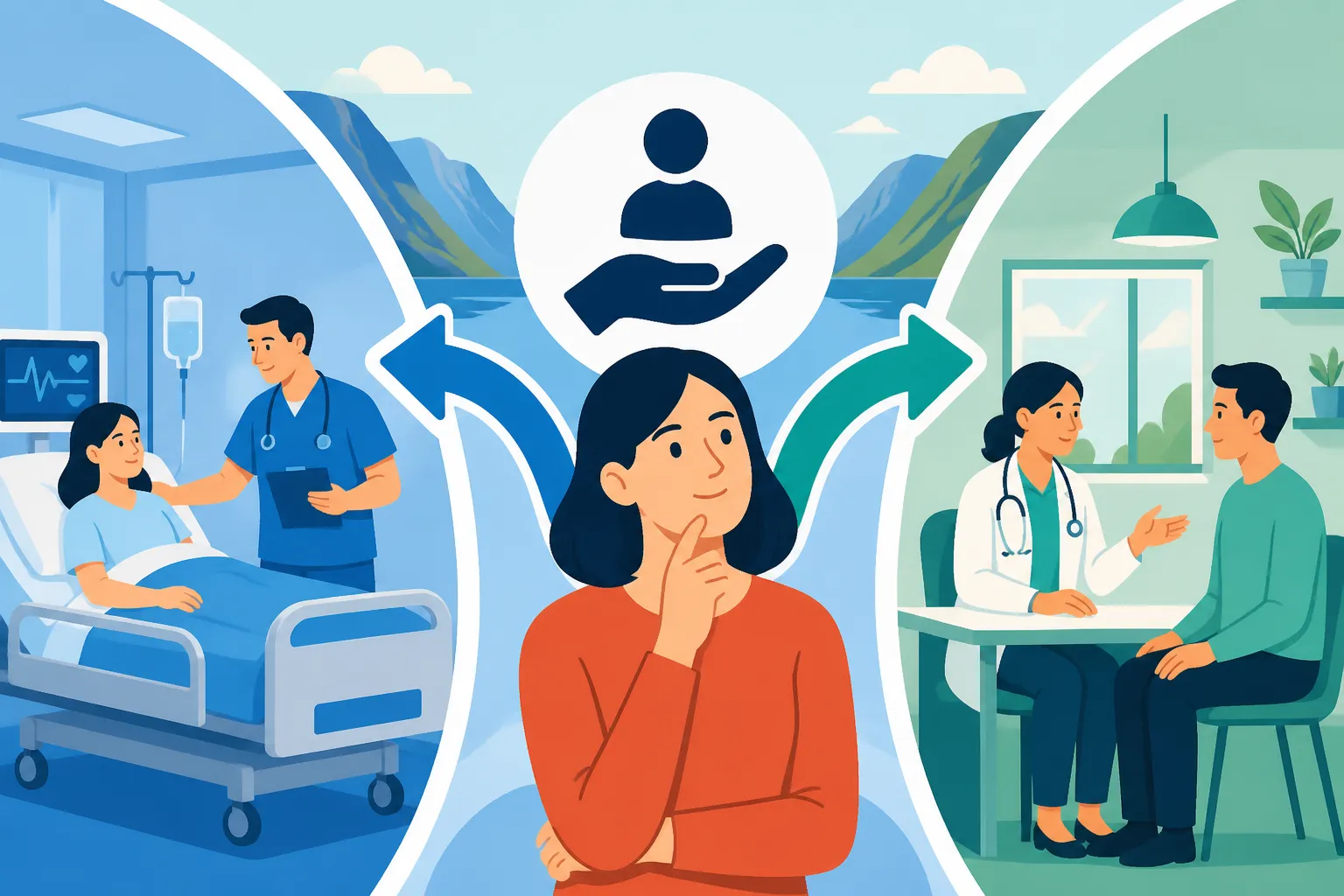
One of the best-kept secrets in the Norwegian healthcare system is the "Right to Choose a Treatment Location" (Fritt behandlingsvalg). Many expats assume that if their GP refers them to the local hospital in Drammen, they must go to Drammen. In reality, you have the right to choose any public hospital in Norway, and even some private clinics that have specific agreements with the state.
This right is designed to foster competition between hospitals and, more importantly, to give patients a way to find shorter waiting lists. If the queue for a cataract surgery is four months at your local hospital but only three weeks in a hospital two towns over, you can choose to go there. The medical treatment costs remain covered by the state, though you may have to pay a small standardized co-payment for travel expenses.
How to Use the "Velg Behandlingssted" Service
The primary tool for exercising this right is the website "Velg behandlingssted" (Choose a treatment location), accessible via the Helsenorge portal. Here, you can search for the specific procedure you need and see the current waiting times at every hospital in the country. It also provides quality indicators, such as the rate of post-operative infections or patient satisfaction scores.
When you find a location you prefer, you simply tell your GP, who then sends the referral to that specific hospital. If you’ve already been referred to one hospital, you can often request to have your referral moved to another. For a step-by-step on how to handle this specific process, our article Can I Choose Which Public Hospital Performs My Surgery? is a vital resource.
Travel Reimbursement (Pasientreiser)
If you choose a hospital that is far from your home, the state helps cover the cost of travel through a system called "Pasientreiser." Generally, you are reimbursed at a fixed rate per kilometer, regardless of how you travel, provided the distance is over a certain threshold. However, if you choose a hospital further away solely based on personal preference rather than waiting times, you may have to cover more of the travel costs yourself.
Navigating Pasientreiser involves filling out digital forms after your appointment. It can be a bit of a bureaucratic hurdle, but it makes the "Patient Choice" system accessible even if you don't have a car. This flexibility is a core right, and it’s worth exercising if you are facing a long wait that is impacting your quality of life.
Limitations of the Choice System
While you can choose where you get treated, you cannot choose who treats you. You are choosing the hospital or clinic, not a specific surgeon. Furthermore, the right to choose does not apply to emergency care. In an emergency, you are always taken to the nearest hospital capable of treating you.
Additionally, some highly specialized treatments (like organ transplants or specific rare cancers) are only performed at one or two "national centers of excellence." In these cases, your choice is limited because only one facility in Norway has the expertise and equipment required. If you feel that your rights are being restricted or you aren't being given the choices you deserve, you should look into Patient Rights: How to File a Complaint with the Health Authority.
Navigating Hospital Life as an Expat
The cultural nuances of Norwegian hospitals can be just as challenging as the medical issues. The system is built on a high degree of trust and "self-management." For example, don't be surprised if a doctor asks you, "What do you think we should do?" This isn't because they don't know; they are practicing shared decision-making. They expect you to be an active participant in your care.
Communication is the most common point of friction. While almost all staff speak English, the default language for paperwork, signage, and digital portals is Norwegian. If you are struggling, don't be afraid to ask for help. The hospital is legally required to provide an interpreter if you cannot communicate effectively with the medical staff. This service is free and can be provided in person or via video link.
Language and Cultural Expectations
In Norwegian culture, there is a concept called "flat hierarchy." This extends to the hospital. You will find that nurses, doctors, and cleaning staff interact quite casually. You are encouraged to ask questions, but also to follow the rules of the ward strictly. Efficiency is prized, and being five minutes late for an outpatient appointment can sometimes result in the appointment being cancelled and you being charged a "no-show" fee.
If you are someone who prefers a more "concierge" style of medicine with personalized attention and private suites, you might find the public system a bit jarring. This is another reason some expats keep a private policy from Cigna Global—it provides a bridge to private facilities where the service culture is more aligned with international private healthcare standards.
Preparing for Your Hospital Visit
Before you head to the hospital, make sure you have the following ready:
- A list of all medications and supplements you are currently taking.
- Your BankID (on your phone) to access Helsenorge and check into kiosks.
- Comfortable, easy-to-remove clothing.
- A pair of "in-house" shoes or slippers (Norwegians never wear outdoor shoes inside the ward).
- Chargers for your devices (Wi-Fi is usually free and high-speed in hospitals).
If you are still in your first few weeks in the country and haven't quite mastered the system, the guide The Fastlege Scheme: Navigating Norway’s GP System will help you understand how to get that crucial first referral that starts the whole process.
Support Systems and Families
Family involvement in Norwegian hospitals is encouraged, but there are strict visiting hours to ensure all patients get enough rest. In pediatric wards, one parent is always allowed (and expected) to stay with the child overnight. In adult wards, overnight stays for family members are usually only permitted in end-of-life situations or if the patient has special needs.
If you are a solo expat, it is worth building a small network of friends who can help with "dugnad" (community effort) by bringing you extra snacks or picking you up upon discharge. The system assumes you have a support network at home, so if you don't, you need to be vocal about it with the hospital staff early on.
Disclaimer
The information provided in this article is for informational purposes only and does not constitute medical or legal advice. While we strive to keep the details accurate and up-to-date for 2026, healthcare regulations and waiting times in Norway are subject to change. Always consult with your GP (Fastlege) or the official Helsenorge portal for the most current information regarding your specific medical situation. The mention of private insurance providers does not constitute an endorsement; please review all policy terms carefully before purchasing.