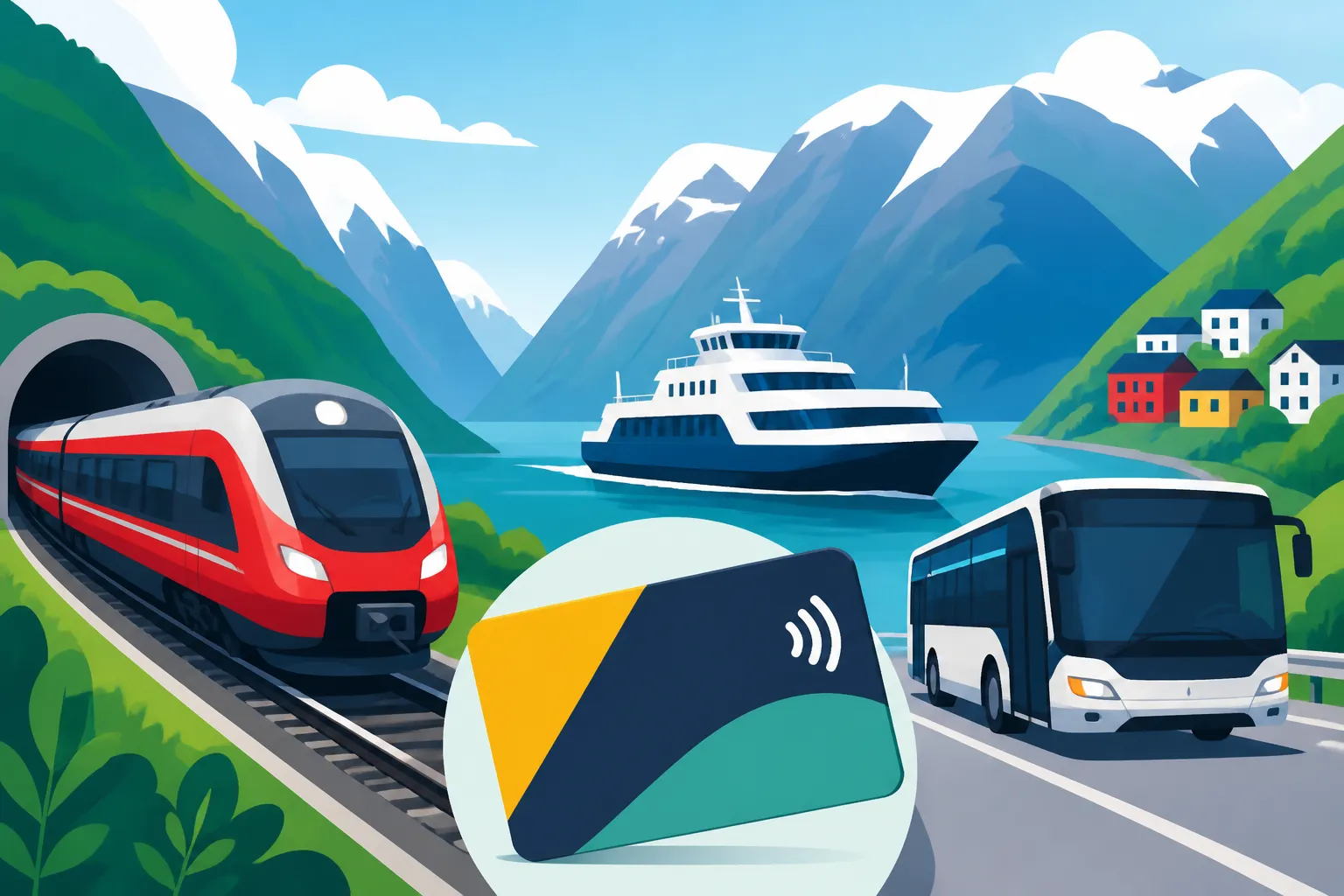
Transportation in Norway: Trains, Buses, Ferries, and Commuter Cards
Moving to Norway often comes with a steep logistical learning curve, especially when you realize that a 50-kilometer distance on a map can take three hours due to fjords and mountain passes. This guide serves as your comprehensive roadmap to mastering the Norwegian transit web, ensuring you can navigate everything from Oslo's subways to remote island ferries without the common newcomer's "analysis paralysis."
The Digital Backbone of Norwegian Transit
When I first arrived in Norway, I spent an embarrassing amount of time trying to find paper schedules at bus stops, only to realize that the entire country had moved into the digital age years ago. The most critical piece of advice I can give any expat or traveler is that your smartphone is your ticket, your timetable, and your navigator. Without reliable data, you are essentially stranded, which is why many veterans recommend setting up an e-SIM through a service like Airalo before you even clear customs. Having that immediate connectivity allows you to download the essential apps that keep the country moving.
The Power of Entur
Entur is the national "brain" of Norwegian transportation. It is a state-owned company that collects data from every single bus, train, ferry, and tram operator in the country. Before Entur, you had to check five different websites if you were traveling from, say, Stavanger up to a remote village in the north. Now, the Entur app provides a door-to-door itinerary. It tells you exactly which platform your train departs from and even shows you the real-time location of your bus on a map.
For those of us who have lived here for years, Entur is the first app we install on a new phone. It handles the complexity of the Norwegian landscape by calculating "transfer time" realistically—it knows that walking between a ferry terminal and a bus stop in a snowstorm takes longer than a sunny stroll in July. If you are trying to coordinate your arrival at a new apartment you found through Spotahome, using Entur to map out the exact walk from the nearest transit hub is a lifesaver.
Regional vs. National Apps
While Entur is the king of planning, you will often find that regional authorities have their own dedicated apps for ticketing. In Oslo and Akershus, you will become very familiar with Ruter. If you are moving to Bergen, you’ll be using Skyss, and in Trondheim, it’s AtB. This can be frustrating for foreigners who expect one unified payment system, but the regional apps often offer better local widgets and real-time alerts for specific neighborhood disruptions.
It is worth noting that while you can often buy tickets for most of Norway within the Entur app, local apps like Ruter frequently have exclusive "add-on" features, such as the ability to see how crowded a specific subway carriage is. When you are standing on a platform in the dark of a Norwegian winter, knowing that the next tram is only three minutes away and has plenty of seating can significantly lower your stress levels.
Why Digital-First Matters
Norway is rapidly becoming a cashless society. On many local buses, especially in rural areas, drivers are no longer allowed to handle cash for safety and efficiency reasons. If you board a bus without a pre-purchased digital ticket or a travel card, you might find yourself in an awkward confrontation or facing a heavy fine. This digital-first approach extends to almost every facet of life here, from How to Use the Ruter App for Oslo Public Transport to paying for a coffee at a mountain lodge.
The reliance on technology means you must keep your phone charged. Most newer buses and trains have USB charging ports, but the cold weather in Norway can drain a battery faster than you’d expect. Newcomers are often advised to carry a power bank, especially when traveling through the more mountainous regions where the search for a signal can also tax your device's energy.
Mastering the Norwegian Rail System
The Norwegian rail network is operated primarily by Vy (formerly NSB), though recent years have seen the introduction of SJ Nord and Go-Ahead Nordic on specific routes. For an expat, the train is often the most comfortable way to see the country, but it requires a bit of strategy to use affordably. The tracks wind through some of the most difficult terrain on earth, which makes for spectacular views but also occasional "Buss for Tog" (Bus for Train) situations during maintenance or extreme weather.
Long-Distance Travel and The Bergen Line
The crown jewel of the system is the Bergensbanen, connecting Oslo and Bergen. It is widely considered one of the most beautiful train journeys in the world, crossing the Hardangervidda plateau at over 1,200 meters above sea level. For residents, this isn't just a tourist excursion; it’s a vital link between the two largest cities. When booking these long-haul trips, you need to understand the Train Travel in Norway: Minipris Tickets and Seat Reservations system.
Minipris tickets are discounted, non-refundable fares that can save you hundreds of kroner if you book several weeks in advance. If you wait until the day of departure, you will pay the "Fullpris," which can be eye-watering. Many expats learn to plan their cross-country trips well in advance, often setting alerts for when the next block of Minipris tickets is released. These trains also offer "Pluss" seats, which include free coffee, snacks, and a quieter environment—well worth the extra 100-200 NOK on a seven-hour journey.
Local Commuter Trains
In the urban hubs around Oslo, Bergen, and Stavanger, commuter trains (L-lines and R-lines) function more like a high-speed subway. These are the lifeblood of the suburbs. If you are looking at housing on Spotahome and see a place in Asker or Lillestrøm, don't be deterred by the distance; the commuter trains are remarkably efficient. They run frequently and are integrated into the regional ticketing system, meaning your monthly bus pass often covers the train within certain zones.
However, be aware of the "Pendlere" (commuter) rush. Between 07:30 and 09:00, and again from 15:30 to 17:00, these trains are packed. Norwegians value their personal space, but during rush hour, even the most stoic local will squeeze in. Unlike some other countries, there is a very strict "let people off first" rule. Standing in front of the doors while people are trying to exit is the quickest way to earn a "Hjelpe meg" (God help me) sigh from a frustrated Norwegian.
Handling Delays and Maintenance
Because of the harsh climate, the rail network undergoes significant "Planlagt vedlikehold" (planned maintenance). This usually happens during Easter, Summer, or long weekends. During these times, the trains stop, and a fleet of buses takes over the route. While the transition is usually smooth and well-signposted, it can double your travel time. Always check the Vy app or Entur before heading to the station, especially if you have a flight to catch.
If a train is delayed by more than 30 minutes (60 minutes for long-distance), you are entitled to a partial refund of your ticket price. Many expats don't realize this and miss out on significant compensation. You can usually file these claims directly through the operator's website. It’s a small consolation when you’re stuck in a tunnel, but it shows that the system, while prone to the whims of nature, is built on a foundation of passenger rights.
The Versatile Bus Network
In many parts of Norway where the mountains are too steep for tracks, the bus is king. The network is divided between "Bybuss" (city buses) and "Ekspressbuss" (long-distance coaches). For those moving into residential areas, the local bus will likely be your most frequent mode of transport.
City Buses and the Zone System
Most major cities use a zone-based pricing model. Understanding Public Transport in Oslo (Ruter): Zones, Tickets, and Monthly Passes is the key to not overpaying. In Oslo, Zone 1 covers the vast majority of the city, but if you venture out to the forests or further suburbs, you might enter Zone 2 or 3. The beauty of the system is that your ticket is time-limited, not ride-limited. A standard ticket usually lasts for 60 minutes, allowing you to switch between buses, trams, and subways as many times as you need within that window.
Night buses (Nattbuss) are a specific quirk of the Norwegian system. In many cities, standard daytime tickets are valid on night buses, but some regions still charge a "night supplement." These buses primarily run on Friday and Saturday nights to get the "ut på byen" (night out) crowd home safely. They can be rowdy, but they are incredibly safe compared to many other major world cities.
Long-Haul Coaches and Nor-Way Bussekspress
For travel between regions not served by trains—such as the journey from Bergen to Stavanger or up into the fjords of Geiranger—the long-distance coach is your best bet. Nor-Way Bussekspress and Vy Express operate modern, comfortable coaches equipped with Wi-Fi, toilets, and often power outlets at every seat. To stay connected during these long rides, having an Airalo data plan ensures you can stream or work without relying on the often-spotty onboard Wi-Fi.
One thing that surprises many newcomers is the "ferry-bus" integration. On many coastal routes, the bus will actually drive onto a ferry. You are required to exit the bus and head to the passenger lounge during the crossing for safety reasons. It’s a fantastic way to stretch your legs and grab a "Svele" (a traditional Norwegian thick pancake) while watching the mountains glide by.
Rural Bus Challenges
In the far north or deep in the interior, buses might only run once or twice a day. In these areas, "Bestillingstransport" (on-demand transport) is common. You essentially have to "book" the bus via a phone call or app a few hours before you need it. If no one books it, the bus doesn't run. This can be a shock for those used to high-frequency urban transit. If you are relocating to a smaller municipality, your first task should be to learn the local bus cadence.
| Mode of Transport | Best For | Typical Cost (Short Trip) | Flexibility |
|---|---|---|---|
| Train (Vy/SJ) | Long-distance / Regional | 250 – 1200 NOK | Moderate (Fixed tracks) |
| City Bus (Ruter/Skyss) | Local commuting | 40 – 60 NOK | High (Frequent stops) |
| Express Bus | Inter-city (No rail) | 300 – 800 NOK | High (Extensive network) |
| Fast Ferry | Coastal city jumping | 150 – 500 NOK | Low (Weather dependent) |
| Car Ferry | Fjord crossings | 100 – 400 NOK | Essential for drivers |
Ferries and the Coastal Highway
Norway has the second-longest coastline in the world, and for thousands of people, a ferry is just a floating section of the highway. Whether you are a pedestrian or a driver, understanding the water-based transit system is essential for life on the west coast and in the north.
Commuter Ferries (Byferge)
In cities like Oslo, Bergen, and Fredrikstad, small passenger ferries act as extensions of the bus network. In Oslo, for example, the ferries to the islands in the Oslofjord depart from Aker Brygge and use the exact same Ruter ticket as the bus. It is one of the cheapest "cruises" you can take. If you find a summer rental on Spotahome near the waterfront, these ferries will likely be your primary way of getting to the city center.
These boats are remarkably punctual, but they are susceptible to ice in the winter and heavy fog in the autumn. During the summer, they are packed with locals heading to the beaches, so give yourself extra time if you’re trying to catch a specific crossing.
The Essential Fjord Crossings
Outside the cities, the large car ferries are vital. If you are Driving in Norway: Licenses, Winter Driving, and Electric Vehicles (EVs), you will eventually encounter a ferry quay. Most of these ferries now use "AutoPASS for ferje." A camera reads your license plate as you drive on, and the bill is sent to your registered account or deducted from your tag. You no longer have to wait for a ticket collector to walk to your window with a credit card machine.
For pedestrians, these ferries are often free or very cheap. There is a specific etiquette to follow: when the ferry arrives, wait for the cars to finish exiting before you walk onto the passenger gangway. Once on board, the cafeteria is the social hub. Even on a short 15-minute crossing, you’ll see locals rushing for their coffee and "lefse."
Hurtigruten and Havila: The Coastal Express
The legendary "Coastal Express" (Hurtigruten and the newer Havila Voyages) serves as both a cruise line for tourists and a vital lifeline for small towns along the coast. These ships stop at 34 ports between Bergen and Kirkenes. While a full 12-day cruise is expensive, you can book "port-to-port" tickets. This is a secret weapon for savvy expats who want to travel between, say, Trondheim and Tromsø with their car and a cabin, treating the transit as a mini-vacation.
The port-to-port service allows you to roll your car onto the ship in the evening, sleep in a comfortable cabin, and drive off in a completely different part of the country the next morning. It beats driving for 15 hours through narrow, snowy roads. Just be aware that these ships are working vessels; they will be loading and unloading pallets of fish and supplies at 3:00 AM, so don't expect total silence if your cabin is near the car deck.
Commuter Cards and Seasonal Passes
If you are using public transport more than three times a week, a single ticket is a waste of money. The Norwegian system is designed to reward frequent users through a variety of pass options.
The 30-Day Pass: Your Best Friend
The "Månedskort" (30-day pass) is the standard for almost everyone living in Norway. It usually pays for itself in about 10 to 12 round trips. Most regional apps allow you to buy this pass and keep it on your phone. If you are caught by a "Billettkontroll" (ticket inspection) and your phone is dead, you might be in trouble, so again, keep that battery charged. In Oslo, a 30-day pass for Zone 1 covers all buses, trams, subways, local trains, and even the ferries to the islands.
There is also a 365-day pass for those who are committed long-term, which offers a further discount. When you move, you can often "transfer" your remaining days to a new zone if your commute changes, though this sometimes requires a visit to a service center like the one at Oslo Central Station.
Student and Senior Discounts
Norway offers generous discounts for students (usually up to age 30, though this varies by region) and seniors (67+). To qualify for a student pass, you must be a full-time student and carry a valid student ID with a semester sticker or the "Studentbevis" app. For those Studying in Norway: Admissions, Visas, and Student Life, the student transit discount is one of the few things that will actually feel affordable in this country.
Seniors and those on certain disability benefits are entitled to "Honnør" tickets, which are 50% off the standard price. Unlike some countries, you don't always need a special card for this; your Norwegian ID showing your age is usually sufficient, though a specific "Honnørkort" from NAV is required for those under 67 who qualify.
The Corporate "Hjem-Jobb-Hjem" Schemes
Many large employers, especially in cities like Stavanger and Kristiansand, participate in the "Hjem-Jobb-Hjem" (Home-Work-Home) program. This is a subsidized transit pass that is significantly cheaper than a standard 30-day pass, provided your employer is a member. It's often paired with free access to city bikes. When you start a new job, always ask your HR department if they offer any "kollektivtransport" benefits. It’s a common perk that can save you thousands of kroner annually.
Traveling with Extras: Bicycles, Pets, and Kids
One of the best things about the Norwegian transit system is its inclusivity. Whether you have a toddler, a mountain bike, or a Golden Retriever, there is a place for you on the bus or train—though there are rules you must follow.
Bicycles on Transit
In a country that loves the outdoors, taking your bike on the train or ferry is common. However, on trains, you often have to book a "sykkelplass" (bike spot) in advance, especially on long-distance routes. On local buses and trams, it’s usually at the driver's discretion; if the bus is full of strollers, you might be told to wait for the next one. During rush hour, bikes are often prohibited to make room for commuters.
If you are Cycling in Norway: Helmet Laws and Winter Bike Tires, you'll find that many transit hubs have "Sykkelhotell" (bike hotels)—secure, indoor parking sheds that you can access via an app for a small monthly fee. This is a game-changer for avoiding bike theft and keeping your seat dry in the rain.
Bringing Pets Along
Norway is generally pet-friendly. On Ruter and most other regional systems, pets travel for free or for a child’s fare. On trains, there are designated "Pet Zones" (Dyr tillatt). You cannot bring a dog into the "Stille" (quiet) zone or the cafeteria. If you are allergic, look for the "Dyr ikke tillatt" (No animals allowed) carriages.
Always keep your dog on a short leash. Norwegians expect pets to be well-behaved and quiet on public transport. If your dog is barking incessantly, you may be asked to leave. Also, remember that during the winter, the salt used on the roads to melt ice can be painful for dogs' paws, so try to carry them across heavily salted areas near station entrances.
Strollers and Families
If you are traveling with a stroller (barnevogn), you usually travel for free on city buses and trams in many Norwegian cities (though you still need a ticket for yourself). There is a designated area in the middle of the bus for strollers. If that area is full (usually room for 2-3), the driver will not let you on.
Norwegians are very respectful of parents, but they also expect you to be efficient. Have your stroller brakes on the moment you are in position. On the T-bane (subway) in Oslo, the gap between the platform and the train can be significant at some older stations, so be prepared to lift. Most stations have elevators, though they can be hidden at the far ends of the platforms.
Practical Tips for the Daily Commute
Living here taught me that "waiting for the bus" is a skill in itself. From dealing with the dark to understanding the unwritten social rules, here is how to blend in.
The Art of the "Invisible" Queue
Norwegians do not queue in a straight line like the British. Instead, they form a "cloud" around the bus stop or platform. However, there is a mental order. People generally know who arrived first. When the doors open, there is a brief moment of negotiation. If you try to push ahead, you will receive some very sharp looks.
On the bus or train, the "empty seat rule" is sacred. If there is a double seat with one person in it, a Norwegian will almost always stand rather than sit next to a stranger, unless the bus is more than 80% full. If you must sit next to someone, a quick "Er det ledig?" (Is this seat free?) is the polite way to ask. Don't be surprised if they don't say anything and just move their bag; it’s not rudeness, it’s just the local way of preserving personal space.
Staying Visible in the Dark
From November to February, visibility is a major safety issue. If you are standing at a rural bus stop in the dark, the driver might literally not see you. It is essential to wear "Refleks" (reflective gear). Whether it’s a vest, a slap-wrap on your arm, or a dangling tag on your bag, it can save your life. Many expats forget this and wonder why the bus blew past them. In the dark, use the flashlight on your phone to wave at the bus as it approaches so the driver knows you’re there.
Connectivity on the Go
Because so much of the system relies on apps, having a steady internet connection is non-negotiable. While trains and express buses offer Wi-Fi, it often chokes when the train enters a tunnel or the bus moves between mountain valleys. This is where having a local SIM or an Airalo e-SIM becomes a practical necessity. It allows you to check for delays on the fly and update your landlord or employer if you’re running late.
| Item | Importance | Why? |
|---|---|---|
| Power Bank | High | Cold weather kills batteries; you need your digital ticket. |
| Refleks | Critical | Drivers cannot see you at stops for 4-5 months of the year. |
| Entur App | High | The only way to see integrated schedules across all companies. |
| Wool Socks | Moderate | Waiting on a platform at -10°C is brutal without them. |
| Airalo e-SIM | High | Essential for data-heavy transit apps and real-time maps. |
Handling Emergencies and Out-of-Hours Travel
What happens when things go wrong? Norway is safe, but being stranded in a blizzard or missing the last ferry of the night requires a plan.
Taxis and Ride-Sharing
Taxis in Norway (Drosje) are incredibly expensive. A 15-minute ride can easily cost 400-500 NOK. Uber and Bolt operate in Oslo and a few other cities, but they are not significantly cheaper than traditional taxis due to strict regulations. Most taxi companies have their own apps (like Oslo Taxi or Bergen Taxi), which are much more reliable than trying to hail one on the street.
If you are stuck, look for a "Taxiholdeplass" (taxi stand). In Norway, you are generally expected to take the first taxi in the line, regardless of the car model or company. If you have a large group or need a child seat, you can ask the handlers or use the app to request a specific vehicle.
Last-Mile Solutions: City Bikes and Scooters
In the summer, electric scooters (Voi, Tier, Ryde) are everywhere in the major cities. They are a great way to bridge the gap between a train station and your final destination. However, Norway has introduced strict laws: you cannot ride them if you have been drinking (same limit as a car), and they are often geofenced to slow down or stop in certain areas.
City bike schemes (Byykkel) are a more traditional and cheaper alternative. For a small annual fee, you can unlock bikes at stations all over the city. They are great for quick errands, but be warned—Norway is hilly. Unless you are in top physical shape, trying to bike up to some of the higher residential areas in Bergen or Oslo will be a struggle.
The "Buss for Tog" Strategy
As mentioned before, "Buss for Tog" is a common occurrence. If your train is replaced by a bus, follow the yellow signs at the station. There are usually "staff" in high-visibility vests directing people. These buses do not always stop at the exact station entrance; they might stop at a nearby main road. If you have a tight connection, always ask the staff which bus is the "ekspress" (direct to the destination) and which is the "lokal" (stops at every station).
Final Thoughts on the Norwegian Way of Travel
Navigating Norway's transit is less about memorizing maps and more about mastering the tools. Once you have your Airalo data set up, your Ruter or Entur app logged in, and your "Refleks" pinned to your coat, the system becomes remarkably predictable. It is a network built on trust, technology, and a deep respect for the challenging geography of the North. Whether you are commuting to a new job or exploring the fjords from a ferry deck, the journey is often just as beautiful as the destination.
Disclaimer
The information provided in this guide is for general informational purposes only and was accurate at the time of writing. Norwegian transportation laws, ticket prices, and routes are subject to frequent changes by regional authorities and private operators. Always check official sources like Entur, Vy, or the UDI before making significant travel or relocation plans. Use of third-party apps and services is at the user's own risk.