Ferry Etiquette: Driving Your Car onto Norwegian Ferries
Driving your car onto a Norwegian ferry for the first time can be a nerve-wracking experience, especially when you are faced with confusing lanes, silent payment systems, and the pressure of a loading deck. This guide provides a veteran expat’s perspective on mastering the "ferry dance," ensuring you understand the technical requirements, the unwritten social rules, and the logistics to navigate Norway’s coastal highways with total confidence.
The Modern Norwegian Ferry: A Silent Digital System
If you are looking for a ticket booth or a person standing at the dock to sell you a boarding pass, you are going to be waiting a long time. In recent years, Norway has almost entirely digitized its ferry payment systems. For a newcomer, this is one of the biggest culture shocks. You drive onto the boat, nobody asks for money, and you start to wonder if you have accidentally committed a crime. Rest assured, the cameras overhead have already scanned your license plate.
Most ferries in Norway operate on the AutoPASS system. This is the same system used for Toll Roads (Bompenger) Costs: Budgeting for Driving in Norway. If you have a tag in your car, the ferry crossing is automatically billed to your account. If you don't have a tag, the system will photograph your plate and send an invoice to the registered owner of the vehicle. However, for tourists or new expats who haven't yet settled into a permanent home via Renting in Norway: Apartments, Contracts, and Tenant Rights, this can lead to expensive administrative fees from rental companies.
To avoid these headaches, most veterans recommend signing up for FerryPay. This is a simple online portal where you register your credit card and license plate. Every time you cross a fjord, the exact amount is deducted without any extra fees. It is a seamless way to handle Transportation in Norway: Trains, Buses, Ferries, and Commuter Cards while you are exploring the coast.
Pre-Arrival: How to Not Miss Your Boat
Norwegian ferries are famously punctual. If the schedule says the boat leaves at 10:15, the ramp is usually lifting at 10:14 and 45 seconds. Relying on Google Maps alone is a rookie mistake. The local topography can interfere with GPS signals, and ferry times can change due to weather or seasonal shifts.
It is wise to download the specific regional apps like Entur or the apps for major operators like Fjord1 and Norled. This is where having reliable data is crucial. If you are a tourist or a new arrival without a local SIM yet, using a service like Airalo to grab an eSIM ensures you can check real-time ferry capacities and delays while sitting in a remote mountain pass. Without a connection from Airalo, you might find yourself waiting two hours for the next crossing because the previous one was cancelled due to high winds.
When you arrive at the quay (ferjekai), you will see numbered lanes. Usually, there are signs indicating which lane is for which destination, as some docks serve multiple routes. If you are driving an electric vehicle, you might be looking for a priority lane. While EVs get a significant discount on the price, they generally wait in the same queue as everyone else unless specified. Knowing this is part of understanding Driving in Norway: Licenses, Winter Driving, and Electric Vehicles (EVs).
The Boarding Process: Following the Yellow Vests
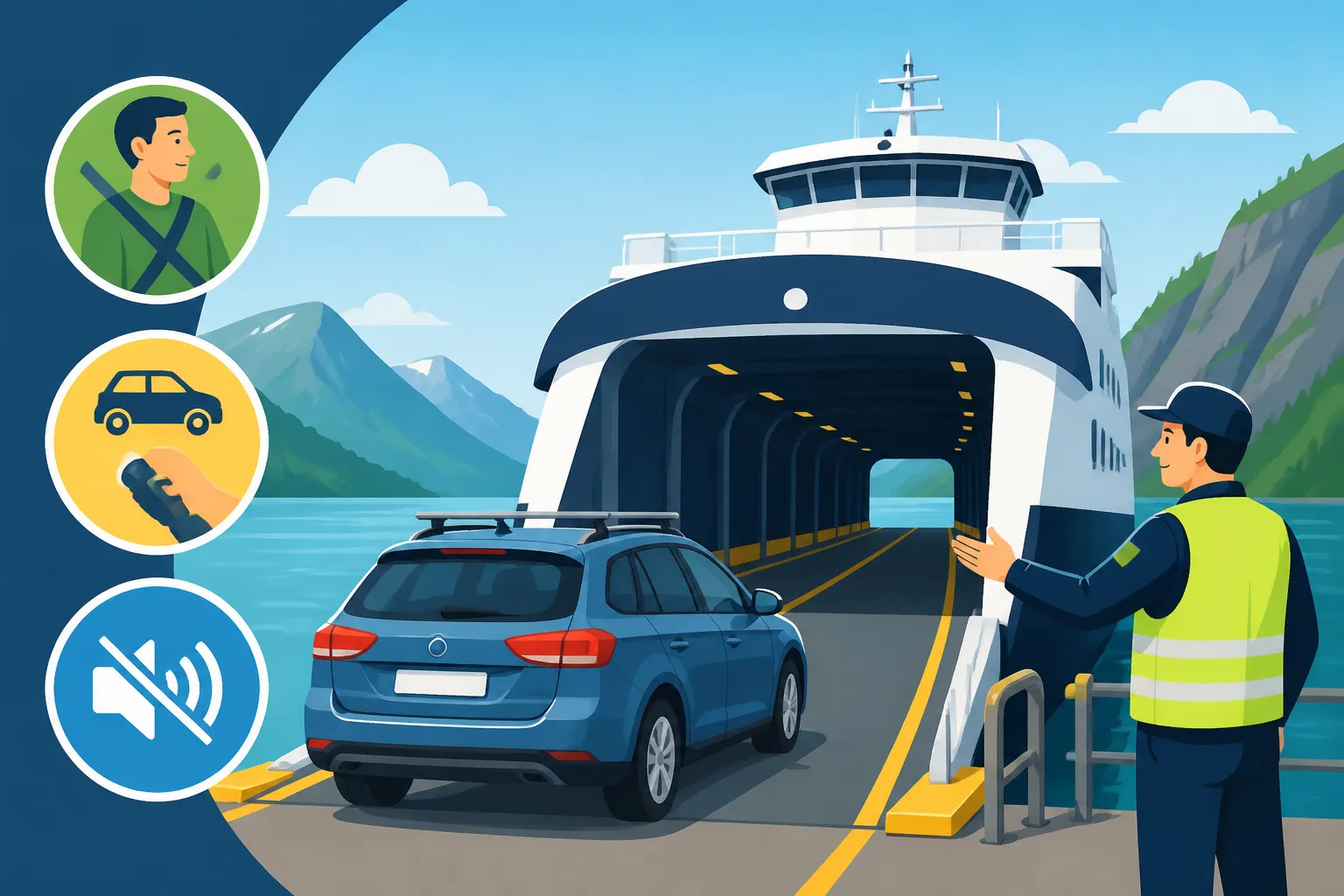
Once the ferry arrives and the incoming cars have exited, the deckhands—usually wearing bright yellow or orange vests—will signal you to board. These individuals are the absolute bosses of the deck. Do not try to be "helpful" by picking your own spot. They are balancing the weight of a massive vessel, and they will point exactly where they want you.
Drive slowly. The metal ramps can be slippery, especially in the winter when you are dealing with Winter Tires (Piggdekk vs Piggfrie): Legal Dates and Rules. Once you are on the deck, pull up as close to the car in front of you as the deckhand indicates. Space is a premium. If you leave a three-meter gap, you are taking up a spot that could have belonged to another traveler, which is a major breach of Norwegian etiquette.
Once parked:
- Put the car in gear (or Park for automatics).
- Engage the handbrake firmly. This is non-negotiable; the fjord can get choppy.
- Turn off your alarm. The motion of the ship often triggers car alarms, which is incredibly annoying for people trying to enjoy their coffee in the lounge above.
- Note which door you used to exit the car deck. On larger ferries, it is easy to get lost.
Life on the Passenger Deck: The Svele Tradition
In many cultures, a ferry is just a floating bus. In Norway, it is a social institution. As soon as the car engines stop, there is a collective scramble for the stairs. This isn't just about getting a good seat; it's about the food.
Every Norwegian ferry worth its salt serves "svele." This is a thick, folded pancake that is traditionally served with either "brunost" (brown cheese) or a sweet buttercream spread. If you want to feel like a local, go to the galley, order a coffee and a svele with buttercream, and sit by the window. It is the quintessential Norwegian travel experience.
While you are up there, you can use the time to check your next destination or look for long-term accommodation options on Spotahome if you are planning to stay in coastal cities like Bergen or Ålesund. Since the ferry rides can last anywhere from 10 to 45 minutes, it’s a perfect window to handle administrative tasks. I’ve actually spent many ferry crossings browsing Spotahome listings to help friends find apartments in Stavanger while watching the mountains glide by.
Understanding the Logistics and Costs
The cost of a ferry is determined by the length of the vehicle. A standard passenger car under 6 meters is the baseline. If you are towing a trailer or driving a large motorhome, the price jumps significantly. This is why many expats choose smaller cars for coastal living.
| Feature | AutoPASS Tag | FerryPay (No Tag) | Payment on Board |
|---|---|---|---|
| Discount | 50% (with prepayment) | 0% (Standard rate) | Usually not possible |
| Ease of Use | Automatic | Automatic after setup | High stress / Impossible |
| Billing | Monthly Invoice | Immediate Card Charge | N/A |
| Requirement | Physical Tag + Account | Online Registration | N/A |
For those planning to live here long-term, getting the AutoPASS for Ferry (Ferjekonto) is a must. You deposit a lump sum (usually around 3,000 NOK), and in exchange, you get a 50% discount on almost every crossing. If you are commuting, this saves you thousands of kroner over the year. It’s one of the first things I tell people to do, right alongside understanding Owning a Car in Norway: Insurance, EU Inspections (EU-kontroll), and Tolls.
Etiquette and Social Norms on the Water
Norwegians value peace and personal space. Even on a crowded ferry, you will notice the lounge remains relatively quiet. If you are traveling with a group, keep the volume down. If you brought your dog, check the signs; most ferries have a designated "pet zone" or require dogs to stay in the car (provided the temperature is safe).
Another crucial point is the "return to car" signal. About five minutes before the ferry docks, an announcement will be made over the loudspeaker. Usually, it’s just a short sentence in Norwegian, but you will see everyone suddenly stand up and head for the exits. Follow them. Nothing stalls a ferry offloading faster than a driver who is still upstairs finishing their coffee while the ramp is down.
When you get back to your car, do not start the engine immediately. Wait until the cars in front of you actually start moving. Filling a closed car deck with exhaust fumes is frowned upon and often dangerous for the staff working down there. It is all part of the broader sense of Norwegian Etiquette: Social Rules, Dugnad, and Making Local Friends.
Special Considerations: EVs and Winter Travel
If you are driving an electric vehicle, you should know that you still pay for the ferry, but the rate is capped at 50% of the price of a petrol car. However, you still need to pay the full price for the passengers in some cases (though many ferries now only charge for the vehicle regardless of the number of occupants).
Winter travel brings its own set of challenges. The ramps can be icy, and the transition from the salt-slush of the road to the metal deck can be slippery. If you are not used to Surviving the Norwegian Winter: Clothing, Heating, and Mørketid (Dark Season), take the boarding process extra slowly. Make sure your headlights are off while you are parked so you don't blind the drivers behind you or the deckhands.
If you find yourself stuck in a remote area because of a missed connection, don't panic. Most ferry docks have a small heated waiting room. This is where your Airalo connection becomes your best friend again, allowing you to update your arrival time for your Airbnb or your Spotahome viewing without having to hunt for a non-existent public Wi-Fi signal in the middle of a fjord.
Common Mistakes to Avoid
The biggest mistake is ignoring the lane numbers. When the ferry arrived, the deckhand skipped him entirely, and he had to wait for the next boat. Always double-check the signs at the entrance to the quay.
Another error is forgetting to check the "Last Departure" time. On smaller routes, the ferry might stop running at 9:00 PM or 10:00 PM. If you are relying on a ferry to get to your hotel, and you miss the last one, you might be looking at a four-hour detour around the mountains. Always have a backup plan, especially when navigating the more rugged parts of the country.
Finally, keep your AutoPASS tag updated. If your credit card expires and your AutoPASS account goes into the negative, you lose your 50% discount immediately. It’s a small administrative task that can save you a lot of money, much like keeping track of your Electric Car Chargers: Using Apps like Fortum, Mer, and Circle K accounts.
Summary Checklist for Your First Ferry Trip
- Register for FerryPay or ensure your AutoPASS tag is active before you leave.
- Download a regional transport app to check live schedules.
- Arrive 10-15 minutes early, especially during the summer tourist season.
- Follow the deckhand's hand signals precisely when boarding.
- Turn off your car alarm and head to the lounge for a svele.
- Return to your vehicle promptly when the announcement is made.
Disclaimer
The information provided in this guide is based on the author's personal experience and current Norwegian regulations as of 2026. Ferry operators, payment systems, and prices can change. Always check the official website of the ferry operator (e.g., Fjord1, Norled, Torghatten) or the Norwegian Public Roads Administration (Statens Vegvesen) for the most up-to-date rules and rates.