Internet Providers in Norway: Fiber Optics and 5G Home Broadband
Moving into a new apartment in Oslo, Bergen, or a remote fjord-side cabin usually comes with the same immediate frustration: staring at a wall socket you don't recognize and realizing your lack of a Norwegian personal number means you might be offline for weeks. This guide solves the complex puzzle of choosing between fiber optics and 5G home broadband, navigating the administrative "BankID gatekeeper," and ensuring you stay connected from the moment you land.
Understanding the Norwegian Internet Infrastructure
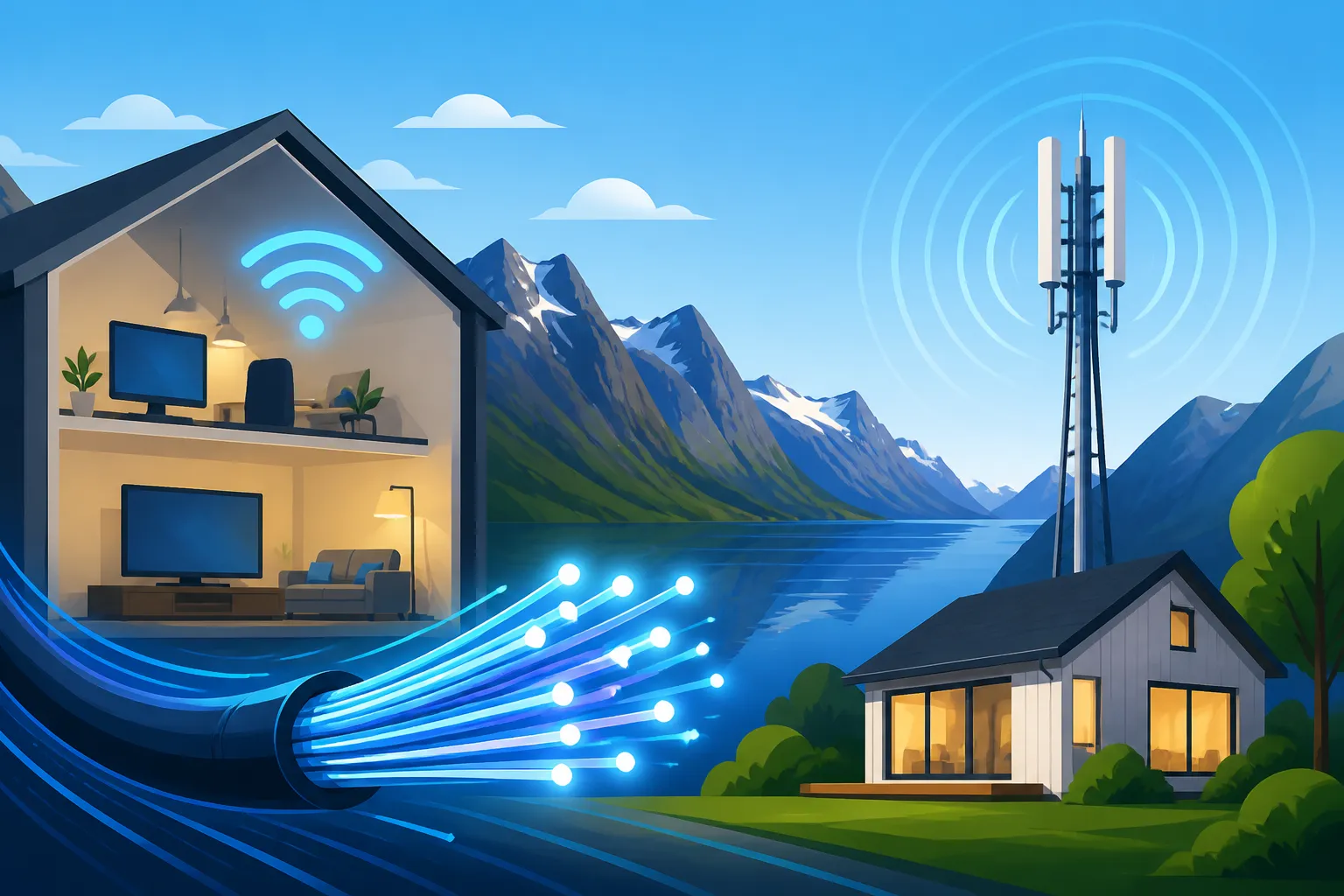
Norway consistently ranks among the top countries globally for internet speed and infrastructure. However, as an expat, you will quickly learn that "availability" and "access" are two very different things. The country is currently in the final stages of phasing out its legacy copper (DSL) network, meaning your choices are almost exclusively high-speed fiber or the rapidly expanding 5G Fixed Wireless Access (FWA).
Fiber Optics (Fiberbredbånd)
Fiber is the gold standard for anyone planning a long-term stay. Most modern apartment buildings in urban centers are already wired for fiber, often through collective agreements. If you are looking at Renting in Norway: Apartments, Contracts, and Tenant Rights, you should always ask if the building has a collective fiber contract. In these cases, the cost is often included in your monthly "felleskostnader" (common costs), and you simply need to plug in a router.
Fiber offers symmetrical speeds, meaning your upload speed is just as fast as your download speed. This is crucial if you are working remotely and frequently uploading large files or participating in high-definition video calls. The stability of fiber is unmatched, unaffected by the heavy snow or coastal winds that can sometimes interfere with wireless signals in the more rugged parts of the country.
5G Fixed Wireless Access (Trådløst Bredbånd)
For those living in older detached houses or areas where digging trenches for fiber is geographically impossible, 5G Home Broadband (Trådløst Bredbånd) has become the primary solution. This technology uses the 5G mobile network to beam high-speed internet to an antenna installed on the outside of your house.
The beauty of 5G FWA is the speed of deployment. While fiber installation can take weeks if a technician needs to visit, 5G can often be set up within a few days. For expats who used Spotahome to find a flexible mid-term rental, 5G FWA is often the easiest way to get high-speed access without waiting for a landlord to approve major structural work or drilling. It provides a "plug-and-play" experience that is far superior to old-school 4G connections.
The Hybrid Landscape of Coax (Kabel-TV)
In some older city blocks, you might still find internet delivered via coaxial cable (the same cable used for traditional TV). While providers like Telia have upgraded much of this to the DOCSIS 3.1 standard, which can theoretically rival fiber speeds, it is fundamentally an asymmetrical technology. You might get 500 Mbps down but only 50 Mbps up. For most users, this is perfectly fine, but it is a distinction worth noting when comparing "high-speed" offers on provider websites.
The Major Players: Who Rules the Norwegian Web
The Norwegian market is dominated by a few massive players and a network of regional specialists. Choosing a provider often depends more on your specific address than on the brand itself, as many regions are served by "natural monopolies" where only one fiber provider has laid cables.
Telenor: The State-Owned Giant
Telenor is the legacy incumbent and remains the largest provider in the country. They have the most extensive infrastructure and offer a seamless transition between mobile and home internet services. Telenor’s customer service is generally regarded as robust, and the company offers excellent English-language support.
Telenor’s "Always Online" guarantee is a specific feature worth considering; if your fiber goes down, they will give you a significant data boost on your Telenor mobile subscription to keep you connected. However, you will likely pay a premium for this reliability. Their packages are rarely the cheapest on the market, but their coverage in the northern regions and rural valleys is often the only viable option.
Telia: The Aggressive Challenger
Telia is the primary competitor to Telenor and has invested heavily in its 5G network. They are often more aggressive with their pricing and "welcome offers" for new residents. If you are trying to figure out Setting Up Utilities: Electricity, Heating, Internet, and Mobile Plans, Telia often offers attractive bundles that include mobile data, home internet, and a TV streaming package (Telia Play).
One major advantage of Telia is their focus on 5G Home Broadband. If fiber isn't available at your address, Telia’s 5G solution is frequently rated as one of the fastest in the country. They also tend to have a slightly more modern digital interface, making it easier to manage your account through their app.
Altibox: The Regional Powerhouse
Altibox is unique because it isn't a single company but a partnership of many local utility and fiber companies (like Lyse in Stavanger or Viken Fiber in Oslo). They consistently win awards for customer satisfaction in Norway. The "Altibox model" involves local ownership of the physical fiber, which often leads to faster technician response times if something breaks.
If your apartment building is an Altibox partner, you are in luck. Their "Model 1" or "Model 2" collective agreements are incredibly cost-effective. However, be aware that Altibox is strictly a fiber provider; they do not offer the same 5G FWA alternatives that Telenor or Telia do.
The Logistics of Installation and Administrative Hurdles
The most significant shock for a new arrival is that you cannot simply walk into a store and buy a high-speed internet contract with just a passport and cash. The system is built around your digital identity.
The BankID and D-Number Requirement
In Norway, your digital life revolves around BankID. Without it, signing an internet contract online is nearly impossible. Most ISP websites will require you to log in with BankID to verify your creditworthiness and address. If you are still waiting for your permanent ID number, you should read BankID Explained: Norway's Digital Identity System and Expat Challenges to understand why this is such a bottleneck.
If you only have a D-Number, you may need to visit a physical Telenor or Telia store in a shopping mall. You will need to show your residence permit and employment contract. Be prepared for them to ask for a deposit, sometimes ranging from 1,000 to 5,000 NOK, because you lack a Norwegian credit history. This is a common hurdle, and while frustrating, it is standard practice.
The Physical Installation Process
If your home is already "fiber-ready," you will receive a "Hjemmesentral" (home center/modem) in the mail. You plug it into the fiber point in the wall, and you're good to go. However, if the house has never had fiber, or if you are switching from a different network, a technician visit is required.
In Norway, technician appointments are notoriously difficult to get on short notice. It is not uncommon to wait 10 to 14 days for a slot. During this gap, many expats rely on temporary mobile data. If you don't have a local SIM yet, using a service like Airalo to get an eSIM with a few gigabytes of data can be a lifesaver for those first few days of navigating Google Maps and Finn.no Masterclass: How to Navigate Norway’s Biggest Housing Site to find furniture.
| Provider Type | Common Names | Best For | Typical Setup Time |
|---|---|---|---|
| National Fiber | Telenor, Telia | Reliability and Bundling | 1-2 weeks |
| Regional Fiber | Altibox, GlobalConnect | Customer Satisfaction | 1-2 weeks |
| 5G Home Broadband | Telenor, Telia, Chili | Speed of Deployment | 3-5 days |
| Budget/DSL | NextGenTel | Low-cost seekers (where available) | 2 weeks |
Cost Analysis and Comparative Value
Internet in Norway is not cheap. You are paying for a high standard of service and infrastructure that can withstand extreme weather.
Pricing Tiers and Speed Brackets
A standard 100/100 Mbps fiber connection will typically cost between 600 NOK and 800 NOK per month. If you want "Gigabit" internet (1,000 Mbps), expect to pay upwards of 1,200 NOK.
For 5G Home Broadband, the pricing is usually based on the speed rather than the data volume. Most providers offer a "Basic" (25 Mbps), "Standard" (100 Mbps), and "Max" (up to 500 Mbps) tier. Unlike mobile phone plans, home 5G usually has no data cap, or a very high "fair use" cap (typically 2 Terabytes), which is more than enough for a family streaming 4K video all month.
Bundling with TV Services
Almost every major provider will try to sell you a "Point-based" TV system. Instead of getting specific channels, you get 50 or 60 "points" that you can use to "buy" streaming services like HBO Max, Viaplay, or specific sports channels. You can swap these points every month. If you are a fan of Norwegian winter sports or want to improve your language skills by watching local news, these bundles can be a good value. However, if you only watch Netflix or YouTube, it is usually cheaper to insist on an "Internet Only" (kun internett) package, even though the ISPs hide these options deep in their websites.
Hidden Costs and Contract Pitfalls to Avoid
The advertised price is rarely the final price you will see on your first bill. As an expat, you need to look specifically for the "Etableringsgebyr" (establishment fee).
Binding Periods (Bindingstid)
Most "welcome offers" come with a 12-month binding period. If you are on a Skilled Worker visa and aren't sure where you'll be in six months, be very careful. Breaking a contract early can result in a fine of 3,000 NOK or more. If you think you might move soon, it is better to pay a higher monthly rate for a "løpende" (ongoing) contract with no binding period.
When you move within Norway, you can usually take your contract with you to your new address for a small fee, provided the same ISP serves that area. This is a common way to avoid early termination fees. You can find more about the logistics of moving in our Moving Out Checklist: Cleaning Standards and Deposit Return.
Router Rentals and Equipment Deposits
Most Norwegian ISPs "lend" you the router. If you cancel your service, you must return the router by mail (using a pre-paid label) or you will be charged an "equipment fee" which can be quite steep. Many expats leave the country and forget to return their Telenor router, only to find a 2,000 NOK collection notice in their email months later. Always keep the receipt from the Posten (post office) when you return equipment.
Solutions for Temporary Residents and New Arrivals
If you are only in Norway for a few months, or if you are living in a "hybel" (a small studio or room in a house), you might not want to sign a formal utility contract.
Mobile Hotspots and Unlimited Data
In recent years, mobile providers like Ice and Chili Mobil have started offering "Unlimited" mobile data plans for around 400-500 NOK per month. If you have a decent 5G signal in your room, you can simply use your phone as a hotspot or buy a small 5G travel router. This bypasses the need for a technician and often works with a D-Number vs Fødselsnummer: How It Affects Your Banking Options.
This is also a great strategy if you are living in a Svalbard Digital Nomad Route: Living in the Arctic Without a Visa scenario, where local infrastructure can be very specific to your housing provider.
Short-term Rental Connectivity
If you are using a platform like Spotahome to book your first month’s stay, the internet is almost always included and functioning the moment you walk in. This allows you the breathing room to get your Fødselsnummer and BankID sorted before you try to sign a contract for your long-term apartment.
Always check the "WiFi speed" in the listing description. In Norway, "High-Speed Internet" usually means 100 Mbps+, but in some historic wooden buildings in Bergen, the thick walls can make the WiFi signal weak in certain rooms. Bringing a long ethernet cable or a simple WiFi extender in your suitcase is a "pro-tip" for any veteran expat.
Checking Availability Before You Sign a Lease
Before you sign a rental contract for that dream apartment, go to the website of a major provider like Telenor or Altibox and type the address into their "Can I get fiber?" search bar. If the result says "Only 5G Home Broadband available," and you are a professional gamer or a video editor, you might want to reconsider that specific property.
The availability of fiber can even vary between different floors of the same building. Being proactive about this check will save you the heartbreak of moving into a beautiful home only to realize you’re stuck with a 10 Mbps connection because the copper lines were cut and the 5G signal is blocked by a nearby hill.
Healthcare and Safety Note for Technical Issues
While not a direct internet issue, remember that in Norway, many emergency services and health portals are accessed via the internet. If your home internet is down, ensure you have a mobile backup. You will need a working connection to access The Helsenorge App: Navigating Your Health Online or to book appointments. Never rely 100% on a single point of connectivity in a country where so much of the administrative infrastructure is digital-first.
Disclaimer
The information provided in this guide is for informational purposes only. Internet service providers in Norway frequently update their pricing, terms of service, and infrastructure availability. Always verify specific contract details, binding periods, and technical requirements directly with the provider before signing any agreement. Costs and availability may vary significantly based on your specific geographical location and residential status in Norway.