Healthcare Rights for D-Number Holders: Exclusions and Alternatives
Waiting for your 11-digit national identity number feels like being trapped in administrative purgatory while your health hangs in the balance. I remember sitting in my first apartment in Bergen with a persistent sinus infection, clutching my D-number letter and realizing that the seamless digital world of Norwegian healthcare was effectively closed to me. This guide breaks down exactly what healthcare rights you have—and which ones you don't—while holding a D-number in Norway.
The Identity Gap: D-Number vs. Fødselsnummer in the Health System
The fundamental hurdle of living in Norway as a temporary resident or a new arrival is the distinction between the D-number (temporary) and the Fødselsnummer (permanent). While both allow you to pay taxes and work, the health system treats them very differently. Understanding this distinction is the first step in managing your expectations and your medical needs during your first few months in the country.
What the D-Number Represents to Helsenorge
A D-number is assigned to individuals who plan to stay in Norway for less than six months, or as a stop-gap measure for those waiting for their permanent identity number to be processed. From a healthcare perspective, the D-number often acts as a "guest pass." You are in the system, but you are not fully integrated into the digital infrastructure that makes the Norwegian system so efficient for locals.
When you log into the Helsenorge portal with a D-number, you will quickly find that many features are grayed out or unavailable. This is because the D-Number vs Fødselsnummer: How It Affects Your Banking Options and your medical access are tied to the level of "electronic ID" you can obtain. Without a permanent number, getting the highest level of BankID is difficult, which in turn limits your ability to see your own medical records or communicate digitally with doctors.
The Residency Requirement for Full Coverage
To be fully covered by the National Insurance Scheme (Folketrygden) and have the same rights as a Norwegian citizen, you generally need to be a resident. Residency is legally defined by the intent to stay for at least 12 months. If you are here on a D-number, the system often assumes you are a short-term visitor.
This creates a "limbo" period. If you are working and paying National Insurance contributions from your first day, you are technically a member of the scheme. However, the administrative machinery used to assign a primary doctor (Fastlege) often requires that permanent 11-digit number. I spent four months paying into the system before I was actually allowed to pick a doctor, a frustration I know many of you are feeling right now. It is essential to understand Folketrygden Basics: Who is Covered by the National Insurance Scheme to know where you stand legally, even if the digital portals say otherwise.
The Emotional Toll of Being "Temporary"
There is a psychological weight to not having a permanent ID in Norway. You feel like a secondary resident. When you go to a pharmacy and they struggle to find your "white" prescription because your D-number doesn't sync correctly with their system, it's easy to feel unwelcome. Validating this frustration is important: the system is not designed to be difficult, but it is optimized for permanent residents. For those in this transition phase, having a backup plan like SafetyWing can provide a much-needed safety net when the public system feels like it’s stalling.
The Fastlege Problem: Can You Actually Get a GP?
The biggest shock for most expats is realizing that holding a D-number usually means you do not have a Fastlege (General Practitioner). In Norway, the Fastlege is the gatekeeper to everything—specialists, non-emergency hospital care, and long-term prescriptions. Without one, you are effectively "doctor-less" in the eyes of the public system.
Why D-Number Holders Are Excluded from the List
The primary reason for this exclusion is capacity. The Fastlege Scheme: Navigating Norway’s GP System is already under immense pressure, with many lists being completely full. The government prioritizes permanent residents for these spots. If you only have a D-number, the system views your stay as too short to justify taking up a spot on a permanent list.
This means you cannot go to the Helsenorge website and click "Change Fastlege." For many, this is where the panic sets in. If you have a chronic condition that requires regular monitoring, being without a GP is more than an inconvenience; it’s a health risk. You will need to rely on the Legevakten (116 117): When and How to Use the Out-of-Hours Service or private clinics, which can be significantly more expensive.
Exceptions for Workers and EU Citizens
There is a small silver lining. If you are an EU/EEA citizen working in Norway, or if you are a non-EU worker with a contract longer than six months, you may still have a right to a Fastlege even while your permanent number is pending. However, you often have to fight for it.
You may need to manually contact Helfo (the Norwegian Health Economics Administration) to prove your employment and your intent to stay. Even then, the process is manual and slow. I have seen colleagues spend hours on the phone with Helfo just to get their D-number manually entered into a doctor's database. If you find yourself in this position, be prepared to provide your employment contract and proof of tax deduction.
Navigating Life Without a Primary Doctor
If you cannot get a Fastlege, your primary route for non-emergency care is through private providers like Dr.Dropin or Volvat. These clinics are excellent and often have English-speaking staff, but they operate outside the subsidized public system. You will pay the full price for a consultation, which can range from 600 NOK to 1500 NOK.
For those who are used to "free" healthcare, this is a bitter pill to swallow. This is why many veteran expats recommend maintaining international coverage such as Cigna Global during your first year. It ensures that if you need a specialist or more than a basic consultation, you aren't stuck paying thousands of kroner out of pocket while waiting for the state to recognize your permanent residency.
Emergency Care and Legevakten: Your Only Public Route
Just because you don't have a GP doesn't mean you will be left to suffer in an emergency. Norway's emergency medical system is robust and available to everyone, regardless of their ID status. However, knowing how to use it correctly is vital to avoid massive bills and long wait times.
Using the 116 117 Number
If you get sick or injured outside of normal business hours, or if you don't have a GP to call during the day, you call 116 117. This is the number for the Legevakt (emergency clinic). As a D-number holder, this will be your main point of contact for the public system.
When you call, you will be triaged by a nurse. Be honest about your symptoms, but also mention that you do not have a Fastlege. They are used to dealing with tourists and temporary workers. If your situation is not a life-threatening emergency but requires a doctor's eyes, they will give you a time to show up. Be aware that Emergency Room Waiting Times: Triage Rules at Norwegian Hospitals apply here, and if your case isn't urgent, you might be waiting for several hours in a very sterile waiting room.
Hospital Admissions and Life-Threatening Emergencies
In a true life-or-death situation, you call 113. The ambulance and immediate life-saving care in a public hospital are generally provided regardless of your status. The paramedics aren't going to check if you have an 11-digit number before they start CPR.
However, the "billing" part happens afterward. If you are a member of the National Insurance Scheme through your work, the costs should be covered. If you are a tourist or a temporary visitor without insurance, the hospital may send a substantial bill to your home address. This is another area where Healthcare Rights for D-Number Holders: Exclusions and Alternatives become clear: the care is guaranteed, but the "free" aspect is not.
The Role of Triage for Non-Permanent Residents
At the Legevakt, you will be categorized based on the severity of your condition.
- Red: Immediate life-threatening.
- Yellow: Urgent, but not immediately life-threatening.
- Green: Not urgent (this is where most "I don't have a GP" visits end up).
If you are "Green," you are at the bottom of the pile. As a D-number holder, you must develop patience. You are essentially using an emergency system for primary care, which is never a fast process in Norway.
| Service Type | D-Number Access | Fødselsnummer Access | Cost Implications |
|---|---|---|---|
| Fastlege (GP) | Rare / Manual Request | Guaranteed | Subsidized (User Fee) |
| Legevakt | Full Access | Full Access | Full Access (Can be higher) |
| Specialist Referral | Very Difficult | Standard Process | Full price without GP |
| Helsenorge App | Limited (No BankID) | Full Access | N/A |
| Hospital Care | Emergency Only | Full Access | Subsidized for Residents |
Costs, User Fees, and the Financial Reality
One of the most misunderstood parts of the Norwegian system is that it isn't entirely free. Everyone pays a "user fee" (egenandel) for consultations, labs, and some medications. For D-number holders, these fees can behave quite differently.
Egenandel vs. Full Payment
If you have a D-number and are working, you are typically entitled to pay the subsidized rate (the egenandel) at public facilities. This is usually around 160–300 NOK for a visit. However, because you aren't in the "system" in the same way, some clinics might default to charging you the "uninsured" rate if they can't verify your status quickly.
Always keep your receipts. If you are overcharged, you can apply for a refund through Helfo once your status is settled. This is a tedious process, but it’s worth it if you end up having to see a doctor multiple times. Understanding User Fees (Egenandel) for Doctor Visits Before Reaching Frikort Status is crucial because, as a D-number holder, you might find it harder to track your progress toward the "free" threshold.
The Frikort (Exemption Card) Hurdle
In Norway, once you pay a certain amount in user fees (about 3,165 NOK in 2026), you get a "frikort" which makes all further public healthcare free for the rest of the calendar year. For permanent residents, this happens automatically. The system tracks their 11-digit number at every pharmacy and clinic.
For you, with a D-number, the "automatic" part often breaks. The system may not link your different visits together correctly, especially if one clinic used your D-number and another used your name and date of birth. You might have to manually prove you've reached the limit. It’s frustrating, and people can end up paying double the limit simply because they didn't realize they had to manually claim their exemption. You should check Is the Frikort Issued Automatically or Do I Have to Apply? to see the latest rules for temporary residents.
Private Clinic Pricing
If you choose to bypass the public struggle and go to a private clinic like Volvat or Aleris, the price is transparent but high. You are looking at:
- General consultation: 1,200 NOK+
- Specialist (Dermatologist/Gynecologist): 2,000 NOK+
- Blood tests: 500 NOK+
While this is expensive, it is often the only way to get a quick referral for something like an MRI or a specialist consultation. If you try to get a specialist referral through the public system without a GP, you are essentially knocking on a locked door.
Private Healthcare Alternatives and Gap Coverage
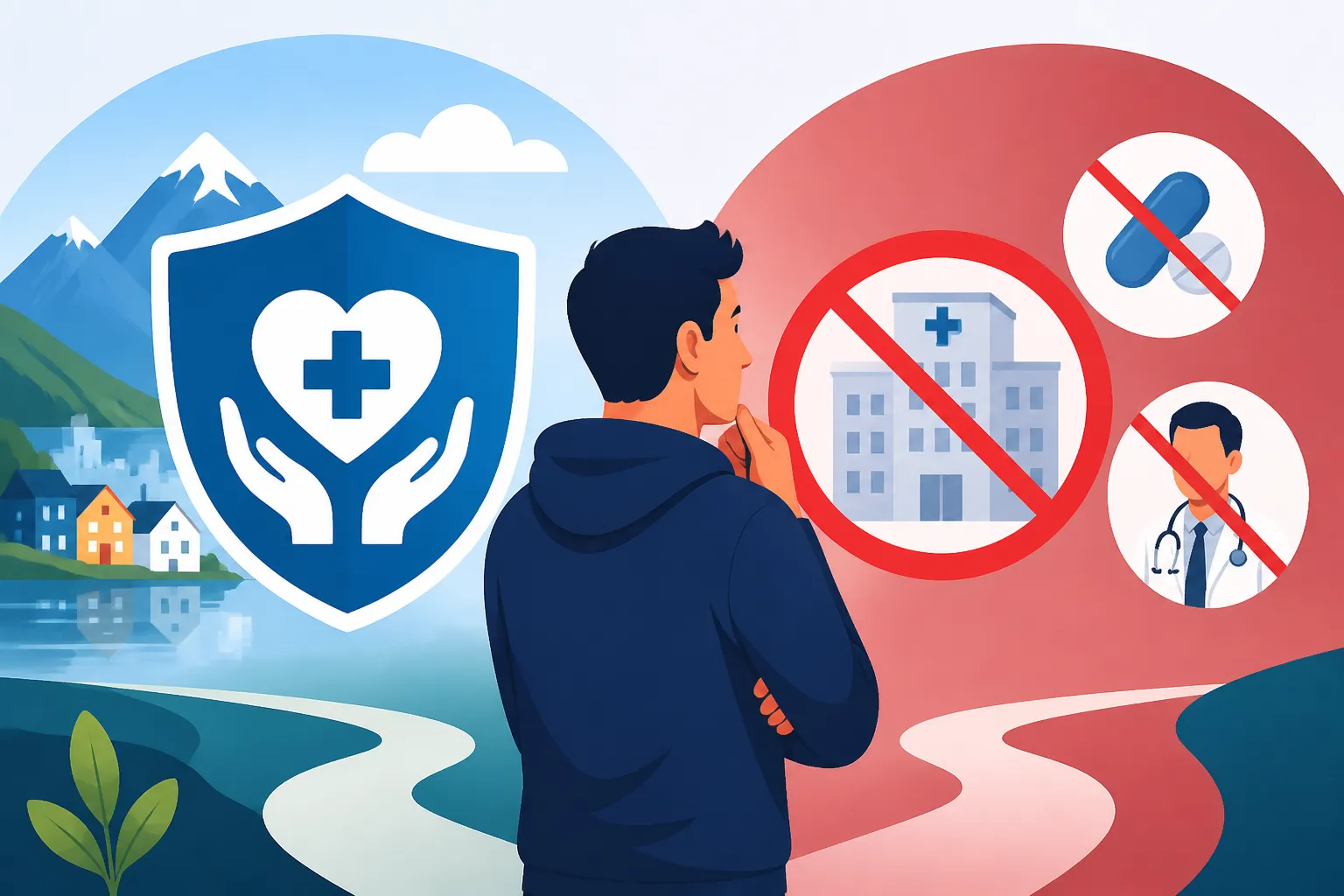
Because of the limitations mentioned above, relying solely on the public system with a D-number is a high-risk strategy. This is where private alternatives come into play.
Using Private Video Consultations
Apps like Kry and Dr.Dropin have revolutionized healthcare for new expats. You can often get a video appointment within 30 minutes. The doctors speak perfect English and can issue prescriptions (hvit resept) that you can pick up at any pharmacy.
The downside? These are "white prescriptions," meaning you pay the full market price for the medicine. There is no state subsidy for these. If you are on expensive long-term medication, this can add up to thousands of kroner a month. However, for a one-off issue like a skin rash or a chest cold, it is a lifesaver. We go into more detail in Using Private Video Consultations (Kry, Dr.Dropin) in Norway.
The Necessity of Private Health Insurance
If you are moving to Norway for a job and you have a family, I cannot stress this enough: get private insurance for the first six to twelve months. Companies like Cigna Global offer plans specifically designed for expats that cover the gaps the Norwegian state leaves open during your transition.
Having private insurance means you can go straight to a specialist without a GP referral. It means if your child needs to see a pediatrician, you aren't waiting weeks for a public appointment that you can't even book online. SafetyWing is another excellent choice, especially for younger expats or digital nomads who need flexible, month-to-month coverage that handles emergencies without the paperwork nightmare of the D-number system.
Complementary Coverage: What It Solves
Private insurance doesn't replace the public system—you are still paying for the public system through your taxes—but it acts as a "fast pass." It solves three main problems:
- The Referral Bottleneck: You don't need a Fastlege to see a specialist.
- The Cost Uncertainty: You know your major bills are covered.
- The Language Barrier: Private insurers often have dedicated English-speaking helplines to help you navigate the local system.
For many, Private Health Insurance in Norway: Is It Worth the Extra Cost? is a question of "peace of mind" vs. "saving money." When you have a D-number, the scale tilts heavily toward "peace of mind."
Moving Toward Permanent Status: When the Rights Change
The day your 11-digit Fødselsnummer arrives in the mail is a day of celebration for any expat. It is the key that unlocks the "real" Norway, including the full suite of healthcare rights.
Registering for a Fastlege
Once you have your permanent number, your first task should be to log onto Helsenorge and find a GP. You can see which doctors have available spots in your municipality. If you live in a major city like Oslo or Bergen, the best doctors often have long waiting lists.
I recommend picking a doctor close to your home or work immediately. Even if they aren't your "dream" doctor, having any Fastlege is better than having none. You can change your doctor up to twice a year. If you're wondering about the logistics, check How to Register for a Fastlege (GP) on Helsenorge for a step-by-step walkthrough.
Merging Your Records
One tricky part of the transition is ensuring your medical history from your "D-number days" follows you to your "Fødselsnummer profile." Because the two numbers are technically different identities in some legacy systems, your old records might not automatically appear.
When you have your first appointment with your new GP, bring any paperwork or receipts from your time with a D-number. Ask them to manually upload these to your journal. This is also the time to ensure your Healthcare Budgeting: The Frikort Exemption Card and User Fees tracking is consolidated so you don't lose progress toward your free healthcare for the year.
Accessing the Full Helsenorge Suite
With a permanent number and a Level 4 BankID, you can finally use the Helsenorge app to its full potential. You can:
- Book and cancel appointments.
- Renew prescriptions with a single click.
- View your lab results and doctor's notes.
- Communicate directly with your GP’s office via text.
This digital convenience is the "Norwegian Dream" we all hear about. It makes managing your health incredibly easy, but it requires that permanent ID to function. Until that day comes, stay proactive, keep your receipts, and don't be afraid to use private alternatives like SafetyWing or Cigna Global to bridge the gap. You aren't "failing" at being an expat by paying for private care; you are simply navigating a system that wasn't built for the "in-between" phase.
Disclaimer
The information provided in this guide is for informational purposes only and does not constitute legal or medical advice. Healthcare regulations in Norway, including user fee limits and UDI/Helfo policies, are subject to change. While we strive to keep this information updated for 2026, always verify your specific rights and obligations with the official Norwegian health authorities (Helsenorge and Helfo) or a qualified legal professional. The mention of private insurance brands does not constitute a formal endorsement; readers should evaluate insurance products based on their own needs and circumstances.