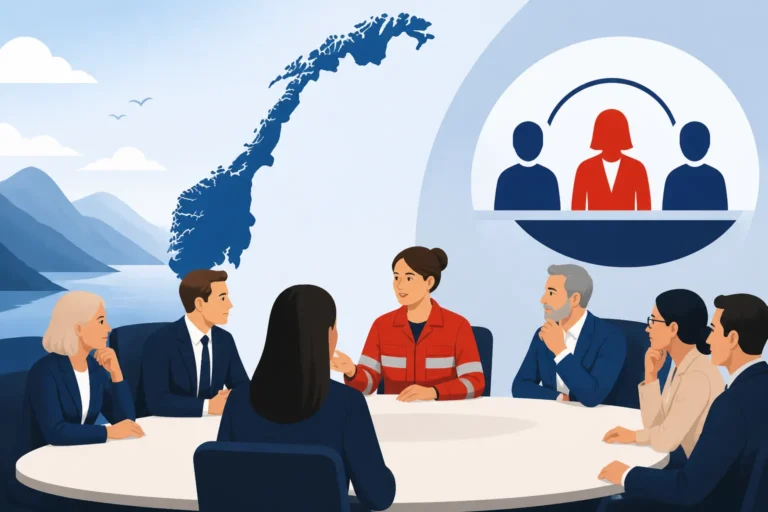
Learning Norwegian for Work: Norskprøven and Language Courses
Most expats arrive in Oslo or Stavanger believing that their fluent English will be a golden ticket to professional success, only to find themselves sitting in silence during the most important office conversations. I spent my first eighteen months in Norway nodding like a bobblehead at the coffee machine, terrified someone would ask my opinion in Norsk. This guide provides the comprehensive roadmap you need to master the language, pass the Norskprøven, and finally feel like a peer in the Norwegian workplace.
The Reality of the Language Barrier in the Norwegian Workplace
There is a common myth that because Norwegians speak incredible English, you don’t really need to learn the local tongue. In your first few weeks, this feels true. You can buy groceries, set up your internet, and even navigate your initial onboarding in English. However, as the months roll by, you will notice a subtle but firm glass ceiling. The "working language" of a company might be English on paper, but the "social and decision-making language" is almost always Norwegian. If you cannot follow the rapid-fire banter during lunch or understand the nuances of a hallway conversation, you are missing out on the social capital required to advance your career.
English is Great but Norsk is King
In professional settings, particularly in sectors like engineering, IT, and shipping, English is the lingua franca for documentation and international meetings. But the moment the external stakeholders leave the Zoom call, the room pivots back to Norwegian. I remember feeling a deep sense of isolation when my team would switch to Norsk to discuss the actual implementation of a project we had just planned in English. It wasn’t that they were being exclusionary on purpose; it’s simply that people are more efficient and comfortable in their native language. To truly integrate, you have to meet them halfway.
Furthermore, many Skilled Worker Visa in Norway: Eligibility, Salary Thresholds, and Process holders find that while they got the job with English, their long-term security depends on language acquisition. If there are layoffs or restructuring, the person who can communicate with local clients and understand the Norwegian Work Culture: Flat Hierarchies and Communication Styles in the native tongue is often seen as more versatile. Learning the language is a form of career insurance that proves your commitment to the country and your colleagues.
The Coffee Machine Connection
The Norwegian workplace is famous for its flat hierarchy and "uformell" (informal) atmosphere. A huge amount of work happens during the "kaffepause." If you are the only one in the breakroom who can't join the conversation about the weekend's cross-country skiing conditions or the latest political debate, you remain a guest rather than a member of the tribe. This social friction adds up over time. It can lead to burnout and the feeling that you are living a parallel life to your coworkers.
I found that my professional relationships didn't truly blossom until I could make a joke in Norwegian—even a bad one. Using a platform like italki to practice conversational Norsk with a tutor who understands workplace slang can be a game-changer here. It allows you to make those embarrassing mistakes in private before you try them out in front of your boss. When you show the effort to speak Norsk, Norwegians generally become much more patient and encouraging, which breaks down the social barriers that English-only speakers often face for years.
Professional Credibility and Industry Standards
For certain professions, the language requirement isn't just a social preference; it’s a legal necessity. Healthcare workers, teachers, and lawyers have strict mandates regarding their Norsk level. Even in unregulated industries, having a Norskprøven certificate on your CV adds a layer of credibility that English speakers lack. It signals to a recruiter that you have the grit to tackle a difficult task and that you are likely to stay in Norway long-term, reducing their "flight risk" concerns.
When you are Writing a Norwegian CV and Cover Letter: Formatting for Success, listing your specific Norskprøven level (A2, B1, B2) gives the employer a concrete metric of your abilities. Without this, "Intermediate Norwegian" is a subjective term that many employers interpret as "cannot actually work in Norsk." By securing a formal result, you remove the guesswork and position yourself as a local candidate who happens to have international experience.
Understanding Norskprøven: The National Language Test
The Norskprøven is the standard national Norwegian language test for adult immigrants. It is administered by HK-dir (The Norwegian Directorate for Higher Education and Skills) and is the exam you will likely take to prove your proficiency for work, permanent residency, or citizenship. The test is digital and held four times a year in municipalities across the country. It is divided into four parts: reading, listening, writing, and oral communication.
Levels A1 to C1 Explained
The test follows the Common European Framework of Reference for Languages (CEFR). A1 and A2 are elementary levels. While an A2 might help you get a job in a warehouse or as a cleaner, it is rarely enough for office work. B1 is the "threshold" level, where you can maintain a conversation and understand the main points of clear standard input. This is often the minimum requirement for many vocational jobs.
B2 is the gold standard for professional work. At this level, you can understand complex text and speak with a degree of fluency that makes regular interaction with native speakers quite easy. Many expats find that B2 Level Norwegian: How Long Does it Realistically Take to Reach? is the most significant hurdle of their first few years. Beyond that, C1 is an advanced academic level, usually required for those studying medicine or law in Norwegian. Most professionals can stop at B2 and have a very successful career.
Structure of the Exam
The exam is designed to be practical. The reading and listening sections are adaptive, meaning the questions get harder or easier based on your previous answers. The writing section usually involves tasks like writing an email to a landlord, a formal complaint, or an argumentative essay on a social issue. This is where your grammar and vocabulary are put to the ultimate test.
The oral section is perhaps the most nerve-wracking. You are paired with another candidate and asked to discuss a topic or describe a picture. The examiners are looking for your ability to interact, use varied vocabulary, and show grammatical control. I remember my palms sweating during my B1 oral exam when I had to discuss "environmental protection" with a complete stranger. It’s intense, but it is a fair reflection of how you will need to use the language in a real Norwegian employment contract scenario where communication is key.
Registration and Practical Logistics
You must register for the Norskprøven during specific windows, usually a few months before the test date. You apply through your local municipality (kommune), and the cost varies depending on whether you are entitled to free instruction or have to pay out of pocket. For those on a Skilled Worker Visa in Norway: Eligibility, Salary Thresholds, and Process, the cost is usually around 1,000 to 2,000 NOK per subtest.
It is vital to check the Permanent Residency Language Requirements: Norskprøven and Social Studies before you book, as the rules for residency often change. Some people only need to pass the oral part, while others need all four. Be aware that spots fill up fast in big cities like Oslo and Bergen. If you miss the window, you’ll be waiting another three months, which can delay your career progression or visa applications significantly.
Choosing the Right Language Course for Your Career
Finding the right course is about balancing your budget, your schedule, and your learning style. Norway offers a mix of public and private options, each with its own pros and cons. As a working professional, you don't have the luxury of sitting in a classroom for six hours a day, so you need a strategy that maximizes your limited "deep work" time.
Municipal Adult Education (Voksenopplæring)
Every municipality in Norway has a "Voksenopplæring" center. These are the official schools for immigrants. If you are here on family reunification from a non-EU country, you might be entitled to free hours. However, most skilled workers have to pay. The advantage of these schools is that they are deeply familiar with the Norskprøven format and the teachers are highly qualified.
The downside is that the pace can sometimes feel slow if you are used to an academic environment. The classes are often large and contain students with very different educational backgrounds. If you are aiming for English-Speaking Jobs in Norway: Top Industries for Foreigners while learning Norsk on the side, look for the "Kveldskurs" (evening classes) or "Sva" (fast-track) options designed specifically for professionals with higher education.
Private Language Schools and Online Platforms
Private schools like Folkeuniversitetet, Lingu, or Alfaskolen offer more flexible, intensive options. They tend to be more expensive, but the groups are smaller, and the focus is often sharper on reaching B2 quickly. They also offer many online-only modules, which are perfect if you are balancing a full-time job and family life.
For those who need maximum flexibility, using italki to find a private Norwegian tutor is an excellent supplement. You can focus specifically on the vocabulary used in your industry—whether that’s IT, finance, or construction. I used a private tutor to go through my Norwegian CV and Cover Letter and practice mock job interviews. This targeted approach is often much more effective for work purposes than a generic classroom setting where you spend weeks learning how to talk about your hobbies.
Specialized Courses for Health and Oil Professionals
If you work in a niche field, look for "Norsk for fagspråk" (Norwegian for specialized language). There are specific courses for nurses and doctors that focus on medical terminology and patient interaction. Similarly, in Stavanger, you can find courses that incorporate technical terms used in the oil and gas industry.
Learning the "standard" Norwegian is one thing, but understanding the Dialects in Norway: Do I Need to Learn the Local Slang? that you’ll encounter on a construction site or in a hospital ward is another. Specialized courses help bridge this gap. They ensure that you don't just pass a test, but that you can actually function safely and effectively in a high-stakes professional environment.
| Feature | Municipal School (Voksenopplæring) | Private Language Schools | Private Tutors (e.g., italki) |
|---|---|---|---|
| Cost | Low (sometimes free) | Moderate to High | Variable (low to high) |
| Pace | Often slower / structured | Fast-track options | Custom / Student-led |
| Flexibility | Set evening/day times | Evening/Weekend/Online | 24/7 availability |
| Focus | General integration / Norskprøven | Norskprøven / Business | Targeted / Conversation |
| Social | High (meet many expats) | Moderate | Low (1-on-1) |
Reaching B2: The Gateway to Professional Employment
B2 is often called the "upper intermediate" level, but in the context of Norway, it is the level where you transition from being "the foreigner" to being "a colleague." This is the point where you stop translating every word in your head and start thinking in Norwegian. It requires a significant jump in both vocabulary and grammatical nuance.
Why B2 is the Magic Number
Most recruiters in Norway view B2 as the minimum for any role that requires autonomy and communication. At B2, you are expected to understand the nuances of a text, identify the speaker's viewpoint, and participate in technical discussions in your field. If you are looking at Salaries and Minimum Wage in Norway: Industry Benchmarks, you will find that roles in the higher salary brackets almost always carry an unspoken B2 requirement.
Even if your office is officially English-speaking, having B2 Norsk allows you to read internal company newsletters, understand the Employment Rights in Norway: The Working Environment Act Explained, and engage with the local labor union (Fagforening). It gives you a seat at the table. Without it, you are always relying on someone else to translate the "vibe" of the company to you, which puts you at a disadvantage.
Strategies for Moving from Intermediate to Advanced
The "B1 plateau" is a real phenomenon where you feel like you aren't improving despite constant study. To break through to B2, you need to shift from passive learning to active production. This means writing longer essays, listening to complex podcasts like "NRK Dagsnytt Atten," and forcing yourself to speak even when it’s difficult.
Grammar becomes more about style and flow at this level. You need to master inversion (the V2 rule), complex conjunctions, and the passive voice. I found it helpful to use the "Skatteetaten" or "NAV" websites as reading practice. Dealing with The Complete Guide to Norwegian Taxes for Expats (Skatteetaten) is a rite of passage, and trying to understand their official letters without Google Translate is a brutal but effective way to reach B2.
Real-World Practice Outside the Classroom
To reach fluency, you must leave the "expat bubble." This is the hardest part. It is so easy to stay in a circle of English-speaking friends and only use Norsk at the grocery store. You need to find a "språkvenn" (language friend) or join a local hobby group. Whether it’s a choir, a hiking club, or a "dugnad" (community volunteer work) at your apartment building, these are the places where real language is used.
I also recommend changing your phone and computer settings to Norwegian. It’s frustrating at first, but it forces you to learn "tech" Norsk. Watching Norwegian TV with Norwegian subtitles (not English!) is another essential habit. Shows like "Exit" or "Lykkeland" provide great insight into both the language and the culture of Norwegian Work Culture: Flat Hierarchies and Communication Styles.
The Financial Side of Learning Norwegian
Learning a language is an investment of both time and money. While the costs can be high, the return on investment (ROI) in terms of salary increases and job security is usually worth it. However, as an expat, you need to be smart about how you fund this journey.
Free vs. Paid Courses: Who Gets What?
The rules for free Norwegian classes are complex. Generally, if you have a residence permit that forms the basis for permanent residency (like family immigration with a person who is not an EU citizen), you might have a "right and obligation" to free Norsk classes. Most skilled workers, however, fall into the category of having the "obligation" but not the "right" to free classes—meaning you must learn, but you have to pay for it yourself.
Check with your local kommune to see if they have any subsidized spots for workers. Sometimes, if a class isn't full, they offer seats at a lower rate. If you are an EU/EEA citizen, you generally have to pay for everything yourself. This is where budgeting becomes crucial, especially given the Cost of Living in Norway 2026: Budgeting for Singles and Families.
Tax Deductions and Employer Sponsorship
Many people don't realize that their employer might be willing to pay for language training. Since it benefits the company to have a more integrated employee, many HR departments have a budget for "kompetanseheving" (skills development). Always ask during your salary negotiation or annual review if the company will cover your Norskprøven fees or a private course.
If your employer won't pay, you should consult with experts like Taxes for Expats to see if your language course fees can be considered a deductible work expense. In some cases, if the language is strictly necessary for you to perform your current job or move to a higher position within the same company, Skatteetaten may allow a deduction. While the rules are strict, it’s always worth investigating to lower your overall Norwegian Taxes for Expats.
Investing in Your Future Salary
Think of the 20,000 or 30,000 NOK you might spend on courses over two years as a capital investment. A professional who speaks B2 Norwegian can often command a salary 10-20% higher than an English-only counterpart in the same industry. It opens up the entire public sector, which is a massive employer in Norway and offers some of the best Employment Rights in Norway: The Working Environment Act Explained.
Moreover, being fluent reduces the risk of long-term unemployment. If you lose your job, being able to register with NAV and apply for roles in Norsk significantly increases your chances of finding a new position quickly. It also allows you to take advantage of Navigating NAV: Unemployment Benefits and Social Safety Nets more effectively, as you can communicate your needs without a translator.
Integrating Language Learning into a Busy Work Schedule
The biggest complaint I hear from fellow expats is: "I work 40 hours a week, I have kids, and I’m exhausted. How can I possibly learn Norsk?" The key is not to treat it as a separate chore, but to weave it into your existing daily routine.
Micro-Learning and Immersion Habits
You don't need a two-hour block of time to learn. You need ten minutes, six times a day. Listen to a Norwegian podcast during your commute on Public Transport in Oslo (Ruter): Zones, Tickets, and Monthly Passes. Use flashcard apps like Anki or Memrise while waiting for the elevator. Read one news article on NRK.no while having your morning coffee.
The most effective habit I formed was the "Norsk-only morning." I told my colleagues that between 8:00 AM and 9:00 AM, I would only speak and listen to Norwegian. It was awkward at first, and there were many long silences, but it created a safe "sprint" for practice. Most Norwegians will respect this boundary if you explain that you are preparing for the Preparing for the Norskprøven: B1 vs B2 Requirements for Jobs.
Digital Resources and Apps for Busy Professionals
Apps like Duolingo or Babbel are great for beginners to build basic vocabulary, but they won't get you to B2. For that, you need more robust tools. "Klar Tale" is an excellent newspaper written in simple Norwegian, and it often comes with audio files so you can listen and read at the same time.
For grammar, the "Exploring Norwegian" or "Stein på Stein" series of textbooks are the standard used in schools. Most of these now have digital versions with interactive exercises. If you find yourself stuck on a specific grammatical concept, a quick 30-minute session with a tutor on italki can clear up months of confusion. It’s about using technology to remove the friction of traveling to a physical school.
Finding a Language Partner (Språkvenn)
A "språkvenn" is a person you meet with just to talk. It’s usually an exchange: you speak Norwegian for 30 minutes, and then you speak your native language for 30 minutes. This is a free and highly effective way to practice. You can find partners through local libraries, Facebook groups, or apps like Tandem.
If you are feeling brave, ask a Norwegian colleague to be your "mentor." Many Norwegians are secretly proud of their language and are happy to help someone who is genuinely trying. Just make sure to tell them: "Ikke bytt til engelsk!" (Don't switch to English!). This is the expat’s greatest battle. Norwegians switch to English to be "helpful," but it actually robs you of the practice you need. You have to be firm and stay in Norsk, even if you are struggling.
Navigating the Workplace Cultural Nuances
Language is more than just words; it’s a vehicle for culture. Even if you speak perfect Norsk, you can still fail in the workplace if you don't understand the underlying social codes. Learning the language helps you decode these invisible rules.
Janteloven and Communication Styles
You have probably heard of "Janteloven"—the unwritten code that says "you are not better than anyone else." In the workplace, this translates to a very direct but modest communication style. Norwegians tend to dislike boasting or "over-selling" themselves. If you use the hyper-energetic, superlative-heavy language of the US corporate world, it can come across as insincere or even aggressive in Norsk.
Learning Norsk helps you master the art of the "softened" disagreement. Instead of saying "That's wrong," a Norwegian might say "Jeg er litt usikker på om det er den beste løsningen" (I'm a little unsure if that's the best solution). Understanding these linguistic nuances is vital for navigating Norwegian Work Culture: Flat Hierarchies and Communication Styles without stepping on toes.
Decoding "Nynorsk" vs. "Bokmål" in the Office
Norway has two official written languages: Bokmål and Nynorsk. Most expats learn Bokmål, as it is the most common in the business world and in Oslo. However, if you work in the public sector or on the west coast, you will encounter Nynorsk. You don't necessarily need to write in Nynorsk, but you must be able to read it.
The real challenge, however, is the Dialects in Norway: Do I Need to Learn the Local Slang?. Someone from Stavanger or Tromsø sounds completely different from someone in Oslo. I remember my first week in a meeting with a man from Sogndal; I thought he was speaking a different language entirely. Don't panic. Even Norwegians sometimes struggle with each other's dialects. The key is to learn "Standard Østnorsk" (the Oslo dialect) as your base and gradually train your ear to the variations.
Professional Networking in Your New Language
In Norway, "it's not what you know, but who you know" is surprisingly true for such a meritocratic country. Networking often happens in informal settings. If you can attend a Julebord Culture: Navigating the Norwegian Office Christmas Party and talk to people from other departments in Norsk, your internal network will explode.
Using your language skills to join a professional organization or a "fagforening" (union) is another great move. These groups hold seminars and social events that are almost always in Norwegian. Showing up and participating proves that you are not just an "expat worker," but a "Norwegian professional." This distinction is subtle, but it makes a world of difference when it comes to long-term career growth and feeling at home in the Land of the Midnight Sun.
Disclaimer
The information provided in this guide is for general informational purposes only and does not constitute legal, financial, or professional immigration advice. Language requirements and visa regulations in Norway are subject to frequent change. Always consult the official websites of HK-dir, UDI, and Skatteetaten for the most up-to-date information regarding Norskprøven and residency requirements.