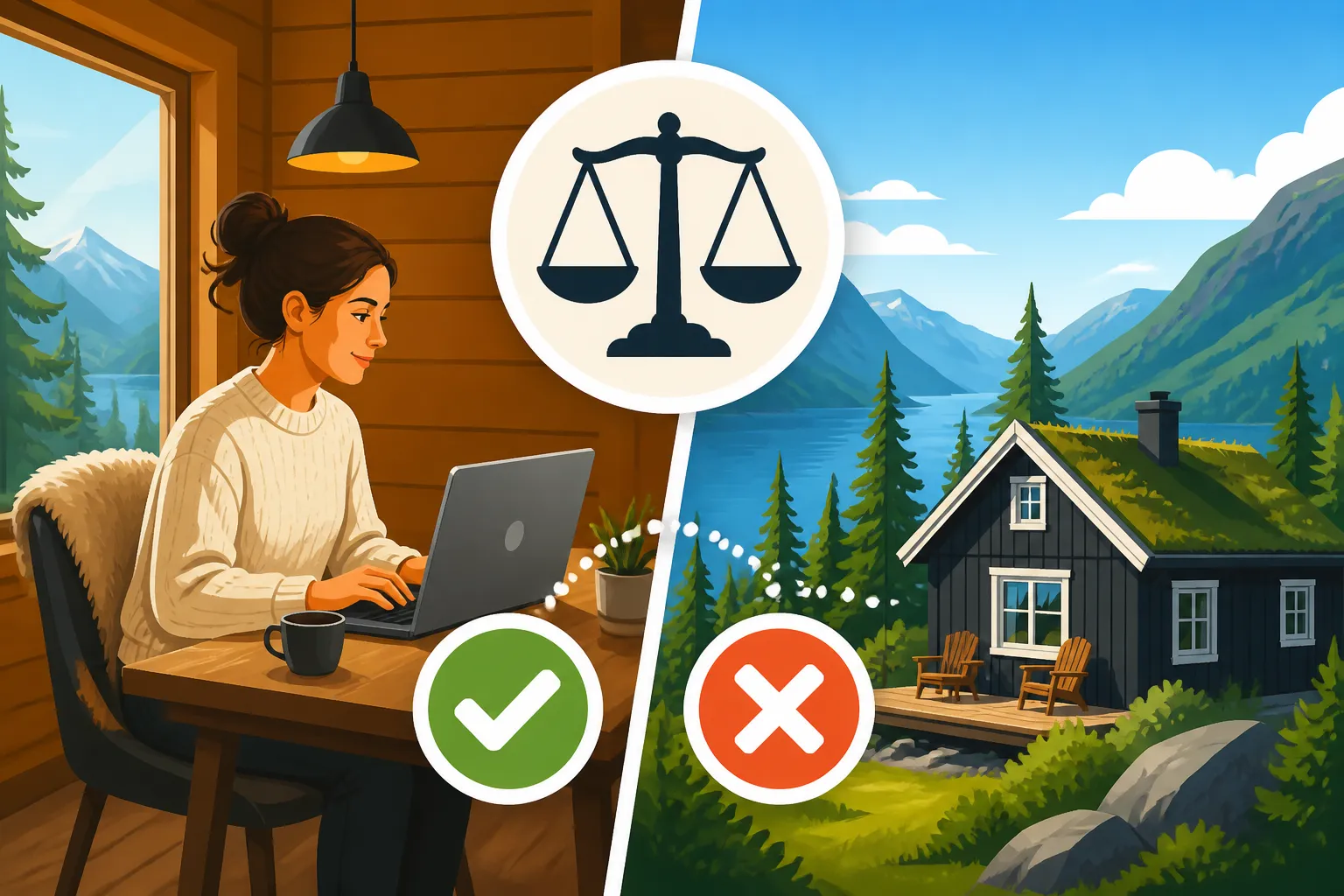
Remote Work from a Cabins (Hyttekontor): Is It Legally Allowed?
Many expats arrive in Norway dreaming of the hyttekontor lifestyle, only to find themselves paralyzed by the fear of accidentally violating their visa terms or triggering a tax audit. I spent months nervously tethering my phone in a drafty mountain shed in Hallingdal before I finally understood how the Norwegian authorities actually view remote work. This guide clarifies the legal, tax, and employment realities of working from a cabin so you can stop worrying and start enjoying the mountains.
The Legal Framework for Hyttekontor in Norway
The first thing you need to understand is that Norway has a very specific set of regulations regarding remote work, often referred to under the umbrella of "hjemmekontor" (home office) rules. In 2022, the Norwegian government updated the Forskrift om arbeid i arbeidstakers hjem (Regulations concerning work in the employee's home), and while these rules specifically mention the "home," they are generally interpreted to cover any location where you perform work for your employer on a regular basis, including a cabin. However, it is vital to distinguish between a right and a privilege. In Norway, you do not have a statutory legal right to work from a cabin; this is entirely dependent on your individual employment contract and the agreement you have with your manager.
When you are looking at Employment Rights in Norway: The Working Environment Act Explained, you will notice that the law emphasizes the "psychosocial work environment." This means your employer is technically responsible for ensuring your "cabin office" is ergonomically sound and safe if you are working there permanently. If you are just heading to the hytte for a long weekend to catch up on emails, the rules are lax. But if you plan to spend three months working from a remote valley in Lofoten, your employer might get twitchy about insurance. Most Norwegian employers are incredibly flexible due to the culture of "trust," but you must have a written agreement. Without a formal nod, you might find yourself in a gray area regarding Standard Working Hours and Overtime Pay Regulations in Norway, especially if your "work" starts blending into your "skiing" time.
To successfully negotiate a long-term hyttekontor arrangement, you need to understand the nuances of Norwegian Work Culture: Flat Hierarchies and Communication Styles. This is where language plays a massive role. I found that my Norwegian colleagues were much more open to my remote work requests once I could articulate my plan in their native tongue. Using a platform like italki to practice these specific professional conversations can be the difference between a "no" and a "see you in three weeks." Being able to discuss "arbeidsmiljø" (work environment) and "produktivitet" (productivity) in Norsk shows that you respect the local corporate values.
Visa Restrictions and the UDI Perspective
If you are in Norway on a Skilled Worker Visa in Norway: Eligibility, Salary Thresholds, and Process, the rules are slightly more rigid than they are for EU/EEA citizens. Your residency is tied to a specific employer and, in some cases, a specific location or type of work. The UDI (Directorate of Immigration) generally cares about where your employer is located and that you are actually performing the work you were hired to do. Working from a cabin within Norway for a few weeks or months usually doesn’t pose a problem for a Skilled Worker permit, as long as you maintain a registered residential address in the National Registry (Folkeregisteret).
The danger zone begins if your "cabin" is actually located outside of Norway—for example, if you decide to work from a cottage in Sweden or your home country for an extended period. This can jeopardize your residency status because you are required to reside in Norway for a certain number of days to maintain your permit and eventually apply for Permanent Residence in Norway: Requirements, Timelines, and Language Tests. If the UDI sees that you have been out of the country for more than the allowed quota (usually 90 days in a year for some permits), your path to permanent residency could be reset. Always ensure your "hyttekontor" is physically located within the Norwegian borders to stay on the right side of the law.
For those who are not yet employed by a Norwegian company and are looking for a more flexible way to stay, you might be investigating the Norway Digital Nomad Visa: Independent Contractor vs Svalbard Routes. The Svalbard route is particularly interesting because it doesn't require a traditional visa, but the "hyttekontor" lifestyle there involves polar bear guards and extreme darkness—a far cry from a cozy cabin in Geilo. For mainland expats, sticking to the rules of your specific residence permit is non-negotiable. If you are unsure, checking your status via the Helsenorge app or the UDI portal is essential, as is Navigating Remote Work Policies Within Norwegian Companies to see if your firm has specific clauses for non-EU staff.
Tax Implications and Social Security
Skatteetaten (the Norwegian Tax Administration) is generally indifferent to whether you are sitting in an office in Oslo or a cabin in Trysil, provided you are still paying your taxes to Norway. However, the financial logistics change when you consider your "commuter" status. If you are working from a cabin because your main home is elsewhere, you might be tempted to claim deductions. This is a complex area of The Complete Guide to Norwegian Taxes for Expats (Skatteetaten). Generally, expenses related to your private cabin are not tax-deductible as "office" expenses unless the room is used exclusively for business, which is a very high bar to clear for a holiday home.
One major headache is the "pendler" (commuter) status. If you are working from a cabin but still paying for a primary residence, you need to be very careful about how you report this. Furthermore, if you are an expat working for a foreign company while sitting in a Norwegian cabin, you are likely creating a "Permanent Establishment" for that company in Norway, which triggers massive tax liabilities for your employer. This is where professional advice from a firm like Taxes for Expats becomes invaluable. They can help you navigate the double taxation treaties between your home country and Norway, ensuring you don't end up with a surprise bill.
You also need to keep your Understanding Your Skattekort (Tax Deduction Card) and How to Change It up to date. If working from a cabin changes your travel habits or your costs significantly, your tax bracket might need adjustment. Remember that your 7.7% or 11% social security contribution (trygdeavgift) is what keeps you covered by the healthcare system. If you are working remotely in a way that suggests you are no longer a resident of your specific municipality, you might find issues when trying to access local services.
| Feature | Working from Home (Hjemmekontor) | Working from Cabin (Hyttekontor) |
|---|---|---|
| Legal Right | Limited (usually by agreement) | None (purely by agreement) |
| Employer Liability | High (Ergonomics/Safety) | Moderate (Usually temporary) |
| Internet Access | Usually Fiber/Stable | Often 5G/Satellite/Unstable |
| Tax Deductions | Possible for dedicated home office | Very difficult for leisure property |
| Visa Impact | Neutral (within Norway) | Neutral (within Norway) |
| Electricity Costs | Standard residential rates | Often higher grid fees (Nettleie) |
Infrastructure and Practical Challenges
The romantic image of the hyttekontor often hits a wall when the first Zoom call of the day drops because of a snowstorm. Infrastructure in Norwegian cabins varies wildly. While many newer cabins have fiber-optic internet, older "enkelt" cabins rely on mobile data. Before you commit to a week of remote work, you need to check the coverage maps for Telenor and Telia. Relying on a mobile hotspot is fine for Slack, but for heavy data lifting, it can be a nightmare. Additionally, you should be aware of Electricity Bills in Norway: Spot Prices, Grid Fees (Nettleie), and Support. Cabins are often classified differently than primary residences for "strømstøtte" (electricity support), meaning a cold winter week of heating a cabin while you work could cost you significantly more than working from your apartment in the city.
Another practical hurdle is the "Dugnad" culture. If your cabin is part of a homeowners' association, you might find that the "remote work" week coincides with a mandatory community cleanup. In Norway, skipping dugnad because you "have a meeting" is often seen as a social faux pas. You are expected to contribute to the community you are living in, even temporarily. This integration is part of Learning Norwegian for Work: Norskprøven and Language Courses; understanding the social expectations of your neighbors in the cabin cluster is just as important as knowing the tax code.
Lastly, consider your physical health. Norwegian cabins are designed for "koselig" (cozy) relaxation, not 8-hour shifts on a laptop. Sitting on a wooden bench or a soft sofa for a week can lead to significant back pain. My first hyttekontor experience ended with a trip to a physiotherapist because I thought a coffee table was a suitable desk. If you plan to do this regularly, invest in a portable laptop stand and a decent chair, or check if your employer will provide equipment for your secondary location—though under the current regulations, they are rarely obligated to do so for a holiday home.
Summary of Responsibilities
When you are setting up your mountain office, remember that you are the one responsible for maintaining the "trust" that the Norwegian system is built on. If your productivity dips because you are out chasing the "Blue Hour" for photography or skiing the freshly groomed tracks, you risk ruining the arrangement for yourself and other expats.
- Get it in Writing: Always have an email or Slack confirmation from your lead before heading to the cabin.
- Check Your Insurance: Confirm that your employer’s occupational injury insurance (yrkesskadeforsikring) covers you while working from a secondary location.
- Monitor Your Days: If you are a non-EU citizen, track every day spent at the hytte to ensure you are meeting the residency requirements for your permit.
- Language is Key: Use tools like italki to improve your Norwegian so you can negotiate these perks with confidence and cultural awareness.
- Tax Compliance: If your work involves international elements, consult with Taxes for Expats to prevent cross-border tax complications.
The "hyttekontor" is one of the greatest perks of living in Norway. It allows you to blend the grueling demands of a modern career with the soul-cleansing power of the Norwegian wilderness. As long as you respect the Employment Rights in Norway: The Working Environment Act Explained and keep your employer in the loop, there is very little stopping you from taking your "kontor" to the clouds.
Disclaimer
The information provided in this guide is for informational purposes only and does not constitute legal or tax advice. Laws and UDI regulations in Norway are subject to change, and you should always consult with a qualified legal professional or the Norwegian Tax Administration (Skatteetaten) regarding your specific situation.