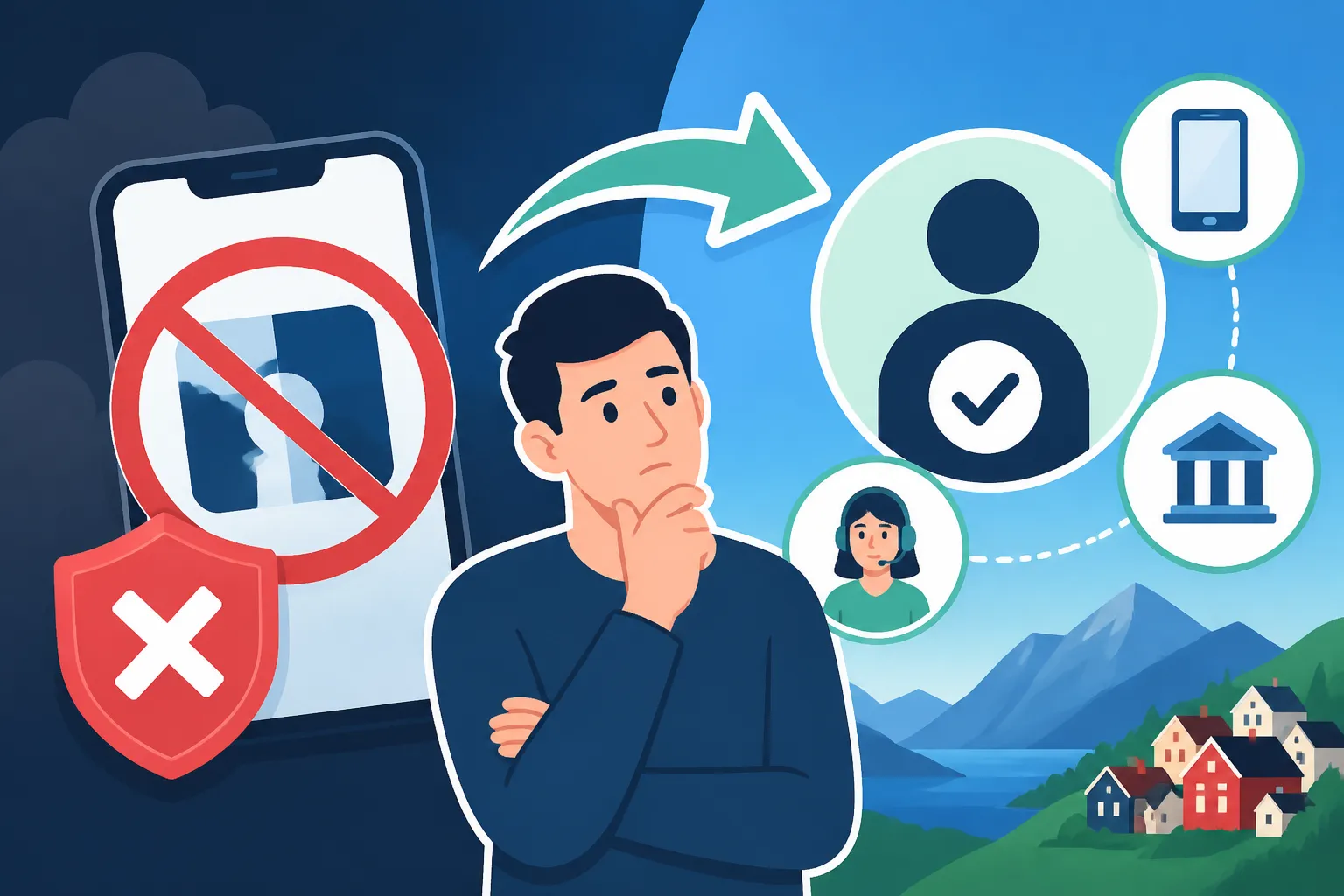
Overcoming the BankID Block: Workarounds for D-Number Holders
Moving to Norway is often touted as a dream, with its stunning fjords and pristine nature, but then reality hits: you're faced with a seemingly impenetrable wall when trying to access basic digital services because you don't have a BankID. For many D-Number holders, this isn't just an inconvenience; it's a constant source of frustration, making everything from paying bills to checking your tax information unnecessarily complicated. This guide aims to dismantle that wall, offering you practical workarounds and a clear roadmap to navigating Norway's digital landscape, even without the coveted BankID.
The BankID Conundrum for D-Number Holders: A Familiar Frustration
Ah, BankID. If you've been in Norway for any length of time as an expat, especially if you're only on a D-Number, you've likely uttered that name with a mix of despair and exasperation. It's the digital key to almost everything here, and not having it feels like being locked out of your own life. You quickly realize that while Norway prides itself on being a modern, digitally advanced society, it often feels like it forgot about the early stages of integration for new arrivals. The frustration is real, and it’s a hurdle many of us have faced, making you wonder if you’ll ever truly get settled.
Why Your D-Number Isn't Enough for Standard BankID
Let's get straight to the heart of it: your D-Number, while a crucial identification number for many administrative purposes in Norway, isn't typically considered robust enough on its own to grant you a full, standard BankID. The BankID system is built on a foundation of trust and strict identity verification, aligning with national security and anti-money laundering regulations. To issue a full BankID, banks require a level of identity assurance that usually comes with a fødselsnummer, Norway's eleven-digit national identity number, and sometimes even a residence permit.
This creates a peculiar Catch-22 situation that many expats find themselves in: you need BankID for everything, but you can't get BankID without a fødselsnummer, and getting a fødselsnummer often requires you to prove you're living and working here long-term, which in turn means interacting with systems that also demand BankID. It's enough to make you want to pull your hair out! Your D-Number is a temporary identification, often issued for tax purposes or short-term work, but it lacks the permanence and depth of verification that the BankID infrastructure demands.
The Endless Loop: Banks, UDI, and Digital Identity
The journey often begins with a hopeful trip to a local bank branch, only to be met with polite but firm rejections. "Sorry, you need a fødselsnummer," they'll say. Or, "You need to have established residency." Then you might try the UDI (Norwegian Directorate of Immigration), or the police, to sort out your residence permit or fødselsnummer application, only to find that booking appointments or checking your status online often requires – you guessed it – BankID. It’s like a cruel joke, isn't it? This bureaucratic merry-go-round leaves many D-Number holders feeling stuck, circling between different government agencies and banks, each pointing to the other.
This isn't just about accessing your online banking; it affects signing rental contracts digitally, accessing your health portal on Helsenorge, applying for various benefits from NAV, and even signing documents electronically with your employer. The physical meeting with the bank for identification, which might seem old-fashioned, is a crucial step in Norway, and even then, without the full fødselsnummer and associated registrations, the system simply won't grant you the all-access pass of a standard BankID. It’s a process designed for stability and long-term residents, making those first few months or even years as a D-Number holder particularly challenging.
Immediate Workarounds: Managing Life Without Full BankID Access
So, you're stuck in Norway without a proper BankID, and the daily grind of life still demands your attention. Don't despair! While it feels like a giant inconvenience, there are indeed ways to navigate crucial services and financial transactions without full BankID access. It requires a bit more effort and sometimes a dash of old-fashioned paper-and-pen, but it’s entirely doable. Think of it as a temporary strategy to keep things ticking over until you get your golden ticket.
Essential Online Services Accessible Without BankID
Even without BankID, you're not completely cut off. Many essential services offer alternative login methods, usually involving a username and password, or sometimes a one-time code sent via SMS or letter. For instance, the tax agency, Skatteetaten, is a prime example. While you can't file your full tax return or make complex changes without a more secure login, you can often view basic information, retrieve your tax card (Skattekort), or get essential forms using a D-Number login with a password. This limited access is crucial, especially when you're trying to understand your financial obligations in Norway. This is particularly relevant if you're engaging with services like Taxes for Expats, who can often guide you through tax declarations even if your online access is restricted.
Many utility providers (electricity, internet, mobile) also offer direct logins to their portals, allowing you to check bills and manage your subscriptions. Similarly, Posten, the national postal service, usually has a separate login for tracking packages and managing mail without requiring BankID. It's a patchwork approach, but it keeps you connected to vital services. The key is to explore each service's website for "alternative login" or "login without BankID" options. Don't assume everything is locked behind that BankID wall; some doors are just a bit harder to open.
Alternative Payment Methods and Digital Tools
Norway is famously moving towards a cashless society. Everywhere you go, from the smallest kiosks to large supermarkets, card payments are the norm. This is good news for D-Number holders, as your international debit or credit card will be your best friend. Many expats rely on their cards issued by banks like Wise for everyday transactions, paying bills, and even making international transfers without incurring exorbitant fees. While Vipps, Norway's ubiquitous mobile payment app, typically requires BankID to set up, you can still function remarkably well with just a regular bank card.
For transferring money internationally or receiving payments, services like Wise are invaluable. They allow you to set up accounts in NOK and other currencies, make transfers with transparent fees, and manage your money digitally without needing a Norwegian BankID. You can use your international banking app for many routine transactions. When it comes to paying bills, if you can’t set up eFaktura or AvtaleGiro via your limited Norwegian bank access, you can often manually pay bills through your online banking by entering the KID number and amount, or sometimes even by physically visiting your bank branch or a post office to make a payment. It's less convenient, but it works!
The Path to "Light" BankID for D-Number Holders
While full BankID might be out of reach for D-Number holders, some Norwegian banks have recognized the struggles faced by new arrivals and offer a "light" version of online banking access, sometimes informally referred to as "BankID light" or simply limited online banking services. This isn't the all-powerful BankID that grants you access to Helsenorge or the UDI portal, but it's a significant step up from having no digital access at all. It primarily allows you to manage your accounts, pay bills within your own bank's portal, and perhaps transfer money.
Which Banks Offer Restricted BankID to D-Number Holders?
Based on recent experiences and information, larger banks such as DNB, Nordea, and SpareBank 1 are often the most accommodating when it comes to opening accounts and providing some form of online banking access to D-Number holders. They understand that new residents need basic financial services, even if their long-term identification isn't fully in place yet. These banks typically allow you to open a current account and get a debit card. Crucially, they may also provide you with access to their own online banking portal, which will have its own login credentials (often a username, password, and a code device or app from the bank itself).
This "light" access means you can check your balance, transfer money between your own accounts, and pay Norwegian bills using the KID number system. However, don't expect it to work for third-party services that explicitly ask for "BankID" as a login option. It's confined to the bank's ecosystem. The application process usually involves a mandatory in-person visit to a branch, where you'll need to present several documents. It's important to research specific bank policies, as these can change, and some branches may be more flexible than others.
The Importance of a Valid, RFID-Enabled Passport
When you do go to a bank to attempt to open an account or secure any form of digital access with a D-Number, one document reigns supreme: your passport. And not just any passport. Norwegian banks are increasingly stringent about requiring a valid, RFID-enabled passport for identity verification. This is because these passports contain a chip that allows for advanced digital verification, providing a higher level of security than traditional passports. If your passport is older and lacks this chip, you might find yourself hitting another roadblock.
This isn't a minor detail; it's often a non-negotiable requirement. Ensure your passport is not only valid and unexpired but also has that little chip symbol on the cover. If you don't have one, or if yours is about to expire, prioritizing getting a new, RFID-enabled passport from your home country should be at the very top of your to-do list before even approaching a Norwegian bank. Without it, even the most sympathetic bank staff will be unable to proceed with your application, leaving you in the same BankID limbo you started in.
The Gold Standard: Obtaining a Fødselsnummer and Full BankID
Ultimately, for full integration into Norwegian digital life, the goal for most expats is to obtain a fødselsnummer (national identity number) and, subsequently, a full BankID. This is the real game-changer that unlocks all the doors. It's the stable foundation upon which everything else is built, from healthcare access on Helsenorge to fully personalized tax services and seamless transactions. It might feel like a distant dream, but there’s a clear pathway to get there.
Transitioning from D-Number to Fødselsnummer: The Key Steps
The transition from a D-Number to a fødselsnummer is fundamentally tied to establishing legal residency in Norway. Generally, this happens when you are granted a residence permit (for non-EU/EEA citizens) or register your residency with the police (for EU/EEA citizens), and crucially, you intend to stay in Norway for at least six months. Once your residence is confirmed and registered with the National Registry (Folkeregisteret), you will typically be assigned a fødselsnummer automatically. This process can be lengthy, with waiting times for UDI applications and police appointments often stretching into weeks or even months. For a more detailed understanding of how these IDs affect your banking options, you might want to read our guide on D-Number vs Fødselsnummer: How It Affects Your Banking Options.
The biggest challenge is often the "chicken and egg" situation: you need a job or a family connection to get a residence permit, and you need a residence permit to get a fødselsnummer, but many jobs and even rental agreements implicitly expect you to have established yourself somewhat. However, once you meet the requirements for long-term residency and register your address with the Folkeregisteret, your fødselsnummer will be issued. You’ll usually receive a letter in the mail confirming your new ID number. This letter is gold – guard it carefully!
The Full BankID Application Process Once You Have a Fødselsnummer
With your fødselsnummer in hand, you are finally ready to apply for the full BankID. This process is much more straightforward. You'll need to visit your bank branch in person, bringing your fødselsnummer confirmation letter (or simply knowing the number), your valid RFID-enabled passport, and possibly your residence card if you’re a non-EU/EEA citizen. The bank will use your fødselsnummer to verify your identity against the national registry. They will then activate your BankID.
Historically, this involved getting a physical code device or BankID på mobil (BankID on mobile). However, BankID på mobil, as a separate SIM-card service, has largely been replaced by the BankID app, which is linked to your device and requires activation via your bank. The process usually involves downloading the app and completing the setup with the bank's assistance. Once activated, you'll be able to use your BankID login details (usually your personal ID number and a password) combined with the app-generated code to access virtually all Norwegian public and private digital services. For more insights on the timeline, you can check out How Long Does it Take to Get a Fødselsnummer for BankID?. This step truly marks your full digital integration into Norway.
Practical Strategies and Insider Tips for Expats
Navigating Norwegian bureaucracy, especially when it comes to something as fundamental as digital identity, can test anyone's patience. But with a bit of forethought and some insider tips, you can make the process less painful. Remember, many of us have been through this exact struggle, so you’re not alone in your frustration. Being prepared and understanding the system’s quirks can save you a lot of grief.
Document Preparation: What to Bring to the Bank
This cannot be stressed enough: come prepared. When you visit a bank to open an account or inquire about digital ID solutions, assume they will ask for every single document you possess, and then some. At a minimum, you should bring:
- Your valid, RFID-enabled passport: This is paramount. Ensure it’s not expiring soon.
- Your D-Number confirmation: A letter from Skatteetaten or the police stating your D-Number.
- Proof of address: A rental contract, recent utility bill in your name, or a letter from your landlord.
- Employment contract: This proves your ties to Norway and often your purpose of stay.
- Residence permit card (if applicable): For non-EU/EEA citizens.
- Letter of appointment from UDI/police (if applicable): If you're awaiting a residence permit or fødselsnummer.
- Any other official ID: Such as a national ID card from your home country.
Always bring both originals and photocopies of everything. Sometimes they just want to see the original; other times, they keep a copy for their records. Having it all neatly organized will show that you're serious and help streamline the process. Banks like DNB, Nordea, and SpareBank 1 are typically the ones to visit. Our guide on Best Norwegian Banks for Expats: DNB, Nordea, SpareBank 1, and Sbanken can provide more details.
Persistence and Patience: Navigating Bureaucracy
The Norwegian system, while efficient once you're in it, can feel incredibly slow and rigid when you're trying to get set up. You might encounter staff who are new or simply less familiar with the specific challenges of D-Number holders. My advice? Be polite, but persistent. If one person can't help you, ask if there’s a colleague who specializes in international clients, or if there's a manager you can speak with. Sometimes, simply trying another branch of the same bank can yield different results. It sounds ridiculous, but it happens.
Don't be afraid to clearly articulate your specific needs and the consequences of not having access (e.g., "I can't pay my rent," or "I can't access my tax information"). While they won't bend rules, clearly explaining the practical impact might help them look for available solutions. And remember, the waiting times for things like residence permits or fødselsnummer registration can be long. Keep track of all your applications via the UDI and Police Portal. Refer to our guide on Navigating the UDI and Police Portal: Booking Appointments and Tracking for tips on this. The key is to take deep breaths, understand that this is a common experience for expats, and keep moving forward, one bureaucratic hurdle at a time. Using tools like Wise for international payments can ease some immediate financial pressures while you wait for your Norwegian banking to stabilize.
Comparison of Digital Access for D-Number vs. Fødselsnummer Holders
To make it a bit clearer, here's a quick overview of what you can generally expect to access with a D-Number versus having a full fødselsnummer and associated BankID. This table provides a snapshot of the digital landscape and might help you prioritize your next steps.
| Service/Feature | D-Number (Limited Access/Workarounds) | Fødselsnummer (Full BankID Access) |
|---|---|---|
| Online Banking | Basic account management, bill payments within bank's portal. | Full access to all bank services, eFaktura, AvtaleGiro. |
| Vipps Setup | Generally not possible (requires BankID). Workarounds include cash/card. | Seamless setup and full functionality. |
| Skatteetaten (Tax Office) | Basic viewing of tax card, some forms. Limited filing/changes. | Full access to "Min side", easily file tax returns. |
| Helsenorge (Health Portal) | No direct access. Physical appointments, phone calls needed. | Full access to medical records, appointments, prescriptions. |
| UDI/Police Portal | Limited access, some document uploads. Appointments via phone/email. | Full login for application status, document submission, appointment booking. |
| Digital Contracts (Rental/Job) | Requires manual signing, sometimes in-person. | Digital signing (e.g., BankID signering) is standard. |
| Government Benefits (NAV) | Manual application forms, phone calls. | Easy online application and management. |
| Public Transport Apps | Often works with foreign credit card, but linking to Norwegian bank is better. | Seamless linking to Norwegian bank accounts for auto-top-up etc. |
It's a stark difference, isn't it? The fødselsnummer truly is the master key to digital Norway. While D-Number holders can make do with workarounds for things like taxes, services like Taxes for Expats can be particularly useful for navigating complex tax situations when your digital access is restricted. Similarly, for setting up payment systems, our guide on Setting Up Vipps: The Requirements for Norway’s Leading Mobile Payment outlines the BankID necessity.
Remember, the initial stages as a D-Number holder can be challenging, but with persistence, careful documentation, and understanding the steps to eventually secure your fødselsnummer and full BankID, you'll soon be navigating Norway's digital landscape like a seasoned local. Our guide on Banking in Norway: How to Open an Account as a Foreigner can provide a broader context for getting your finances sorted. Also, don't forget the importance of the Folketrygden, which is closely tied to your national ID – learn more with Folketrygden Basics: Who is Covered by the National Insurance Scheme. And when it's time to file your taxes, insights from The Complete Guide to Norwegian Taxes for Expats (Skatteetaten) and Filing Your Tax Return (Skattemelding): Deadlines and Common Deductions will be invaluable, regardless of your BankID status.
Disclaimer
The information provided in this guide is for general informational purposes only and does not constitute legal or financial advice. While we strive to keep the content accurate and up-to-date, rules and regulations in Norway, particularly concerning banking, immigration, and digital identity, can change rapidly. Always consult with the relevant official authorities (such as UDI, Skatteetaten, your bank) or a professional advisor for specific guidance tailored to your personal situation.