Paying Bills with a Foreign Credit Card: Traps and Surcharges
Arriving in Norway with a premium foreign credit card often feels like bringing a luxury sports car to a hiking trail; it looks impressive, but it is not designed for the local terrain. Many expats face immediate rejection when trying to pay rent or utilities with international plastic. This guide explains the hidden surcharges, the technical barriers of the Norwegian banking system, and how to navigate these financial hurdles efficiently.
The Illusion of Global Convenience in a Localized System
When you first land at Gardermoen, your Visa or Mastercard works perfectly for a train ticket or a coffee. You might think that this convenience will extend to your new life as a resident. However, Norway operates on a dual-track payment system that most newcomers do not understand until their first major bill arrives. While retail stores accept international credit cards, the backbone of Norwegian bill payments is the BankAxept system, a national debit scheme that carries significantly lower transaction fees for merchants.
The friction begins when you attempt to pay a "Giro" (an invoice) using a foreign credit card. Most Norwegian service providers—landlords, electricity companies like Fjordkraft, and even the mobile provider Telia—do not offer a credit card payment portal. They expect a direct bank transfer with a specific reference number. If you find a third-party service that allows you to pay these invoices with a foreign credit card, you are likely walking into a trap of high service fees and unfavorable exchange rates. This is where a service like Wise becomes invaluable, as it allows you to hold NOK and transfer it locally without the credit card overhead.
Furthermore, many expats find that their foreign cards are physically rejected at the post office (Posten) when trying to pay for customs fees or shipping. This is because these institutions often only accept BankAxept-enabled debit cards to avoid the 2% to 3% interchange fees associated with international credit networks. This "rejection at the counter" is a common rite of passage that underscores the need for a local banking strategy.
The Stealth Surcharges: Where Your Money Actually Goes
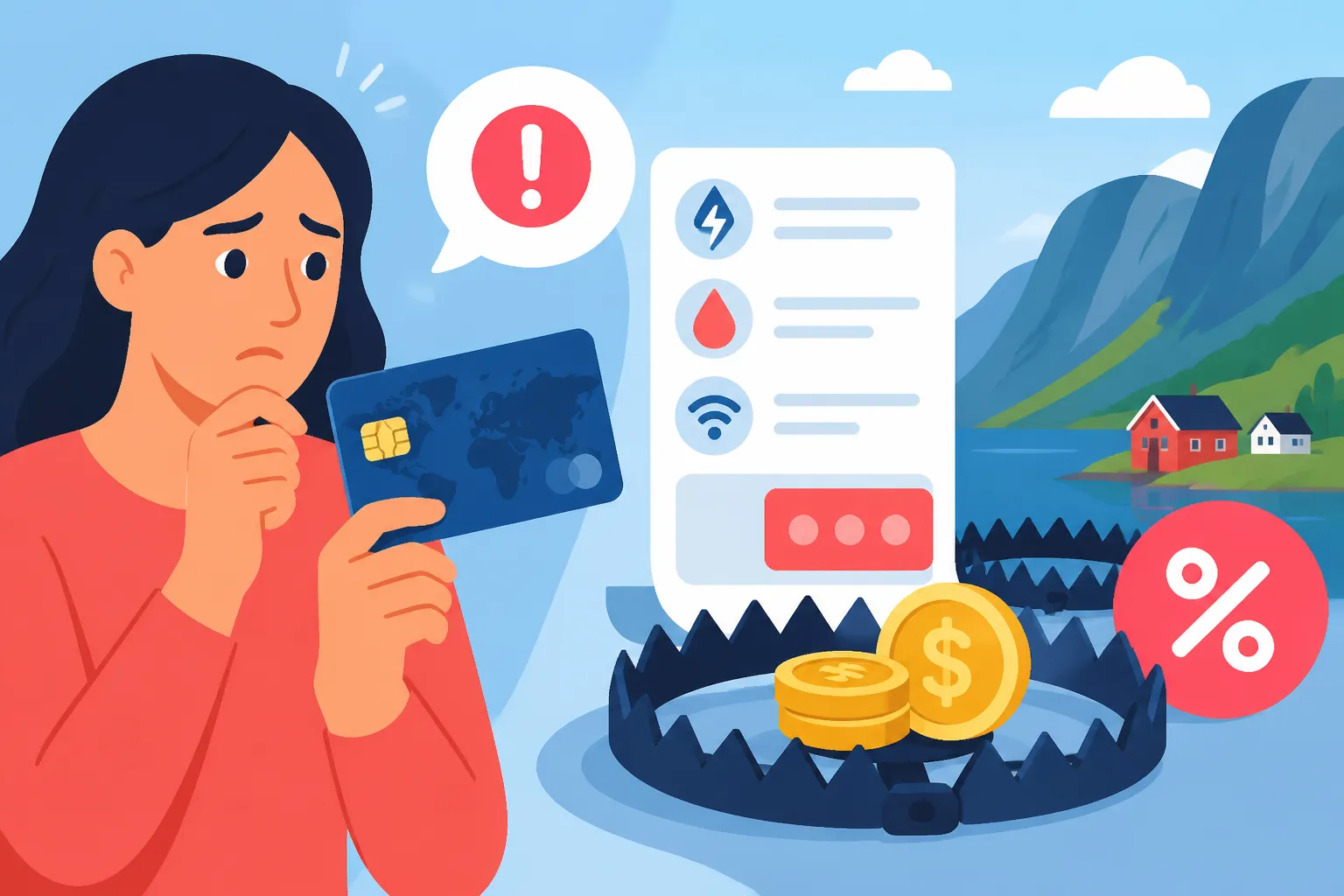
Using a foreign credit card for recurring bills in Norway is rarely a flat-fee affair. The costs are layered, often hidden in the fine print of your home bank’s terms and conditions or the merchant’s payment processor. The most common trap is the Foreign Transaction Fee (FX fee), which usually ranges from 1% to 3% of the total transaction. On a monthly rent payment of 15,000 NOK, a 3% fee is 450 NOK literally thrown away every month.
Another sophisticated trap is Dynamic Currency Conversion (DCC). This happens when a terminal or an online portal asks if you want to pay in your "home currency" (like USD or GBP) instead of NOK. It sounds helpful, but it allows the merchant's bank to set the exchange rate, which is almost always 5% to 7% worse than the mid-market rate. If you are a US citizen living abroad, you might be consulting with Taxes for Expats to ensure your foreign accounts are reported correctly, and they will likely tell you that keeping your transactions in the local currency is the first step toward clear financial record-keeping.
Beyond the exchange rate, there are "convenience fees." Some Norwegian platforms that do accept credit cards for public services may pass the merchant's processing fee directly to you. This is increasingly common with smaller municipalities or private kindergartens. When you add up the FX fee, the exchange rate spread, and the merchant surcharge, you could be paying nearly 10% more for your Cost of Living in Norway 2026: Budgeting for Singles and Families than a neighbor using a local bank account.
The KID Problem: Why Your Credit Card App is Useless for Norwegian Bills
In Norway, almost every bill comes with a KID (Kundeidentifikasjon) number. This is a unique string of digits that identifies you and the specific invoice to the recipient's automated accounting system. Your foreign credit card app—whether it’s Chase, Barclays, or American Express—does not have a field for a KID number. This is the fundamental reason why you cannot simply "pay" a Norwegian utility bill through your home bank’s online portal.
Without a KID number, your payment will likely be rejected or, worse, sit in the recipient's "unidentified payments" account while you receive late notices and debt collection warnings. Navigating the BankID Explained: Norway's Digital Identity System and Expat Challenges is essential because BankID is the key that unlocks the ability to pay these KID-labeled invoices through a Norwegian interface. Until you have this, you are stuck in a manual payment loop that is both expensive and prone to error.
For those in their first month, the frustration of not being able to use a credit card for a deposit can be overwhelming. Many landlords will not accept credit card payments for a security deposit because of the high fees and the risk of chargebacks. In these cases, using Wise to send a domestic-style transfer is the only realistic bridge until you can successfully manage Banking in Norway: How to Open an Account as a Foreigner.
Comparing the Real Costs of Bill Payment Methods
To visualize the impact of these "traps," consider a typical monthly bill load for an expat in Oslo. The following table compares using a standard foreign credit card versus using a local-adjacent solution like a multi-currency account.
| Payment Type | Foreign Credit Card (3% FX Fee) | Wise / Local Transfer | Difference (Yearly) |
|---|---|---|---|
| Rent (18,000 NOK) | 18,540 NOK | 18,045 NOK | 5,940 NOK |
| Electricity (1,500 NOK) | 1,545 NOK | 1,504 NOK | 492 NOK |
| Internet/Mobile (800 NOK) | 824 NOK | 802 NOK | 264 NOK |
| Gym/Subscr. (600 NOK) | 618 NOK | 602 NOK | 192 NOK |
| Total Monthly | 21,527 NOK | 20,953 NOK | 6,888 NOK |
As shown, the "convenience" of your foreign card could be costing you nearly 7,000 NOK a year—enough for a nice weekend trip to the mountains or several high-quality wool sweaters for the winter. This is why veteran expats prioritize moving away from foreign plastic as soon as their D-Number vs Fødselsnummer: How It Affects Your Banking Options are sorted.
Technical Barriers: 3D Secure and Geographical Blocks
Even if you are willing to pay the surcharges, you may find your foreign card blocked by your own bank's security protocols. Norwegian payment gateways are heavily reliant on the latest version of 3D Secure. If your home bank hasn't updated its verification methods, your transaction for a simple bus pass on the Ruter app will fail repeatedly. This is particularly common with North American cards that sometimes rely on older verification standards.
Geographical blocks are another headache. You might successfully pay for a hotel in Bergen, but when you try to pay a municipal tax bill or a medical fee at the Legevakt, your bank's fraud detection algorithm might flag the "unusual" Norwegian merchant. This leads to the embarrassing and stressful situation of having your only source of funds frozen while you are trying to navigate a new country.
While you are waiting for your Norwegian credentials, it is a good idea to check your First 30 Days Health Checklist: GP, Frikort, and Pharmacies to see which services might require immediate payment. Having a backup plan, such as a pre-funded Wise card or a travel-specific card with no FX fees, is a mandatory safety net. Additionally, consult with Taxes for Expats if you plan on moving large sums of money to cover your initial costs, as they can advise on the tax implications of these transfers.
Strategic Workarounds for the First 90 Days
The "90-day gap" is the period between arriving in Norway and finally receiving your BankID. During this time, you are in financial limbo. You cannot yet set up What is eFaktura and AvtaleGiro? Setting Up Automatic Bills, which is the standard way Norwegians avoid late fees. To survive this period without falling into the credit card trap, you should adopt a "transfer-first" mentality.
- Fund a Multi-currency Account: Use Wise to convert your home currency into NOK at the mid-market rate. This gives you a "local" pot of money to draw from.
- Request PDF Invoices: Ask your service providers to send invoices via email (PDF) rather than through a digital portal. This allows you to see the KID number and account details clearly.
- Manual Bank Transfers: Use your home bank’s international transfer feature only as a last resort. Instead, use a specialist service to send the exact NOK amount to the recipient’s IBAN, ensuring the KID number is placed in the "Message to Recipient" field.
- Avoid Automated "Card on File" for Utilities: Some companies will let you register a foreign card for monthly billing, but they often charge a premium for the "service." Always check if Can I Pay Bills Online (Nettbank) Without BankID? applies to your specific provider.
During this transition, remember that your financial footprint is being tracked. If you are a US expat, companies like Taxes for Expats can help you understand the FBAR and FATCA reporting requirements that kick in when you start moving money into these bridge accounts or local Norwegian banks.
Moving Toward a Local Solution
The ultimate goal is to stop using foreign credit cards for anything other than perhaps emergency travel points. Once you have your personnummer, you should immediately apply for a local bank account. This allows you to participate in The Complete Guide to Norwegian Taxes for Expats (Skatteetaten) ecosystem, where refunds and payments flow seamlessly.
Even if you have trouble at first, there are ways of Can I Open a Norwegian Bank Account Without a Permanent Address? depending on your employer and residency status. A local account unlocks Vipps, the mobile payment app that is ubiquitous in Norway. Without Vipps, you cannot pay back a friend for dinner or buy a waffle at a local sports event easily. Vipps is tied to your Norwegian bank account and bypasses the international credit card networks entirely, saving everyone money.
Once your local account is active, you can finally start Filing Your Tax Return (Skattemelding): Deadlines and Common Deductions with the confidence that your bank and Skatteetaten are "talking" to each other. The data from your local bank is automatically reported to the tax authorities, making your life significantly easier come April.
Disclaimer
The information provided in this guide is for informational purposes only and does not constitute financial, legal, or tax advice. Banking regulations, exchange rates, and fee structures in Norway and for third-party services like Wise or Taxes for Expats can change frequently. Always verify current terms and conditions with your specific financial institution or a qualified professional before making significant financial decisions.